

EN 60947-2:2026 Compliance Checklist for Breaker Exporters
EN 60947-2:2026 Compliance Checklist for Breaker Exporters
Key Takeaways
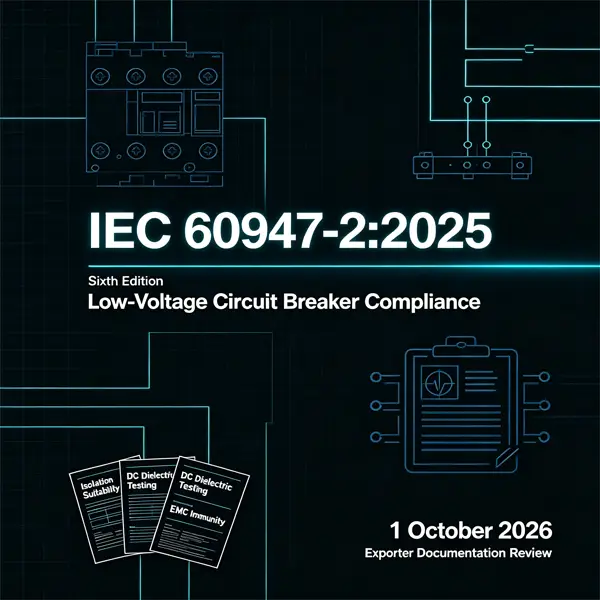
- IEC 60947-2:2025 is the sixth edition and replaces the 2016 fifth edition together with Amendment 1:2019.
- The scope covers circuit-breakers rated up to 1,000 V AC or 1,500 V DC, including integrally fused types.
- Key revisions address isolation suitability, external current-setting devices, protective separation, and DC dielectric testing.
- Annex P covers DC circuit-breakers for photovoltaic applications; Annex R covers auto-reclosing residual current protection.
- Published industry notices point to 1 October 2026 as the effective date for both EU and Saudi Arabian alignments.
- Exporters should re-verify Icu/Ics type-test reports, electronic trip unit EMC files, and material declarations before Q4 shipments.
Low-voltage circuit breaker compliance is entering a new cycle. IEC 60947-2 has been revised into its sixth edition, and regional adoptions in the European Union, Saudi Arabia and Brazil are following with their own effective dates. For manufacturers, distributors and EPC buyers, the practical question is no longer whether a product works, but whether its type-test evidence still references the standard version that a customs authority accepts.
LVMA Electric, a low-voltage electrical manufacturer based in Yueqing, Zhejiang, China, supplies MCB, MCCB, ACB and DC protection devices to more than 80 countries. This article summarises what changes, which products fall in scope, and what documentation should be reviewed before the next export cycle.
What is IEC 60947-2?
IEC 60947-2 is an international standard published by the International Electrotechnical Commission that specifies the characteristics, operational behaviour, dielectric properties, EMC requirements and type-test methods for low-voltage circuit-breakers, used for industrial and commercial power distribution, and rated up to 1,000 V AC or 1,500 V DC.
The standard applies to equipment intended to be installed and operated by instructed or skilled persons. Household circuit-breakers designed for use by uninstructed persons fall under the separate IEC 60898 series instead. Circuit-breakers for equipment such as appliances are covered by IEC 60934.
What changed in the sixth edition
The 2025 edition constitutes a technical revision rather than a simple correction. The published scope lists the following significant technical changes relative to the previous edition:
| Change | Practical impact on suppliers |
|---|---|
| Suitability for isolation clarified | Isolation claims on nameplates and datasheets need re-confirmation. |
| Classification by interrupting medium, design and isolation removed | Old product classification wording should be updated in catalogues. |
| Current setting adjusted by an external device connected to the release | Electronic trip units with external setting interfaces need review. |
| Requirements for circuits with protective separation | Relevant for control circuits and segregated wiring designs. |
| Additional tests for ground-fault overcurrent releases | Extends type-test scope for breakers with ground-fault protection. |
| Additional dielectric tests in tripped position | Verification after interruption, not only in closed position. |
| DC voltage used for dielectric tests | Test labs need DC-capable dielectric setups. |
| Individual pole breaking capacity under phase-to-neutral AC voltage | Additional single-pole short-circuit verification. |
| Improved measurement of power loss | Loss figures in datasheets may be re-measured. |
| Changes in EMC tests | Immunity evidence for electronic releases is a focus area. |
| Introduction of CBI class W | New class for circuit-breakers not fulfilling overcurrent protection requirements. |
Which products are in scope
| Product | Typical standard basis | LVMA product line |
|---|---|---|
| MCB for industrial panels | IEC 60947-2 (household types use IEC 60898-1) | MCB |
| MCCB | IEC 60947-2 | MCCB |
| ACB | IEC 60947-2, class B with Icw | Air circuit breaker |
| DC circuit-breaker for PV | IEC 60947-2 Annex P | DC MCB 1500V |
| RCBO / RCCB with reclosing | IEC 60947-2 Annex B and Annex R | RCCB / RCBO |
A frequent mistake is applying IEC 60898-1 to industrial installations, or the reverse. IEC 60898-1 governs household and similar installations for uninstructed persons and focuses on B/C/D tripping characteristics, temperature rise and basic tripping tests. IEC 60947-2 governs industrial devices and adds short-circuit breaking capacity, selectivity with upstream and downstream devices, and durability assessment.
Regional timelines reported for 2026
Standard revisions take legal effect only when a national or regional body cites them. The following alignments have been reported in published industry notices. Because enforcement depends on official citations and laboratory readiness, every date below should be confirmed against the authority’s own publication before shipment planning.
| Market | Reported instrument | Reported effective date | Reported focus |
|---|---|---|---|
| European Union | Adoption of IEC 60947-2:2025 as EN 60947-2:2026, published in the Official Journal of the European Union | 1 October 2026 | Short-circuit breaking capacity verification, EMC immunity of electronic trip units, green material declarations |
| Saudi Arabia | SASO IEC 60947-2:2026, second edition | 1 October 2026 | Dynamic Arc Voltage Method for Icu/Ics verification |
| Brazil | INMETRO ordinance amending conformity assessment for industrial circuit-breakers of 63 A and above | 1 August 2026 | Asymmetric short-circuit current waveform testing |
Two cautions apply. First, publication of a standard is not the same as withdrawal of the presumption of conformity for the previous version; the version cited in the official journal governs. Second, product ratings above 63 A and breaking capacities of 25 kA and above are generally the most sensitive to changes in arc-energy test methods, so those SKUs should be prioritised for re-validation.
Exporter compliance checklist
- Map the product scope. List every EU-, GCC- and Brazil-bound SKU of MCB, MCCB, ACB and DC circuit-breakers, and record which standard version each current test report cites.
- Prioritise high-risk ratings. Start with devices rated above 63 A and breaking capacity of 25 kA or higher, since arc-energy requirements are most demanding in that range.
- Review type-test evidence. Confirm whether existing Icu/Ics reports remain acceptable, and whether DC dielectric testing and single-pole breaking capacity tests are included.
- Check electronic trip unit files. EMC immunity evidence under Annex J and external current-setting behaviour under clause 5.7.3 are common documentation gaps.
- Update declarations. Material declarations and green compliance statements referenced in EU market-access documentation should match the revised basis.
- Align customer documents. Tender specifications, product datasheets and submission files may begin to reference the new version explicitly; align wording before submission.
- Build in laboratory lead time. Short-circuit testing capacity is finite. Schedule sample submission early relative to your Q4 delivery commitments.
Standards and compliance
The authoritative source for the standard itself is the International Electrotechnical Commission. Market-specific adoption should be confirmed against the official journal or national standards body publication for the destination market, including SASO for Saudi Arabia and INMETRO for Brazil. Confirm the applicable version against the latest official citation before shipment, and treat laboratory accreditation status as a separate check.
How LVMA Electric supports this
LVMA Electric manufactures low-voltage protection devices across four factories covering more than 50,000 square metres, with an annual capacity of 600,000 units in the low-voltage electrical factory. Products are developed and tested against IEC 60947 and IEC 60898 requirements, with CE, CB, TUV and CCC certification. OEM and ODM configurations — including custom current ratings, tripping curves, branding and packaging — are available for distributors and panel builders who need to align documentation with a specific destination market.
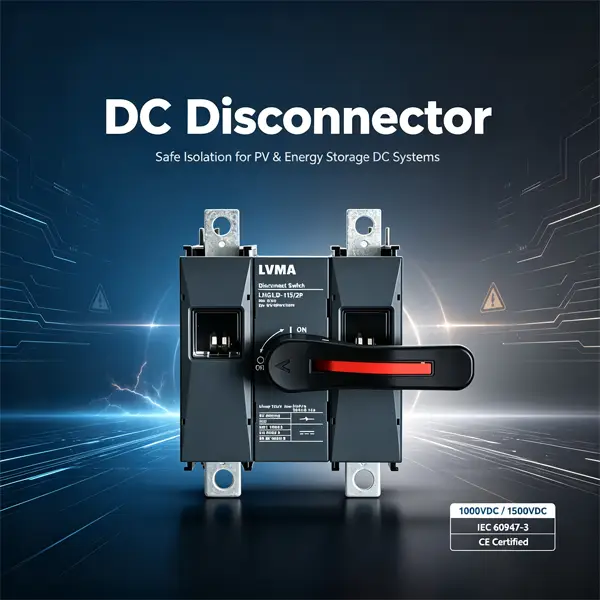
For DC-side protection, the range includes DC MCB, DC isolation switches and DC combiner boxes used in PV and energy storage systems.
FAQ
What is the difference between IEC 60947-2:2016 and IEC 60947-2:2025?
IEC 60947-2:2025 is the sixth edition and cancels and replaces the fifth edition published in 2016 along with Amendment 1:2019. It is a technical revision covering isolation suitability, removal of the classification by interrupting medium, external current-setting devices, protective separation, additional ground-fault and dielectric tests, DC dielectric testing, single-pole breaking capacity, power loss measurement, EMC test changes, and CBI class W.
Does IEC 60947-2 apply to MCB used in homes?
No. Household circuit-breakers intended for use by uninstructed persons are covered by the IEC 60898 series. IEC 60947-2 applies to circuit-breakers installed and operated by instructed or skilled persons, which includes MCB used in industrial and commercial distribution panels.
Which annex applies to DC circuit-breakers for solar PV?
Annex P of IEC 60947-2 contains the requirements and test methods for DC circuit-breakers used in photovoltaic applications. Because DC arcs lack a natural current zero crossing, devices must be verified for DC interruption rather than assumed equivalent to AC ratings.
When does EN 60947-2:2026 take effect in the EU?
Published industry notices indicate 1 October 2026 as the effective date following publication in the Official Journal of the European Union. Exporters should confirm the cited version directly with the OJEU listing and their notified body, since the cited version governs the presumption of conformity.
What should exporters do first?
Start with a scope review. Identify every affected SKU, record which standard version each existing type-test report cites, and prioritise devices rated above 63 A with breaking capacity of 25 kA or higher. Then confirm laboratory availability, since short-circuit testing lead times can exceed eight weeks.
How does the change affect ATS and transfer switching equipment?
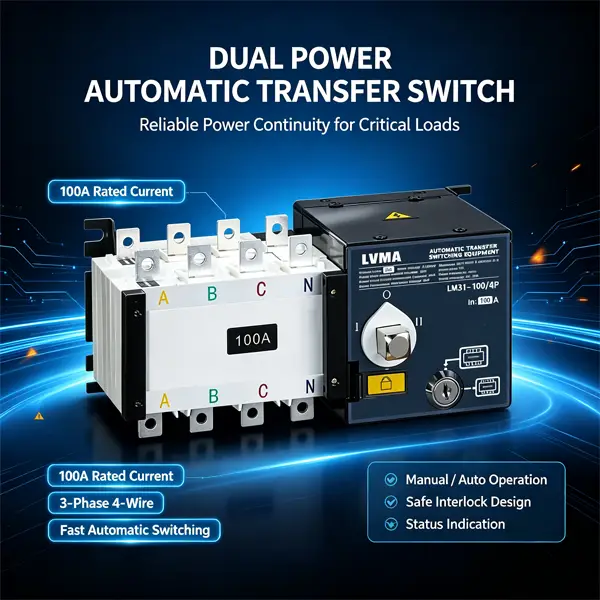
Automatic transfer switches are covered by IEC 60947-6-1 rather than IEC 60947-2, but the breakers used inside an ATS assembly are in scope. Panel builders should verify the protection devices inside ATS assemblies against the revised basis.
Conclusion
The sixth edition of IEC 60947-2 is more than a wording update: it changes what test evidence looks like for short-circuit performance, dielectric verification and EMC immunity. With regional alignments reported for 1 October 2026, the remaining window is best used for scope mapping and laboratory scheduling rather than for waiting. Contact the LVMA Electric team for product documentation, test report references and OEM/ODM options for your destination market.
Last updated: 2026-09-23. Standards and effective dates quoted here reflect published industry notices and should be confirmed against the official citation of the relevant authority before shipment.
Share This Article
Follow Us
Key Takeaways
- IEC 60947-2:2025 is the sixth edition and replaces the 2016 fifth edition together with Amendment 1:2019.
- The scope covers circuit-breakers rated up to 1,000 V AC or 1,500 V DC, including integrally fused types.
- Key revisions address isolation suitability, external current-setting devices, protective separation, and DC dielectric testing.
- Annex P covers DC circuit-breakers for photovoltaic applications; Annex R covers auto-reclosing residual current protection.
- Published industry notices point to 1 October 2026 as the effective date for both EU and Saudi Arabian alignments.
- Exporters should re-verify Icu/Ics type-test reports, electronic trip unit EMC files, and material declarations before Q4 shipments.
Low-voltage circuit breaker compliance is entering a new cycle. IEC 60947-2 has been revised into its sixth edition, and regional adoptions in the European Union, Saudi Arabia and Brazil are following with their own effective dates. For manufacturers, distributors and EPC buyers, the practical question is no longer whether a product works, but whether its type-test evidence still references the standard version that a customs authority accepts.
LVMA Electric, a low-voltage electrical manufacturer based in Yueqing, Zhejiang, China, supplies MCB, MCCB, ACB and DC protection devices to more than 80 countries. This article summarises what changes, which products fall in scope, and what documentation should be reviewed before the next export cycle.
What is IEC 60947-2?
IEC 60947-2 is an international standard published by the International Electrotechnical Commission that specifies the characteristics, operational behaviour, dielectric properties, EMC requirements and type-test methods for low-voltage circuit-breakers, used for industrial and commercial power distribution, and rated up to 1,000 V AC or 1,500 V DC.
The standard applies to equipment intended to be installed and operated by instructed or skilled persons. Household circuit-breakers designed for use by uninstructed persons fall under the separate IEC 60898 series instead. Circuit-breakers for equipment such as appliances are covered by IEC 60934.
What changed in the sixth edition
The 2025 edition constitutes a technical revision rather than a simple correction. The published scope lists the following significant technical changes relative to the previous edition:
| Change | Practical impact on suppliers |
|---|---|
| Suitability for isolation clarified | Isolation claims on nameplates and datasheets need re-confirmation. |
| Classification by interrupting medium, design and isolation removed | Old product classification wording should be updated in catalogues. |
| Current setting adjusted by an external device connected to the release | Electronic trip units with external setting interfaces need review. |
| Requirements for circuits with protective separation | Relevant for control circuits and segregated wiring designs. |
| Additional tests for ground-fault overcurrent releases | Extends type-test scope for breakers with ground-fault protection. |
| Additional dielectric tests in tripped position | Verification after interruption, not only in closed position. |
| DC voltage used for dielectric tests | Test labs need DC-capable dielectric setups. |
| Individual pole breaking capacity under phase-to-neutral AC voltage | Additional single-pole short-circuit verification. |
| Improved measurement of power loss | Loss figures in datasheets may be re-measured. |
| Changes in EMC tests | Immunity evidence for electronic releases is a focus area. |
| Introduction of CBI class W | New class for circuit-breakers not fulfilling overcurrent protection requirements. |
Which products are in scope
| Product | Typical standard basis | LVMA product line |
|---|---|---|
| MCB for industrial panels | IEC 60947-2 (household types use IEC 60898-1) | MCB |
| MCCB | IEC 60947-2 | MCCB |
| ACB | IEC 60947-2, class B with Icw | Air circuit breaker |
| DC circuit-breaker for PV | IEC 60947-2 Annex P | DC MCB 1500V |
| RCBO / RCCB with reclosing | IEC 60947-2 Annex B and Annex R | RCCB / RCBO |
A frequent mistake is applying IEC 60898-1 to industrial installations, or the reverse. IEC 60898-1 governs household and similar installations for uninstructed persons and focuses on B/C/D tripping characteristics, temperature rise and basic tripping tests. IEC 60947-2 governs industrial devices and adds short-circuit breaking capacity, selectivity with upstream and downstream devices, and durability assessment.
Regional timelines reported for 2026
Standard revisions take legal effect only when a national or regional body cites them. The following alignments have been reported in published industry notices. Because enforcement depends on official citations and laboratory readiness, every date below should be confirmed against the authority’s own publication before shipment planning.
| Market | Reported instrument | Reported effective date | Reported focus |
|---|---|---|---|
| European Union | Adoption of IEC 60947-2:2025 as EN 60947-2:2026, published in the Official Journal of the European Union | 1 October 2026 | Short-circuit breaking capacity verification, EMC immunity of electronic trip units, green material declarations |
| Saudi Arabia | SASO IEC 60947-2:2026, second edition | 1 October 2026 | Dynamic Arc Voltage Method for Icu/Ics verification |
| Brazil | INMETRO ordinance amending conformity assessment for industrial circuit-breakers of 63 A and above | 1 August 2026 | Asymmetric short-circuit current waveform testing |
Two cautions apply. First, publication of a standard is not the same as withdrawal of the presumption of conformity for the previous version; the version cited in the official journal governs. Second, product ratings above 63 A and breaking capacities of 25 kA and above are generally the most sensitive to changes in arc-energy test methods, so those SKUs should be prioritised for re-validation.
Exporter compliance checklist
- Map the product scope. List every EU-, GCC- and Brazil-bound SKU of MCB, MCCB, ACB and DC circuit-breakers, and record which standard version each current test report cites.
- Prioritise high-risk ratings. Start with devices rated above 63 A and breaking capacity of 25 kA or higher, since arc-energy requirements are most demanding in that range.
- Review type-test evidence. Confirm whether existing Icu/Ics reports remain acceptable, and whether DC dielectric testing and single-pole breaking capacity tests are included.
- Check electronic trip unit files. EMC immunity evidence under Annex J and external current-setting behaviour under clause 5.7.3 are common documentation gaps.
- Update declarations. Material declarations and green compliance statements referenced in EU market-access documentation should match the revised basis.
- Align customer documents. Tender specifications, product datasheets and submission files may begin to reference the new version explicitly; align wording before submission.
- Build in laboratory lead time. Short-circuit testing capacity is finite. Schedule sample submission early relative to your Q4 delivery commitments.
Standards and compliance
The authoritative source for the standard itself is the International Electrotechnical Commission. Market-specific adoption should be confirmed against the official journal or national standards body publication for the destination market, including SASO for Saudi Arabia and INMETRO for Brazil. Confirm the applicable version against the latest official citation before shipment, and treat laboratory accreditation status as a separate check.
How LVMA Electric supports this
LVMA Electric manufactures low-voltage protection devices across four factories covering more than 50,000 square metres, with an annual capacity of 600,000 units in the low-voltage electrical factory. Products are developed and tested against IEC 60947 and IEC 60898 requirements, with CE, CB, TUV and CCC certification. OEM and ODM configurations — including custom current ratings, tripping curves, branding and packaging — are available for distributors and panel builders who need to align documentation with a specific destination market.
For DC-side protection, the range includes DC MCB, DC isolation switches and DC combiner boxes used in PV and energy storage systems.
FAQ
What is the difference between IEC 60947-2:2016 and IEC 60947-2:2025?
IEC 60947-2:2025 is the sixth edition and cancels and replaces the fifth edition published in 2016 along with Amendment 1:2019. It is a technical revision covering isolation suitability, removal of the classification by interrupting medium, external current-setting devices, protective separation, additional ground-fault and dielectric tests, DC dielectric testing, single-pole breaking capacity, power loss measurement, EMC test changes, and CBI class W.
Does IEC 60947-2 apply to MCB used in homes?
No. Household circuit-breakers intended for use by uninstructed persons are covered by the IEC 60898 series. IEC 60947-2 applies to circuit-breakers installed and operated by instructed or skilled persons, which includes MCB used in industrial and commercial distribution panels.
Which annex applies to DC circuit-breakers for solar PV?
Annex P of IEC 60947-2 contains the requirements and test methods for DC circuit-breakers used in photovoltaic applications. Because DC arcs lack a natural current zero crossing, devices must be verified for DC interruption rather than assumed equivalent to AC ratings.
When does EN 60947-2:2026 take effect in the EU?
Published industry notices indicate 1 October 2026 as the effective date following publication in the Official Journal of the European Union. Exporters should confirm the cited version directly with the OJEU listing and their notified body, since the cited version governs the presumption of conformity.
What should exporters do first?
Start with a scope review. Identify every affected SKU, record which standard version each existing type-test report cites, and prioritise devices rated above 63 A with breaking capacity of 25 kA or higher. Then confirm laboratory availability, since short-circuit testing lead times can exceed eight weeks.
How does the change affect ATS and transfer switching equipment?
Automatic transfer switches are covered by IEC 60947-6-1 rather than IEC 60947-2, but the breakers used inside an ATS assembly are in scope. Panel builders should verify the protection devices inside ATS assemblies against the revised basis.
Conclusion
The sixth edition of IEC 60947-2 is more than a wording update: it changes what test evidence looks like for short-circuit performance, dielectric verification and EMC immunity. With regional alignments reported for 1 October 2026, the remaining window is best used for scope mapping and laboratory scheduling rather than for waiting. Contact the LVMA Electric team for product documentation, test report references and OEM/ODM options for your destination market.
Last updated: 2026-09-23. Standards and effective dates quoted here reflect published industry notices and should be confirmed against the official citation of the relevant authority before shipment.
Contact Us
Related Blog




Contact Us
Have questions about our products or services? Our team is here to help you with any inquiries.