

Proven Solar PV Protection & Switching Solutions
Proven Solar PV Protection & Switching Solutions
A solar array is judged by what it produces on a bright afternoon. The protection hardware around it is judged on the worst day of the year, and by then it is usually sealed inside a cabinet that nobody opens.
That gap is where most service calls start. A loose DC termination. A breaker never rated for reverse current. A surge event with no proper path to earth. On the AC side an upstream device will often clear a fault by itself. On the DC side, a series arc at 600 V or 1000 V has no zero crossing to put it out, so it keeps burning until something else gives way.
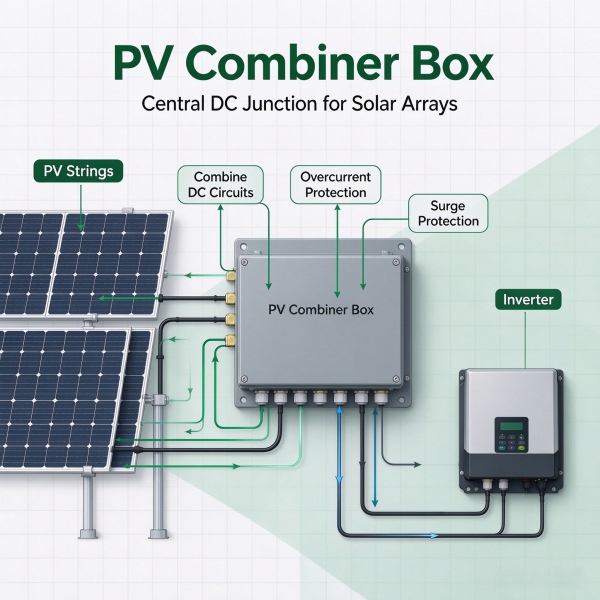
LVMA Electrical builds the devices that sit between a PV array and that failure mode: ATS, DC MCCB, DC MCB, DC SPD, DC fuse and DC isolator, plus the pre-wired combiner and distribution boxes that house them. What follows is the same product matrix we ship to solar installers and EPC contractors working on residential hybrid systems, outdoor cabinets and commercial rooftops.
Six devices, one protection chain
No single component protects a PV system. Protection works as a chain, and every link has a different job.
01 · ATS — Automatic Transfer Switch (dual power seamless switching)The changeover point between grid and backup source. In a hybrid system it decides, in milliseconds, whether the house runs on utility power, a generator or the battery bank. Seamless switching matters because pumps, compressors and servers do not tolerate a long gap.
02 · DC MCCB — Molded Case Circuit Breaker (high breaking DC protection)The heavy-duty link. Used on the battery main and the incoming DC feeder where prospective fault current is highest, and where a miniature device would simply not have the breaking capacity to clear it safely.
03 · DC MCB — Miniature Circuit Breaker (PV string & battery overload defense)One per string, or per small DC circuit. It handles overload and short-circuit protection at the string level, so a fault in one array does not take down the whole installation.
04 · DC SPD — Surge Protective Device (lightning & surge protection)Mounted at the DC entry point, it clamps transient overvoltage from a nearby strike or a switching event before it reaches the inverter’s input stage. Inverters are expensive; SPDs are not.
05 · DC Fuse — Photovoltaic Fuse & Holder (short-circuit safety)The gPV-rated fuse is the last line of defense against reverse current in a parallel string configuration. Its holder matters as much as the fuse: finger-safe, tool-free replacement, correct DC rating.
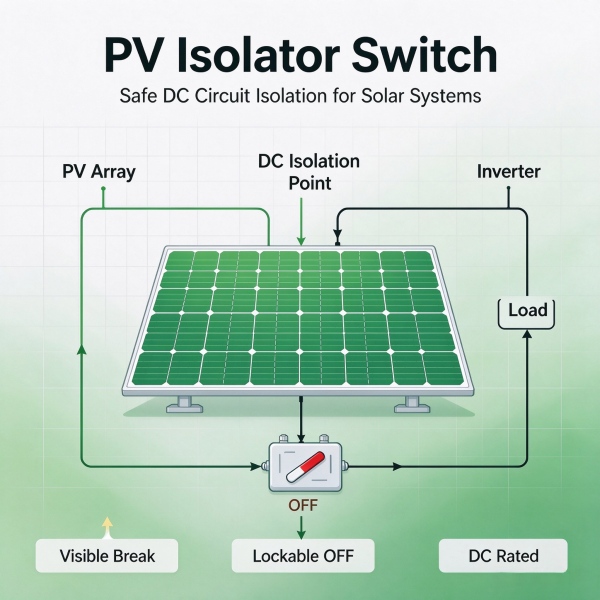
06 · DC Isolator — Load Break Disconnector (safe manual solar isolation)The device an installer or technician touches before any maintenance. It must break under load, be clearly labeled, and be lockable, because the person relying on it is standing next to live DC conductors.
Add them together and you get the full path: isolation, switching, breaking, string protection, surge clamping and short-circuit clearing, all sized to the same system voltage.
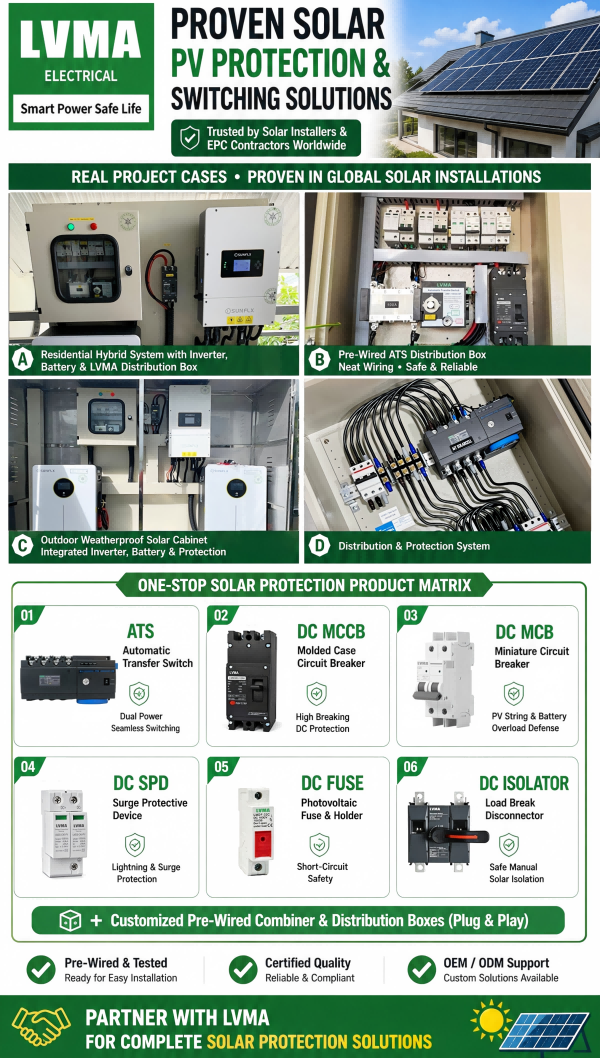
Real project cases, proven in global solar installations
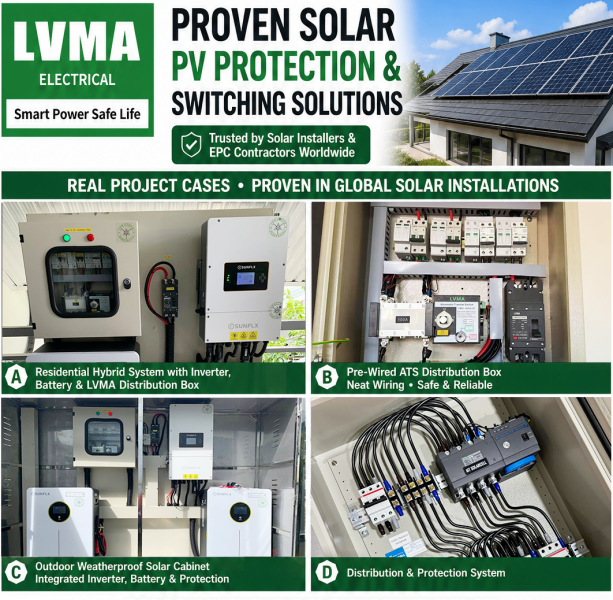
A.Residential hybrid system with inverter, battery and LVMA distribution box.The most common configuration we see: a hybrid inverter, a wall-mounted battery, and a compact distribution box tying the DC and AC sides together in one place. Everything an electrician needs to commission the system sits behind one door.
B.Pre-wired ATS distribution box.
Grid input, generator input, load output and the control logic already terminated, bundled and labeled. Neat wiring is not cosmetic. It is what lets a second technician troubleshoot the box six months later without a wiring diagram in hand. Safe and reliable starts with legible.
C.Outdoor weatherproof solar cabinet.
Inverter, battery and protection integrated in a single IP-rated enclosure for sites with no plant room: carports, farm buildings, containerized setups and coastal installations where salt spray eats unprotected hardware.
D.Distribution and protection system.
Multi-string commercial layout with grouped breakers, busbars and surge protection arranged for inspection and future expansion rather than for the shortest possible cable run.
Pre-wired and tested: why plug-and-play shortens the install
Field labor is the scarcest resource on any solar project. A crew that spends a day terminating DIN rail components is a crew not mounting panels.
Every LVMA pre-wired box arrives assembled, torque-checked, function-tested and labeled, with the internal schematic fixed to the inside of the door. On site the work reduces to mounting, landing the incoming and outgoing cables, and commissioning. Three things follow: fewer wiring errors at the point where DC faults are most likely, shorter commissioning windows, and fewer questions from the AHJ inspector because the enclosure documents itself.
Certified quality, reliable and compliant
Protection devices are only useful if they are rated for the duty they actually see. When specifying, ask for the standard behind each device and the test report that proves it:
- DC MCCB and DC isolator: IEC 60947-2 and IEC 60947-3, with DC voltage and utilization category stated
- DC MCB: DC-rated breaking capacity at the system voltage, not an AC figure with a DC label
- DC SPD: IEC 61643-31 for photovoltaic applications, with Ucpv above the array’s maximum system voltage
- DC fuse: IEC 60269-6 gPV characteristic, holder rated for the same voltage
Certified quality means the certificate names your configuration. Reliable and compliant means the inspector accepts it the first time.
OEM / ODM support for distributors and system integrators
Most of our overseas partners do not sell a catalog product. They sell a box designed around one market’s grid, one utility’s interconnection rule, one brand’s inverter footprint. We support that with custom busbar layouts, enclosure sizes and materials, terminal and gland positions, bilingual silk-screen labeling, private-label packaging and documentation packages. Send a single-line diagram and a target price; we will come back with a build.
A short specification checklist
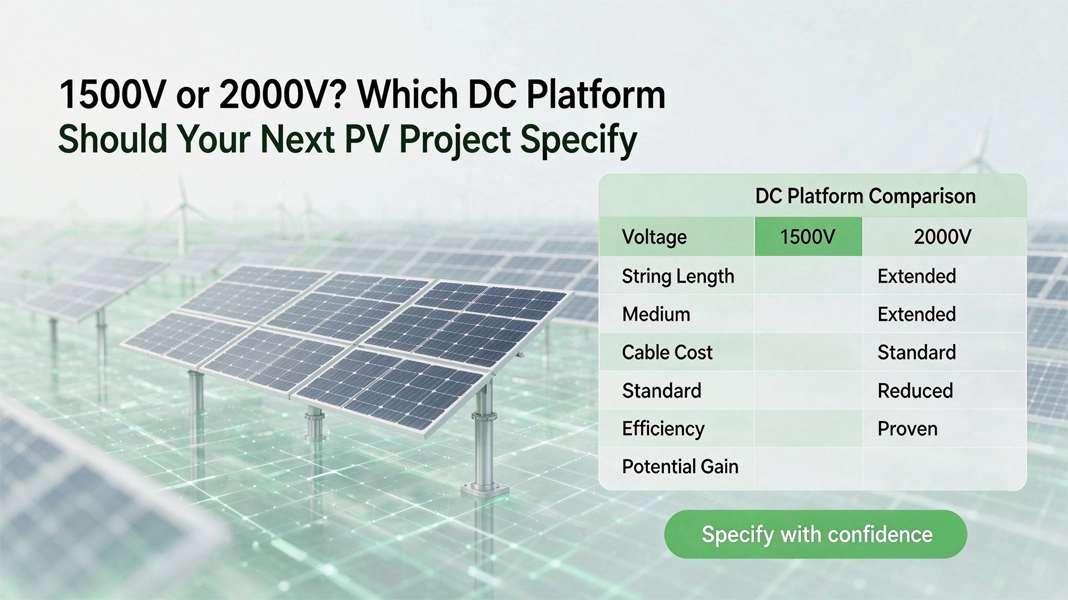
- System voltage: 600 V, 1000 V or 1500 V DC, and the number of strings
- Continuous current and Isc per string, with ambient temperature derating applied
- Prospective short-circuit current at the battery main, to size MCCB breaking capacity
- Enclosure IP rating and UV exposure at the mounting location
- Isolation and lockout requirements from the local authority having jurisdiction
- Certification and language requirements for the destination market
Share This Article
Follow Us
A solar array is judged by what it produces on a bright afternoon. The protection hardware around it is judged on the worst day of the year, and by then it is usually sealed inside a cabinet that nobody opens.
That gap is where most service calls start. A loose DC termination. A breaker never rated for reverse current. A surge event with no proper path to earth. On the AC side an upstream device will often clear a fault by itself. On the DC side, a series arc at 600 V or 1000 V has no zero crossing to put it out, so it keeps burning until something else gives way.
LVMA Electrical builds the devices that sit between a PV array and that failure mode: ATS, DC MCCB, DC MCB, DC SPD, DC fuse and DC isolator, plus the pre-wired combiner and distribution boxes that house them. What follows is the same product matrix we ship to solar installers and EPC contractors working on residential hybrid systems, outdoor cabinets and commercial rooftops.
Six devices, one protection chain
No single component protects a PV system. Protection works as a chain, and every link has a different job.
01 · ATS — Automatic Transfer Switch (dual power seamless switching)The changeover point between grid and backup source. In a hybrid system it decides, in milliseconds, whether the house runs on utility power, a generator or the battery bank. Seamless switching matters because pumps, compressors and servers do not tolerate a long gap.
02 · DC MCCB — Molded Case Circuit Breaker (high breaking DC protection)The heavy-duty link. Used on the battery main and the incoming DC feeder where prospective fault current is highest, and where a miniature device would simply not have the breaking capacity to clear it safely.
03 · DC MCB — Miniature Circuit Breaker (PV string & battery overload defense)One per string, or per small DC circuit. It handles overload and short-circuit protection at the string level, so a fault in one array does not take down the whole installation.
04 · DC SPD — Surge Protective Device (lightning & surge protection)Mounted at the DC entry point, it clamps transient overvoltage from a nearby strike or a switching event before it reaches the inverter’s input stage. Inverters are expensive; SPDs are not.
05 · DC Fuse — Photovoltaic Fuse & Holder (short-circuit safety)The gPV-rated fuse is the last line of defense against reverse current in a parallel string configuration. Its holder matters as much as the fuse: finger-safe, tool-free replacement, correct DC rating.
06 · DC Isolator — Load Break Disconnector (safe manual solar isolation)The device an installer or technician touches before any maintenance. It must break under load, be clearly labeled, and be lockable, because the person relying on it is standing next to live DC conductors.
Add them together and you get the full path: isolation, switching, breaking, string protection, surge clamping and short-circuit clearing, all sized to the same system voltage.
Real project cases, proven in global solar installations
A.Residential hybrid system with inverter, battery and LVMA distribution box.The most common configuration we see: a hybrid inverter, a wall-mounted battery, and a compact distribution box tying the DC and AC sides together in one place. Everything an electrician needs to commission the system sits behind one door.
B.Pre-wired ATS distribution box.
Grid input, generator input, load output and the control logic already terminated, bundled and labeled. Neat wiring is not cosmetic. It is what lets a second technician troubleshoot the box six months later without a wiring diagram in hand. Safe and reliable starts with legible.
C.Outdoor weatherproof solar cabinet.
Inverter, battery and protection integrated in a single IP-rated enclosure for sites with no plant room: carports, farm buildings, containerized setups and coastal installations where salt spray eats unprotected hardware.
D.Distribution and protection system.
Multi-string commercial layout with grouped breakers, busbars and surge protection arranged for inspection and future expansion rather than for the shortest possible cable run.
Pre-wired and tested: why plug-and-play shortens the install
Field labor is the scarcest resource on any solar project. A crew that spends a day terminating DIN rail components is a crew not mounting panels.
Every LVMA pre-wired box arrives assembled, torque-checked, function-tested and labeled, with the internal schematic fixed to the inside of the door. On site the work reduces to mounting, landing the incoming and outgoing cables, and commissioning. Three things follow: fewer wiring errors at the point where DC faults are most likely, shorter commissioning windows, and fewer questions from the AHJ inspector because the enclosure documents itself.
Certified quality, reliable and compliant
Protection devices are only useful if they are rated for the duty they actually see. When specifying, ask for the standard behind each device and the test report that proves it:
- DC MCCB and DC isolator: IEC 60947-2 and IEC 60947-3, with DC voltage and utilization category stated
- DC MCB: DC-rated breaking capacity at the system voltage, not an AC figure with a DC label
- DC SPD: IEC 61643-31 for photovoltaic applications, with Ucpv above the array’s maximum system voltage
- DC fuse: IEC 60269-6 gPV characteristic, holder rated for the same voltage
Certified quality means the certificate names your configuration. Reliable and compliant means the inspector accepts it the first time.
OEM / ODM support for distributors and system integrators
Most of our overseas partners do not sell a catalog product. They sell a box designed around one market’s grid, one utility’s interconnection rule, one brand’s inverter footprint. We support that with custom busbar layouts, enclosure sizes and materials, terminal and gland positions, bilingual silk-screen labeling, private-label packaging and documentation packages. Send a single-line diagram and a target price; we will come back with a build.
A short specification checklist
- System voltage: 600 V, 1000 V or 1500 V DC, and the number of strings
- Continuous current and Isc per string, with ambient temperature derating applied
- Prospective short-circuit current at the battery main, to size MCCB breaking capacity
- Enclosure IP rating and UV exposure at the mounting location
- Isolation and lockout requirements from the local authority having jurisdiction
- Certification and language requirements for the destination market
Contact Us
Related Blog

Contact Us
Have questions about our products or services? Our team is here to help you with any inquiries.