

Philippines Solar Market 2026: Solar Growth & DC Protection
Philippines Solar Market 2026: Solar Growth & DC Protection
Two years ago, solar power was no longer a niche sector in the Philippines. My observation is: solar module prices have fallen, yet electricity bills remain high, which is why roofs are now covered in photovoltaic panels.
So, where exactly is the Philippines Solar Market 2026?
1. The Philippines Solar Market 2026 Is Gaining Momentum
Import data is the quickest indicator for gaining insight into the solar market, and the Philippine market is developing very rapidly.
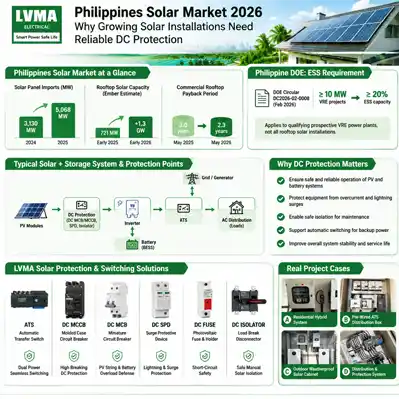
According to Ember’s analysis of UN trade data, solar module imports in the Philippines were approximately 3130 MW in 2024, growing to 5068 MW in 2025. The same analysis shows that in March and April 2026, over 3000 MW of PV modules were shipped from China to the Philippines in total. This means that a large volume of equipment flooded into the country in just eight weeks!
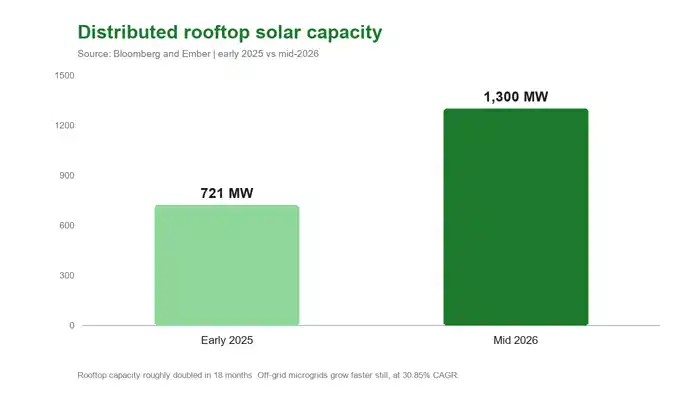
Rooftop solar is a little bit different, and it holds more reference value for suppliers selling “protection” equipment (such as circuit breakers, fuses, distribution boxes, etc.). According to Ember’s estimates, rooftop solar installed capacity has grown from approximately 721 MW at the beginning of 2025 to approximately 1.3 GW at the beginning of 2026 [see chart below]. This primarily refers to distributed systems on the roofs of commercial buildings, rather than large-scale ground-mounted power plants.
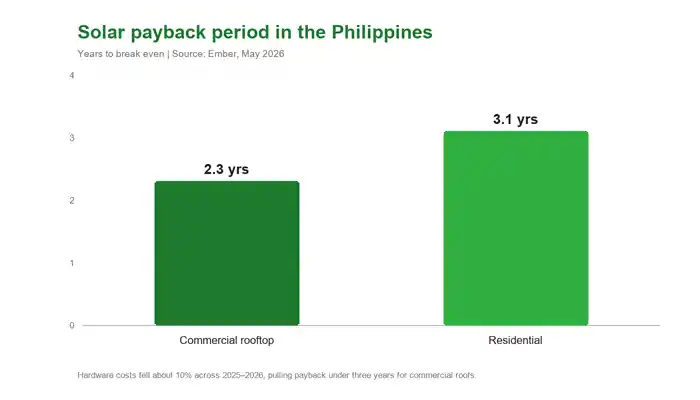
Why the sudden surge in demand? I believe the main reason is—”money.” Let’s look at a set of data: Ember’s analysis in May 2026 shows that the payback period for commercial rooftop PV projects is approximately 2.3 years, shortened from 3 years in May 2025. The payback period for both residential and industrial projects is 3.1 years. For warehouses with heavy daytime electricity loads, the payback period is less than three years, which is enough to move a project from “next year’s wish list” to “this year’s capital expenditure plan” ahead of schedule.
This is the situation on the demand side. On the supply side, the situation is less optimistic—and this is the topic we discuss most frequently when communicating with installers.
2. Battery Storage Is Creating New Opportunities for Solar Protection Equipment
In the past, batteries (energy storage systems) might have been optional; today, they are often the key factor in whether a project can be approved. “PV + energy storage” systems can store excess electricity generated during the day and release it at later times. Depending on the system design, it can also ensure continuous power supply to the premises during grid outages. Manufacturing plants, cold storage facilities, hotels, warehouses, and critical infrastructure are the primary users of such systems; for them, the system’s uptime (availability) is far more important than the efficiency of the PV modules.
With the introduction of energy storage systems, project specifications also change. A standard grid-tied PV system usually has only one main DC circuit; whereas a hybrid system may include multiple DC circuits, battery connections, inverter interfaces, and additional switching devices. All these elements must be incorporated into the design of the protection system, rather than being left for remediation during the commissioning phase.
Regarding the specifics of DC2026-02-0008
In February 2026, the Philippine Department of Energy issued Department Circular No. DC2026-02-0008, updating the country’s energy storage system policy. According to this policy, proposed “Variable Renewable Energy” (VRE) power plants with an installed capacity of 10 megawatts (MW) or more must be equipped with an energy storage system, with a capacity of at least 20% of the total installed capacity of the plant (specific requirements are subject to system studies and technical specifications).
| VRE plant capacity | Minimum ESS power capacity |
| 10 MW | 2 MW |
| 20 MW | 4 MW |
| 50 MW | 10 MW |
Two points need to be clarified here, as people often confuse these concepts during consultation: this regulation only applies to eligible VRE power plants, rather than covering all rooftop photovoltaic projects. Furthermore, MW (megawatt) and MWh (megawatt-hour) have different meanings: MW refers to the rated power of the energy storage system, while MWh refers to the total amount of energy it can store. Both values must be referenced when evaluating battery specifications, otherwise the specification descriptions would be meaningless.
3. Why DC Protection Matters in Solar PV and Battery Systems
A solar power system is not simply a collection of panels connected to an inverter. It is an electrical installation that must operate safely under normal conditions and respond correctly when faults occur.
DC circuits have characteristics that make protection selection particularly important.
In an AC circuit, current naturally passes through zero during each cycle, helping a circuit breaker interrupt an electrical arc. DC current does not have this natural zero-crossing point, which can make arc interruption more challenging. This is one reason why an AC circuit breaker should not automatically be used in a DC application. For solar PV and battery systems, protective devices must be designed and rated for the actual DC operating conditions. Voltage rating, current rating, breaking capacity and pole configuration all need to be considered.
Equipment in solar or energy storage systems must be selected based on actual DC operating conditions (including voltage, current, breaking capacity, and pole configuration). If any of these parameters are incorrect, the equipment may fail to effectively interrupt fault current at a critical moment. Additionally, there are weather factors. The climate in the Philippines is hot and humid, with abundant rainfall and frequent thunderstorms. Since outdoor installations are exposed to this environment year-round, the protection rating of the enclosure and the connection methods are just as important as the internal equipment itself.
These are the components that come up most often in solar and storage work:
| Picture | Component | Function |
 | DC molded case circuit breaker (DC MCCB) | Overcurrent protection and isolation on the battery and combiner side, usually 500–1500 V. See DC MCCB options |
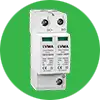 | DC surge protection device (DC SPD) | Stops lightning and switching surges before they kill inverters and MPPT inputs. See DC SPD options |
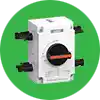 | DC isolator switch | Safe manual disconnect for array-side maintenance. See DC isolators |
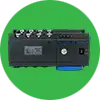 | Automatic transfer switch (ATS) | Moves load between grid and solar/storage backup during outages. See ATS options |
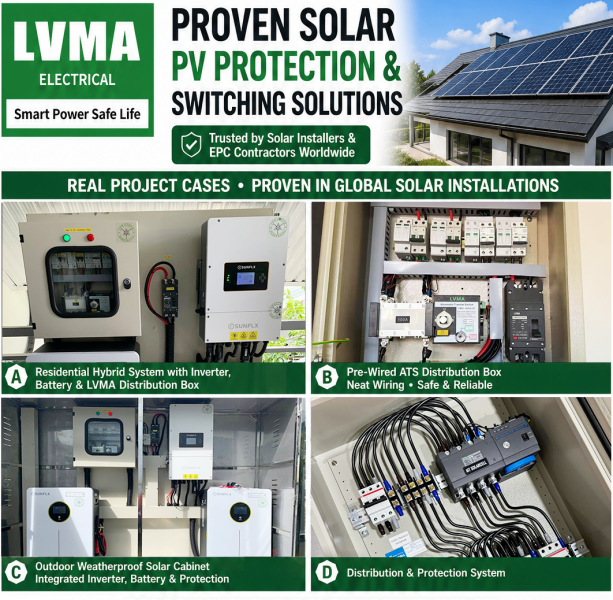
In practical applications, pre-assembled DC protection and automatic transfer switch (ATS) cabinets are generally superior to systems pieced together from individual components. These tested modular units can be installed directly as a whole. All wiring is checked before leaving the factory, eliminating the need for installers to repeat circuit design and assembly work for each project.
Most failures we see are not caused by the equipment itself, but by improper selection. Examples include: insufficient breaking capacity, incorrect selection of DC voltage ratings, or the installation of surge protective devices (SPDs) that cannot effectively suppress surges at a specific location.
4.Why Automatic Transfer Switches Are Non-Negotiable Here
The Philippines consists of 7,641 islands and has three basically independent power grids: Luzon, Visayas, and Mindanao. Due to weak interconnections between these grids, rotational brownouts have become the norm. In September 2026, multiple generator sets in the Visayas grid shut down simultaneously, leading to widespread power outages, and the grid immediately issued a power reserve alert. Furthermore, typhoons often cause even longer outages.
If a solar power system cannot achieve automatic switching, its utility is greatly diminished. When the grid loses power, an Automatic Transfer Switch (ATS) can switch the load to the solar and energy storage system, ensuring that factories continue production, cold storage goods remain refrigerated, and hotels and Business Process Outsourcing (BPO) offices maintain normal operations.
For the cold storage and food processing industries, even a power outage of just a few seconds can lead to product spoilage. Therefore, the transfer time is no less important than the rated parameters on the equipment label.
5.A Sourcing Checklist for Philippine Solar Buyers
A few checks before you place the order. They separate a project that survives the first storm from one that needs a service call.
| Check | What to verify | How LVMA helps |
| Certifications | CE, TUV and CB | We send the certificate for the exact model you order. |
| DC voltage rating | Utility-scale and hybrid storage want 500–1500 V DC breakers and isolators. | Our DC MCB, DC MCCB, DC SPD and DC isolator range covers 500–1500 V as standard. |
| Breaking capacity | The DC MCCB has to clear the array’s maximum short-circuit current. | We size the breaker against your array data before quoting. |
| Surge class | A Type 2 DC SPD on the array/combiner side, rated for the system’s DC voltage. | Type 2 DC SPDs matched to system voltage, supplied as a set with the enclosure. |
| Typhoon and humidity durability | Enclosures and terminations that handle humidity and temperature cycling. | IP66/IP67-rated enclosures, anti-corrosion treatment, sealed cable entries. |
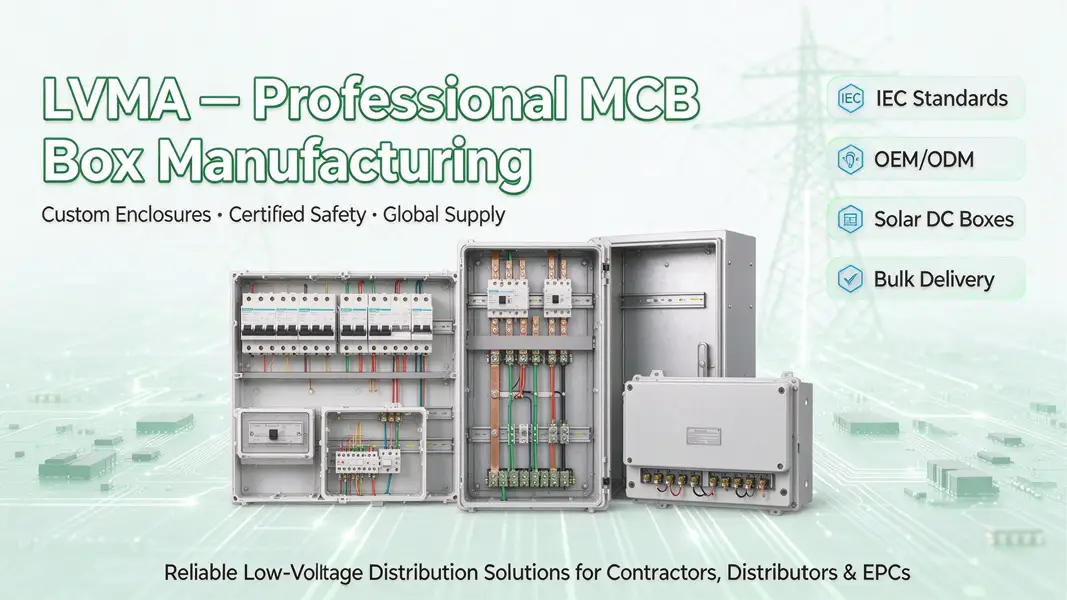
| Local assembly support | Pre-assembled or modular enclosures cut wiring errors and speed up installs. | LVMA electric offers pre-assembled DC protection + ATS enclosures, wired and tested before shipment. |
Send us your single-line diagram before ordering. We will tell you what we would change. That is usually cheaper than finding out on site.
6.Frequently Asked Questions from Buyers
6.1 Why is the Philippines Solar Market 2026 growing?
Interest in rooftop solar, high electricity costs, and more cost-effective equipment are prompting more businesses and households to turn to solar energy. Energy storage systems are also increasingly being incorporated into project planning.
6.2 What is the payback period for commercial rooftop solar projects?
According to Ember’s analysis in May 2026, the payback period is approximately 2.3 years. The actual return depends on installation costs, electricity prices, power generation, and the customer’s electricity usage patterns.
6.3 Why is DC protection critical in solar systems?
Solar arrays operate on direct current (DC) and require protection against overcurrent, short circuits, and transient overvoltages. Configuring appropriate DC circuit breakers, surge protective devices (SPDs), and disconnect switches helps ensure the safe operation and maintenance of the system.
6.4 What is the difference between a DC Molded Case Circuit Breaker (DC MCCB) and a DC Surge Protective Device (DC SPD)?
A DC Molded Case Circuit Breaker (DC MCCB) is responsible for providing overcurrent and short-circuit protection within its rated range; while a DC Surge Protective Device (DC SPD) is used to protect equipment from transient overvoltage. Both have different functions and cannot be substituted for each other.
6.5 Are DC disconnect switches the same thing as DC circuit breakers?
No. Disconnect switches are used to break the circuit, while circuit breakers provide overcurrent protection. Depending on the specific design, many installation projects may require both devices to be equipped.
6.6 Does every solar installation project need to be equipped with energy storage batteries?
No. Whether energy storage is required depends on the specific needs of the project and relevant regulations. The energy storage system (ESS) requirements introduced in 2026 only apply to eligible variable renewable energy (VRE) power plants with an installed capacity of 10 megawatts (MW) or more, and are not targeted at all rooftop solar projects.
6.7 What is the function of an automatic transfer switch in a solar system?
It can switch the connected load between different power sources (such as grid power and backup generator or inverter power). It is used when the system needs to achieve automatic backup power switching.
7.Sources and market data notes
The market figures here come mainly from Ember’s published research and Philippine government information.
- Ember,How the Philippines’ rooftop solar surge can flip the energy emergency script, May 2026. Includes import analysis, rooftop estimates and market observations.
- Ember,Payback period for residential rooftop solar in the Philippines falls to just three years as electricity prices surge, 28 May 2026. Includes residential, commercial and industrial payback estimates.
- Philippine Department of Energy, Department Circular No. DC2026-02-0008, 20 February 2026. Official ESS policy update
- Philippine Department of Energy, press release on mandatory energy storage integration, 26 February 2026.
Data notes: Import data reflects the equipment entering the country, not the installed capacity. Data related to rooftop photovoltaics is an independent estimate and does not come from the official national registration system. The payback period is a simulated estimate based on Ember’s assumptions and the electricity price level in 2026; actual project results may vary.
Author: Shirley Ye, Chief Marketing Officer, Zhejiang LVMA Electric Co., Ltd.
Share This Article
Follow Us
Two years ago, solar power was no longer a niche sector in the Philippines. My observation is: solar module prices have fallen, yet electricity bills remain high, which is why roofs are now covered in photovoltaic panels.
So, where exactly is the Philippines Solar Market 2026?
1. The Philippines Solar Market 2026 Is Gaining Momentum
Import data is the quickest indicator for gaining insight into the solar market, and the Philippine market is developing very rapidly.
According to Ember’s analysis of UN trade data, solar module imports in the Philippines were approximately 3130 MW in 2024, growing to 5068 MW in 2025. The same analysis shows that in March and April 2026, over 3000 MW of PV modules were shipped from China to the Philippines in total. This means that a large volume of equipment flooded into the country in just eight weeks!
Rooftop solar is a little bit different, and it holds more reference value for suppliers selling “protection” equipment (such as circuit breakers, fuses, distribution boxes, etc.). According to Ember’s estimates, rooftop solar installed capacity has grown from approximately 721 MW at the beginning of 2025 to approximately 1.3 GW at the beginning of 2026 [see chart below]. This primarily refers to distributed systems on the roofs of commercial buildings, rather than large-scale ground-mounted power plants.
Why the sudden surge in demand? I believe the main reason is—”money.” Let’s look at a set of data: Ember’s analysis in May 2026 shows that the payback period for commercial rooftop PV projects is approximately 2.3 years, shortened from 3 years in May 2025. The payback period for both residential and industrial projects is 3.1 years. For warehouses with heavy daytime electricity loads, the payback period is less than three years, which is enough to move a project from “next year’s wish list” to “this year’s capital expenditure plan” ahead of schedule.
This is the situation on the demand side. On the supply side, the situation is less optimistic—and this is the topic we discuss most frequently when communicating with installers.
2. Battery Storage Is Creating New Opportunities for Solar Protection Equipment
In the past, batteries (energy storage systems) might have been optional; today, they are often the key factor in whether a project can be approved. “PV + energy storage” systems can store excess electricity generated during the day and release it at later times. Depending on the system design, it can also ensure continuous power supply to the premises during grid outages. Manufacturing plants, cold storage facilities, hotels, warehouses, and critical infrastructure are the primary users of such systems; for them, the system’s uptime (availability) is far more important than the efficiency of the PV modules.
With the introduction of energy storage systems, project specifications also change. A standard grid-tied PV system usually has only one main DC circuit; whereas a hybrid system may include multiple DC circuits, battery connections, inverter interfaces, and additional switching devices. All these elements must be incorporated into the design of the protection system, rather than being left for remediation during the commissioning phase.
Regarding the specifics of DC2026-02-0008
In February 2026, the Philippine Department of Energy issued Department Circular No. DC2026-02-0008, updating the country’s energy storage system policy. According to this policy, proposed “Variable Renewable Energy” (VRE) power plants with an installed capacity of 10 megawatts (MW) or more must be equipped with an energy storage system, with a capacity of at least 20% of the total installed capacity of the plant (specific requirements are subject to system studies and technical specifications).
| VRE plant capacity | Minimum ESS power capacity |
| 10 MW | 2 MW |
| 20 MW | 4 MW |
| 50 MW | 10 MW |
Two points need to be clarified here, as people often confuse these concepts during consultation: this regulation only applies to eligible VRE power plants, rather than covering all rooftop photovoltaic projects. Furthermore, MW (megawatt) and MWh (megawatt-hour) have different meanings: MW refers to the rated power of the energy storage system, while MWh refers to the total amount of energy it can store. Both values must be referenced when evaluating battery specifications, otherwise the specification descriptions would be meaningless.
3. Why DC Protection Matters in Solar PV and Battery Systems
A solar power system is not simply a collection of panels connected to an inverter. It is an electrical installation that must operate safely under normal conditions and respond correctly when faults occur.
DC circuits have characteristics that make protection selection particularly important.
In an AC circuit, current naturally passes through zero during each cycle, helping a circuit breaker interrupt an electrical arc. DC current does not have this natural zero-crossing point, which can make arc interruption more challenging. This is one reason why an AC circuit breaker should not automatically be used in a DC application. For solar PV and battery systems, protective devices must be designed and rated for the actual DC operating conditions. Voltage rating, current rating, breaking capacity and pole configuration all need to be considered.
Equipment in solar or energy storage systems must be selected based on actual DC operating conditions (including voltage, current, breaking capacity, and pole configuration). If any of these parameters are incorrect, the equipment may fail to effectively interrupt fault current at a critical moment. Additionally, there are weather factors. The climate in the Philippines is hot and humid, with abundant rainfall and frequent thunderstorms. Since outdoor installations are exposed to this environment year-round, the protection rating of the enclosure and the connection methods are just as important as the internal equipment itself.
These are the components that come up most often in solar and storage work:
| Picture | Component | Function |
| DC molded case circuit breaker (DC MCCB) | Overcurrent protection and isolation on the battery and combiner side, usually 500–1500 V. See DC MCCB options |
| DC surge protection device (DC SPD) | Stops lightning and switching surges before they kill inverters and MPPT inputs. See DC SPD options |
| DC isolator switch | Safe manual disconnect for array-side maintenance. See DC isolators |
| Automatic transfer switch (ATS) | Moves load between grid and solar/storage backup during outages. See ATS options |
In practical applications, pre-assembled DC protection and automatic transfer switch (ATS) cabinets are generally superior to systems pieced together from individual components. These tested modular units can be installed directly as a whole. All wiring is checked before leaving the factory, eliminating the need for installers to repeat circuit design and assembly work for each project.
Most failures we see are not caused by the equipment itself, but by improper selection. Examples include: insufficient breaking capacity, incorrect selection of DC voltage ratings, or the installation of surge protective devices (SPDs) that cannot effectively suppress surges at a specific location.
4.Why Automatic Transfer Switches Are Non-Negotiable Here
The Philippines consists of 7,641 islands and has three basically independent power grids: Luzon, Visayas, and Mindanao. Due to weak interconnections between these grids, rotational brownouts have become the norm. In September 2026, multiple generator sets in the Visayas grid shut down simultaneously, leading to widespread power outages, and the grid immediately issued a power reserve alert. Furthermore, typhoons often cause even longer outages.
If a solar power system cannot achieve automatic switching, its utility is greatly diminished. When the grid loses power, an Automatic Transfer Switch (ATS) can switch the load to the solar and energy storage system, ensuring that factories continue production, cold storage goods remain refrigerated, and hotels and Business Process Outsourcing (BPO) offices maintain normal operations.
For the cold storage and food processing industries, even a power outage of just a few seconds can lead to product spoilage. Therefore, the transfer time is no less important than the rated parameters on the equipment label.
5.A Sourcing Checklist for Philippine Solar Buyers
A few checks before you place the order. They separate a project that survives the first storm from one that needs a service call.
| Check | What to verify | How LVMA helps |
| Certifications | CE, TUV and CB | We send the certificate for the exact model you order. |
| DC voltage rating | Utility-scale and hybrid storage want 500–1500 V DC breakers and isolators. | Our DC MCB, DC MCCB, DC SPD and DC isolator range covers 500–1500 V as standard. |
| Breaking capacity | The DC MCCB has to clear the array’s maximum short-circuit current. | We size the breaker against your array data before quoting. |
| Surge class | A Type 2 DC SPD on the array/combiner side, rated for the system’s DC voltage. | Type 2 DC SPDs matched to system voltage, supplied as a set with the enclosure. |
| Typhoon and humidity durability | Enclosures and terminations that handle humidity and temperature cycling. | IP66/IP67-rated enclosures, anti-corrosion treatment, sealed cable entries. |
| Local assembly support | Pre-assembled or modular enclosures cut wiring errors and speed up installs. | LVMA electric offers pre-assembled DC protection + ATS enclosures, wired and tested before shipment. |
Send us your single-line diagram before ordering. We will tell you what we would change. That is usually cheaper than finding out on site.
6.Frequently Asked Questions from Buyers
6.1 Why is the Philippines Solar Market 2026 growing?
Interest in rooftop solar, high electricity costs, and more cost-effective equipment are prompting more businesses and households to turn to solar energy. Energy storage systems are also increasingly being incorporated into project planning.
6.2 What is the payback period for commercial rooftop solar projects?
According to Ember’s analysis in May 2026, the payback period is approximately 2.3 years. The actual return depends on installation costs, electricity prices, power generation, and the customer’s electricity usage patterns.
6.3 Why is DC protection critical in solar systems?
Solar arrays operate on direct current (DC) and require protection against overcurrent, short circuits, and transient overvoltages. Configuring appropriate DC circuit breakers, surge protective devices (SPDs), and disconnect switches helps ensure the safe operation and maintenance of the system.
6.4 What is the difference between a DC Molded Case Circuit Breaker (DC MCCB) and a DC Surge Protective Device (DC SPD)?
A DC Molded Case Circuit Breaker (DC MCCB) is responsible for providing overcurrent and short-circuit protection within its rated range; while a DC Surge Protective Device (DC SPD) is used to protect equipment from transient overvoltage. Both have different functions and cannot be substituted for each other.
6.5 Are DC disconnect switches the same thing as DC circuit breakers?
No. Disconnect switches are used to break the circuit, while circuit breakers provide overcurrent protection. Depending on the specific design, many installation projects may require both devices to be equipped.
6.6 Does every solar installation project need to be equipped with energy storage batteries?
No. Whether energy storage is required depends on the specific needs of the project and relevant regulations. The energy storage system (ESS) requirements introduced in 2026 only apply to eligible variable renewable energy (VRE) power plants with an installed capacity of 10 megawatts (MW) or more, and are not targeted at all rooftop solar projects.
6.7 What is the function of an automatic transfer switch in a solar system?
It can switch the connected load between different power sources (such as grid power and backup generator or inverter power). It is used when the system needs to achieve automatic backup power switching.
7.Sources and market data notes
The market figures here come mainly from Ember’s published research and Philippine government information.
- Ember,How the Philippines’ rooftop solar surge can flip the energy emergency script, May 2026. Includes import analysis, rooftop estimates and market observations.
- Ember,Payback period for residential rooftop solar in the Philippines falls to just three years as electricity prices surge, 28 May 2026. Includes residential, commercial and industrial payback estimates.
- Philippine Department of Energy, Department Circular No. DC2026-02-0008, 20 February 2026. Official ESS policy update
- Philippine Department of Energy, press release on mandatory energy storage integration, 26 February 2026.
Data notes: Import data reflects the equipment entering the country, not the installed capacity. Data related to rooftop photovoltaics is an independent estimate and does not come from the official national registration system. The payback period is a simulated estimate based on Ember’s assumptions and the electricity price level in 2026; actual project results may vary.
Author: Shirley Ye, Chief Marketing Officer, Zhejiang LVMA Electric Co., Ltd.
Contact Us
Related Blog

Contact Us
Have questions about our products or services? Our team is here to help you with any inquiries.