

What is an Automatic Transfer Switch (ATS)? Types, Working Principle & Applications
What is an Automatic Transfer Switch (ATS)? Types, Working Principle & Applications
Introduction: Why Automatic Transfer Switches Are Indispensable
Power downtime is one of the most costly risks for residential, commercial, and industrial facilities. Unexpected utility failures can lead to data loss, equipment damage, production halts, and compromised safety in critical environments like hospitals, data centers, and telecom stations. To eliminate unplanned power interruptions, Automatic Transfer Switches (ATS) serve as the core safeguard for dual-power supply systems.
Unlike manual changeover switches that require human operation, an ATS is a self-monitoring, electromechanical device that continuously tracks the voltage and frequency of the primary power source. Once it detects power failure, under-voltage, or phase loss, it automatically transfers the load to the standby power source within milliseconds to seconds. When utility power restores to normal parameters, it switches back safely and resets for the next standby cycle .
Not all ATS units are built the same. Based on internal driving structures and working mechanisms, mainstream ATS products are divided into three core types: motorized ATS, excitation (magnetic) ATS, and circuit breaker-based ATS. Understanding their differences is critical for selecting the right switch for your power system.
Core Basics: How Does an Automatic Transfer Switch Work?
Before diving into type comparisons, it is necessary to master the universal working logic of all ATS devices. A complete ATS system consists of three key components: a microprocessor control unit, a mechanical switching actuator, and dual-power mechanical interlock structure.
<ol”>
- Real-time Monitoring: The intelligent controller continuously samples voltage, frequency, and phase sequence of the main and standby power sources.
- Fault Judgment: When the main power fails or operates abnormally beyond preset thresholds, the system triggers the transfer command.
- Isolation & Switching: The mechanical actuator disconnects the faulty main power first, then connects the standby power to the load (open-transition switching, the most common mode).
- Restore & Reset: After the main power recovers stably for a preset delay, the ATS switches the load back and returns to standby monitoring status.
All ATS adopts strict mechanical and electrical interlock design to prevent parallel connection of two power sources, avoiding short-circuit accidents and power source damage .
Three Main Types of Automatic Transfer Switches (Full Comparison)
The biggest distinction between ATS models lies in their driving and execution structure. Below is a detailed breakdown of motorized, excitation, and circuit breaker ATS, covering working principles, pros, cons, and typical use cases.
1. Motorized Automatic Transfer Switch (Motor-Driven ATS)
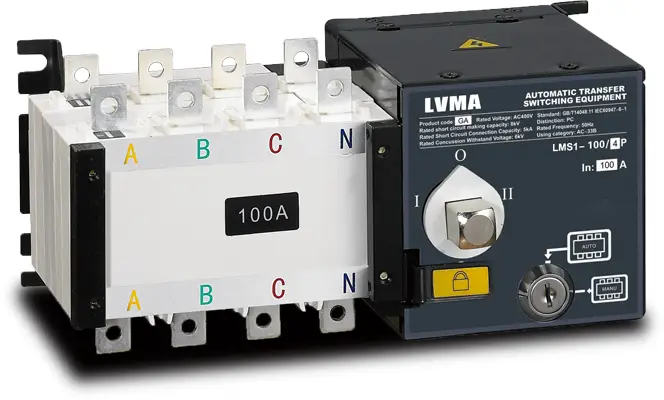
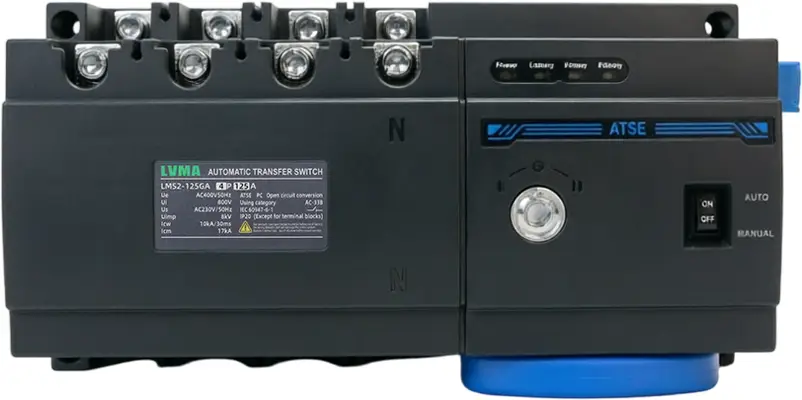
Motorized ATS is the most widely used conventional type, driven by a small dedicated servo motor. It relies on mechanical gear transmission to complete switch position conversion between main power and standby power.
Working Principle
When the control unit sends a switching signal, the built-in motor starts and drives the gear and crank linkage mechanism to push the switch contact assembly to act. The motor stops automatically after completing the disconnection and connection action, and the switch maintains a stable state through mechanical self-locking. This structure realizes fully automatic, unmanned power transfer.
Key Advantages
- High stability and durability: Mature mechanical transmission structure, low failure rate, suitable for long-term continuous monitoring.
- Large current bearing capacity: Supports high-power load scenarios, with complete specifications from 63A to 6300A.
- Safe and reliable: Dual mechanical and electrical interlocks completely avoid dual-power parallel connection risks.
- Wide adaptability: Compatible with generator standby power and municipal dual-power systems.
Disadvantages
- Relatively slow switching speed: Mechanical gear transmission takes 1–3 seconds for full transfer, causing short-term power off for loads.
- Larger volume: The motor and gear set occupy more installation space.
Best Applications
Commercial buildings, residential communities, factory workshops, lighting power systems, and conventional industrial equipment that allow short power interruption. It is the preferred choice for most general dual-power distribution projects.
2. Excitation (Magnetic) Automatic Transfer Switch
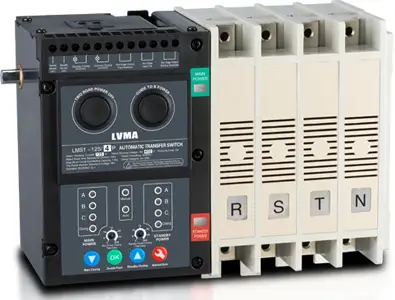
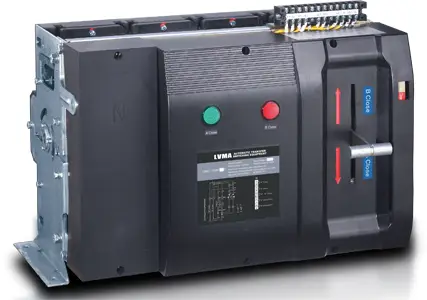
Also known as electromagnetic ATS or contactor-type ATS, the excitation ATS takes electromagnetic coils as the driving core, replacing the motor gear structure. It is a fast-response electromechanical switching device.
Working Principle
The ATS is equipped with two sets of electromagnetic excitation coils corresponding to main and standby power positions. When a power fault is detected, the control system instantly energizes the standby coil and de-energizes the main coil. The electromagnetic suction drives the contactor to complete rapid disconnection and closing actions, realizing power transfer in a very short time.
Key Advantages
- Ultra-fast switching speed: Completes power transfer within 0.1–0.5 seconds, far faster than motorized ATS.
- Compact and lightweight: No bulky motor and gear components, saving installation space.
- High sensitivity: Instantly responds to voltage loss and phase failure faults.
Disadvantages
- Wide rated current coverage: suitable for scenarios that require quick power restoration (63-6300A). Mostly used for small and medium current loads.
- Coil heating risk: Long-term energization may cause coil heating, affecting service life.
- Lower mechanical stability: Slightly poorer shock resistance compared with motorized structures.
Best Applications
Small and medium-sized commercial equipment, office power supply, precision instrument loads, and scenarios requiring fast power recovery and low tolerance for long power outage time.
3. Circuit Breaker-Type ATS (CB-Type ATS)
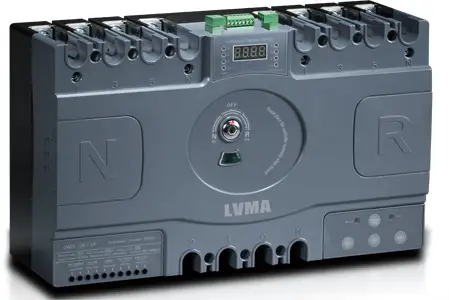
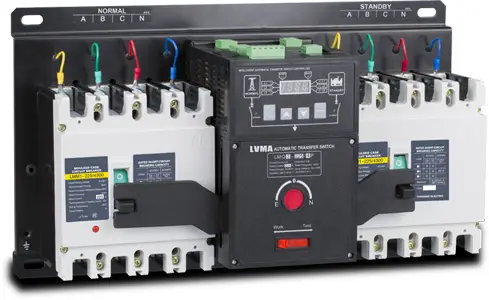
Circuit breaker-type ATS is a high-performance integrated switch composed of two low-voltage circuit breakers and a dedicated mechanical interlock linkage mechanism. It is the only ATS type with complete short-circuit and overload protection functions .
Working Principle
The two circuit breakers are respectively connected to the main power and standby power. The intelligent controller monitors power status and controls the opening and closing of the breakers through the linkage mechanism. The rigid mechanical interlock ensures that the two breakers cannot be closed simultaneously, fundamentally eliminating dual-power parallel faults. Different from ordinary switches, CB-type ATS integrates protection and switching functions in one unit.
Key Advantages
- Built-in full protection: Equipped with overload, short-circuit, and under-voltage protection, no additional circuit breakers needed.
- High safety and fault resistance: Can break short-circuit current, suitable for complex industrial power environments.
- Strong load adaptability: Covers low, medium, and high current specifications, supporting heavy industrial loads.
- Dual manual/auto operation: Supports automatic switching and manual emergency operation for maintenance.
Disadvantages
- Higher cost: Integrated protection structure leads to higher price than ordinary ATS.
- Slightly larger size: Integrated dual-breaker structure requires more installation space.
Best Applications
Industrial production lines, data centers, hospital emergency power systems, precision equipment rooms, and other critical scenarios requiring high power supply safety and fault protection.
Motorized vs Excitation vs Circuit Breaker ATS: Full Comparison Table
| Comparison Item | Motorized ATS | Excitation (Magnetic) ATS | Circuit Breaker-Type ATS |
|---|---|---|---|
| Driving Structure | Servo motor + gear linkage | Electromagnetic coil suction | Dual circuit breaker + mechanical interlock |
| Switching Speed | 1–3 seconds | 0.1–0.5 seconds | 1–3 seconds |
| Protection Function | Basic switching protection (no short-circuit breaking) | Simple switching protection | Full overload & short-circuit protection |
| Current Range | 63A–3200A | 63-6300A | 63A–1250A |
| Stability | Excellent (long service life) | Good (limited by coil life) | Best (industrial-grade safety) |
| Cost | Low-Medium | Low-High | Low-Medium |
| Core Scenarios | General commercial & residential use | loads requiring fast switching | Critical industrial & emergency power |
How to Choose the Right ATS Type for Your Project
Selecting a suitable automatic transfer switch depends on your load requirements, power system grade, and budget. Follow these practical rules:
- Ordinary civil buildings & general loads: Choose motorized ATS for balanced stability and cost performance.
- Precision loads needing fast recovery: Choose excitation ATS to minimize power interruption time.
- Critical industrial & emergency power systems: Choose circuit breaker-type ATS for comprehensive fault protection and maximum power safety.
- High-current heavy-load scenarios: Prioritize motorized or CB-type ATS, avoid excitation ATS with limited current capacity.
FAQs About Automatic Transfer Switches
Q1: Is ATS the same as STS?
No. ATS (Automatic Transfer Switch) is a mechanical switch with break-before-make action, suitable for most power distribution systems with allowable short power outages. STS (Static Transfer Switch) is an electronic semiconductor switch with make-before-break action, achieving uninterrupted switching for ultra-sensitive loads.
Q2: Can ATS work without a generator?
Yes. ATS is applicable to dual municipal power sources as well. It automatically switches between two independent utility power lines to ensure continuous power supply.
Q3: Does CB-type ATS need additional protection devices?
No. Circuit breaker-type ATS integrates overload, short-circuit, and under-voltage protection, which can replace traditional circuit breakers and transfer switches, simplifying the power distribution system structure .
Conclusion
Automatic Transfer Switches (ATS) are the backbone of reliable dual-power supply systems. Motorized ATS delivers stable and cost-effective performance for general use, excitation ATS provides ultra-fast switching for precision loads, and circuit breaker-type ATS offers industrial-grade full protection for critical power scenarios. By clarifying the structural and functional differences between the three types, you can avoid mismatched model selection, reduce power failure risks, and extend the service life of your entire electrical system.
For any power distribution project, matching the correct ATS type to your load demand is the key to achieving long-term safe, stable, and unattended power supply.
Share This Article
Follow Us
Introduction: Why Automatic Transfer Switches Are Indispensable
Power downtime is one of the most costly risks for residential, commercial, and industrial facilities. Unexpected utility failures can lead to data loss, equipment damage, production halts, and compromised safety in critical environments like hospitals, data centers, and telecom stations. To eliminate unplanned power interruptions, Automatic Transfer Switches (ATS) serve as the core safeguard for dual-power supply systems.
Unlike manual changeover switches that require human operation, an ATS is a self-monitoring, electromechanical device that continuously tracks the voltage and frequency of the primary power source. Once it detects power failure, under-voltage, or phase loss, it automatically transfers the load to the standby power source within milliseconds to seconds. When utility power restores to normal parameters, it switches back safely and resets for the next standby cycle .
Not all ATS units are built the same. Based on internal driving structures and working mechanisms, mainstream ATS products are divided into three core types: motorized ATS, excitation (magnetic) ATS, and circuit breaker-based ATS. Understanding their differences is critical for selecting the right switch for your power system.
Core Basics: How Does an Automatic Transfer Switch Work?
Before diving into type comparisons, it is necessary to master the universal working logic of all ATS devices. A complete ATS system consists of three key components: a microprocessor control unit, a mechanical switching actuator, and dual-power mechanical interlock structure.
<ol”>
- Real-time Monitoring: The intelligent controller continuously samples voltage, frequency, and phase sequence of the main and standby power sources.
- Fault Judgment: When the main power fails or operates abnormally beyond preset thresholds, the system triggers the transfer command.
- Isolation & Switching: The mechanical actuator disconnects the faulty main power first, then connects the standby power to the load (open-transition switching, the most common mode).
- Restore & Reset: After the main power recovers stably for a preset delay, the ATS switches the load back and returns to standby monitoring status.
All ATS adopts strict mechanical and electrical interlock design to prevent parallel connection of two power sources, avoiding short-circuit accidents and power source damage .
Three Main Types of Automatic Transfer Switches (Full Comparison)
The biggest distinction between ATS models lies in their driving and execution structure. Below is a detailed breakdown of motorized, excitation, and circuit breaker ATS, covering working principles, pros, cons, and typical use cases.
1. Motorized Automatic Transfer Switch (Motor-Driven ATS)
Motorized ATS is the most widely used conventional type, driven by a small dedicated servo motor. It relies on mechanical gear transmission to complete switch position conversion between main power and standby power.
Working Principle
When the control unit sends a switching signal, the built-in motor starts and drives the gear and crank linkage mechanism to push the switch contact assembly to act. The motor stops automatically after completing the disconnection and connection action, and the switch maintains a stable state through mechanical self-locking. This structure realizes fully automatic, unmanned power transfer.
Key Advantages
- High stability and durability: Mature mechanical transmission structure, low failure rate, suitable for long-term continuous monitoring.
- Large current bearing capacity: Supports high-power load scenarios, with complete specifications from 63A to 6300A.
- Safe and reliable: Dual mechanical and electrical interlocks completely avoid dual-power parallel connection risks.
- Wide adaptability: Compatible with generator standby power and municipal dual-power systems.
Disadvantages
- Relatively slow switching speed: Mechanical gear transmission takes 1–3 seconds for full transfer, causing short-term power off for loads.
- Larger volume: The motor and gear set occupy more installation space.
Best Applications
Commercial buildings, residential communities, factory workshops, lighting power systems, and conventional industrial equipment that allow short power interruption. It is the preferred choice for most general dual-power distribution projects.
2. Excitation (Magnetic) Automatic Transfer Switch
Also known as electromagnetic ATS or contactor-type ATS, the excitation ATS takes electromagnetic coils as the driving core, replacing the motor gear structure. It is a fast-response electromechanical switching device.
Working Principle
The ATS is equipped with two sets of electromagnetic excitation coils corresponding to main and standby power positions. When a power fault is detected, the control system instantly energizes the standby coil and de-energizes the main coil. The electromagnetic suction drives the contactor to complete rapid disconnection and closing actions, realizing power transfer in a very short time.
Key Advantages
- Ultra-fast switching speed: Completes power transfer within 0.1–0.5 seconds, far faster than motorized ATS.
- Compact and lightweight: No bulky motor and gear components, saving installation space.
- High sensitivity: Instantly responds to voltage loss and phase failure faults.
Disadvantages
- Wide rated current coverage: suitable for scenarios that require quick power restoration (63-6300A). Mostly used for small and medium current loads.
- Coil heating risk: Long-term energization may cause coil heating, affecting service life.
- Lower mechanical stability: Slightly poorer shock resistance compared with motorized structures.
Best Applications
Small and medium-sized commercial equipment, office power supply, precision instrument loads, and scenarios requiring fast power recovery and low tolerance for long power outage time.
3. Circuit Breaker-Type ATS (CB-Type ATS)
Circuit breaker-type ATS is a high-performance integrated switch composed of two low-voltage circuit breakers and a dedicated mechanical interlock linkage mechanism. It is the only ATS type with complete short-circuit and overload protection functions .
Working Principle
The two circuit breakers are respectively connected to the main power and standby power. The intelligent controller monitors power status and controls the opening and closing of the breakers through the linkage mechanism. The rigid mechanical interlock ensures that the two breakers cannot be closed simultaneously, fundamentally eliminating dual-power parallel faults. Different from ordinary switches, CB-type ATS integrates protection and switching functions in one unit.
Key Advantages
- Built-in full protection: Equipped with overload, short-circuit, and under-voltage protection, no additional circuit breakers needed.
- High safety and fault resistance: Can break short-circuit current, suitable for complex industrial power environments.
- Strong load adaptability: Covers low, medium, and high current specifications, supporting heavy industrial loads.
- Dual manual/auto operation: Supports automatic switching and manual emergency operation for maintenance.
Disadvantages
- Higher cost: Integrated protection structure leads to higher price than ordinary ATS.
- Slightly larger size: Integrated dual-breaker structure requires more installation space.
Best Applications
Industrial production lines, data centers, hospital emergency power systems, precision equipment rooms, and other critical scenarios requiring high power supply safety and fault protection.
Motorized vs Excitation vs Circuit Breaker ATS: Full Comparison Table
| Comparison Item | Motorized ATS | Excitation (Magnetic) ATS | Circuit Breaker-Type ATS |
|---|---|---|---|
| Driving Structure | Servo motor + gear linkage | Electromagnetic coil suction | Dual circuit breaker + mechanical interlock |
| Switching Speed | 1–3 seconds | 0.1–0.5 seconds | 1–3 seconds |
| Protection Function | Basic switching protection (no short-circuit breaking) | Simple switching protection | Full overload & short-circuit protection |
| Current Range | 63A–3200A | 63-6300A | 63A–1250A |
| Stability | Excellent (long service life) | Good (limited by coil life) | Best (industrial-grade safety) |
| Cost | Low-Medium | Low-High | Low-Medium |
| Core Scenarios | General commercial & residential use | loads requiring fast switching | Critical industrial & emergency power |
How to Choose the Right ATS Type for Your Project
Selecting a suitable automatic transfer switch depends on your load requirements, power system grade, and budget. Follow these practical rules:
- Ordinary civil buildings & general loads: Choose motorized ATS for balanced stability and cost performance.
- Precision loads needing fast recovery: Choose excitation ATS to minimize power interruption time.
- Critical industrial & emergency power systems: Choose circuit breaker-type ATS for comprehensive fault protection and maximum power safety.
- High-current heavy-load scenarios: Prioritize motorized or CB-type ATS, avoid excitation ATS with limited current capacity.
FAQs About Automatic Transfer Switches
Q1: Is ATS the same as STS?
No. ATS (Automatic Transfer Switch) is a mechanical switch with break-before-make action, suitable for most power distribution systems with allowable short power outages. STS (Static Transfer Switch) is an electronic semiconductor switch with make-before-break action, achieving uninterrupted switching for ultra-sensitive loads.
Q2: Can ATS work without a generator?
Yes. ATS is applicable to dual municipal power sources as well. It automatically switches between two independent utility power lines to ensure continuous power supply.
Q3: Does CB-type ATS need additional protection devices?
No. Circuit breaker-type ATS integrates overload, short-circuit, and under-voltage protection, which can replace traditional circuit breakers and transfer switches, simplifying the power distribution system structure .
Conclusion
Automatic Transfer Switches (ATS) are the backbone of reliable dual-power supply systems. Motorized ATS delivers stable and cost-effective performance for general use, excitation ATS provides ultra-fast switching for precision loads, and circuit breaker-type ATS offers industrial-grade full protection for critical power scenarios. By clarifying the structural and functional differences between the three types, you can avoid mismatched model selection, reduce power failure risks, and extend the service life of your entire electrical system.
For any power distribution project, matching the correct ATS type to your load demand is the key to achieving long-term safe, stable, and unattended power supply.
Contact Us
Related Blog




Contact Us
Have questions about our products or services? Our team is here to help you with any inquiries.