

1000V AC Air Circuit Breaker for Solar PV Systems: Technical Guide, Specs & Use Case
1000V AC Air Circuit Breaker for Solar PV Systems: Technical Guide, Specs & Use Case
Meta Title: 1000V AC Air Circuit Breaker for Solar PV | AC Side Protection & Selection Guide Meta Description: Explore 1000V AC air circuit breakers designed for PV AC distribution. Learn technical specs, LSIG protection, PV+BESS use cases, coordination rules and sizing tips for solar EPC and electrical engineers.
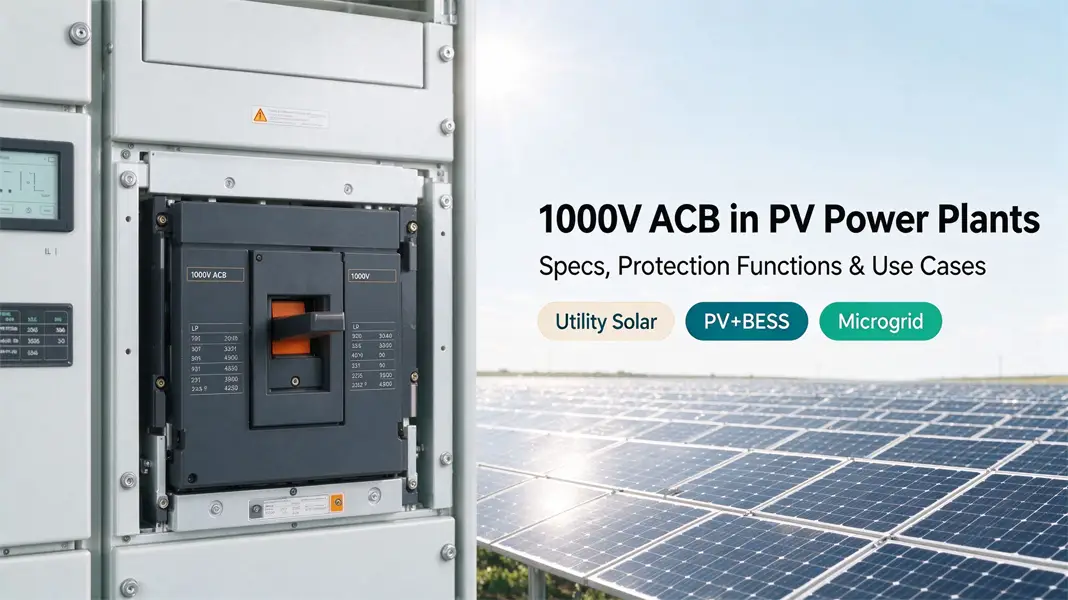
If you are working on utility-scale solar farms, C&I PV plants or hybrid PV+BESS projects, you have likely noticed a clear shift: more designers adopt 1000V AC distribution on the inverter AC side to cut cable cost, reduce resistive losses and simplify long-distance power collection. For the main incomer, bus tie and high-current feeder positions in these 1000V AC solar stations, a standard 690V ACB cannot be used. You need a dedicated 1000V AC rated air circuit breaker, built and tested for continuous operation at Ue=1000V AC under IEC 60947-2.
This article shares practical engineering knowledge for EPC teams, electrical consultants and solar plant operators. We will clarify its working logic, publish accurate rating tables, break down PV-specific protection requirements, map real application scenarios and highlight common design traps that trigger site acceptance delays.
What Is a 1000V AC Air Circuit Breaker for PV?
A 1000V AC air circuit breaker (ACB) is a heavy-duty low-voltage switching and protection device with rated operational voltage Ue = 1000V AC, using air as the arc quenching medium. It is installed after inverters, on the AC collection bus of solar power stations.
This is the most important distinction to avoid confusion: it is not a 1000V DC breaker for PV strings. DC combiner boxes, PV modules and DC cables are protected by DC-rated breakers and DC isolators. The 1000V AC ACB handles aggregated AC power from multiple inverters, protecting LV busbars, station transformers, AC feeder cables and providing safe isolation for maintenance.
The core advantage of 1000V AC distribution in PV: compared with traditional 400V or 690V AC collection, higher AC voltage reduces operating current at the same power level. This lowers cable cross-section, cuts copper expenditure and minimizes voltage drop across wide-area ground-mount sites. However, the trade-off is higher arc energy during faults, which means only breakers with official 1000V AC breaking ratings are qualified for this duty.
Where Does It Fit Inside a PV Plant One-Line Diagram?
Typical power flow for a grid-connected solar farm with 1000V AC collection: PV Modules → DC Combiner → Inverter (DC/AC conversion) → AC Feeder → 1000V AC LV Bus → Step-up Transformer → MV Grid
The 1000V AC ACB is placed at these critical nodes:
- Main incomer of the step-up station LV cabinet, collecting power from dozens of inverters
- Bus tie (sectionaliser) breaker for split 1000V AC busbars, supporting partial maintenance without full plant shutdown
- Large individual inverter cluster feeder breaker
- Common bus main breaker for hybrid PV+BESS systems, where power flows bidirectionally between inverters and PCS converters
- Off-grid solar microgrid main protection and isolation point
Core Technical Specifications Table (1000V AC PV ACB, IEC 60947-2)
| Parameter | Specification |
|---|---|
| Standard | IEC 60947-2, PV installation follows IEC 60364-7-712 |
| Rated operational voltage (Ue) | AC 400V/690V/1000V, 50/60 Hz |
| Rated insulation voltage (Ui) | 1250V AC |
| Rated impulse withstand voltage (Uimp) | 12 kV |
| Pole options | 3P / 4P; 4P for systems requiring neutral isolation |
| Rated frame current (In) | 630A, 800A, 1000A, 1250A, 1600A, 2000A, 2500A, 3200A, 4000A, 5000A, 6300A |
| Icu (Ultimate short-circuit breaking capacity @1000V AC) | 36kA / 50kA / 65kA |
| Ics (Service short-circuit breaking capacity @1000V AC) | 100% Icu |
| Icw (Short-time withstand current) | 40–50kA for 1 second |
| Icm (Rated making capacity) | 2.2 × Icu (peak value) |
| Mounting form | Fixed type / Draw-out type |
| Ambient temperature range | Standard: -5°C ~ +40°C; PV extended version: -25°C ~ +70°C |
| Derating rule | Current derating required above 40°C and above 1000m altitude |
| Trip unit type | Electronic LSIG, self-powered or auxiliary powered |
| Communication | Modbus-RTU, Modbus-TCP optional for SCADA integration |
| Metering function | 3-phase V, I, P, Q, energy, power factor, THD recording |
| Certifications | CE, CB available |
LSIG Protection Functions Tuned for Solar AC-Side Conditions
Modern PV 1000V AC ACBs use electronic trip units with full LSIG protection. PV load characteristics — irradiance fluctuation, harmonic distortion and bidirectional power flow in storage hybrids — make careful setting critical.
L: Long-time overload protection Adjustable Ir (0.4–1.0 × In) and inverse long-time delay tr. It protects busbars, transformer windings and heavy AC cables. In PV design, you must set Ir higher than the maximum continuous export current, plus margin for irradiance surge and temperature derating. Avoid nuisance tripping during noon peak generation.
S: Short-time delay protection Adjustable Isd and tsd with optional I²t curve. This is the core function for selective coordination. When a downstream feeder fault occurs, the main 1000V ACB holds the fault current for a preset short time, waiting for the downstream MCCB to trip first. Without sufficient Icw and short-time delay, a single inverter feeder fault will trip the whole station main breaker and cause massive generation loss.
I: Instantaneous short-circuit protection Fast trip for extreme bolted faults. For strict selectivity schemes, engineers often disable or raise the instantaneous threshold on the main incomer.
G: Earth fault protection Residual earth-fault protection (Ig, tg). This is tricky on long PV AC cables. Parasitic capacitive leakage current across many parallel AC feeders can trigger false earth-fault alarms. The best practice is grading earth-fault curves between main ACB and feeder protection, rather than simply setting a low sensitive pickup.
Beyond LSIG, the trip unit can feed real-time data to your solar SCADA platform: breaker status, fault timestamp, fault current value, power yield and alarm signals. This is extremely valuable for remote unmanned solar stations.
Real PV Application Scenarios
1. Utility-Scale Ground-Mount Solar Farms
This is the fastest-growing use case. Large solar sites spread over hundreds of acres use 1000V AC collection to reduce BOS cost. The 1000V AC ACB acts as the main incomer inside each step-up skid or containerized LV switchroom. Draw-out construction is strongly recommended here: technicians can withdraw and test the breaker while the busbar section remains energized, cutting maintenance downtime.
2. C&I Rooftop and Carport PV Plants
Large commercial rooftop clusters with dozens of central inverters can adopt 1000V AC collection instead of traditional 400V. The ACB is installed in the main PCC room, aggregating multiple inverter AC combiner outputs. It coordinates with the building’s existing low-voltage distribution and backup generator interlock logic.
3. Hybrid PV + Battery Energy Storage (BESS)
This is the most technically demanding scenario. Power flows in two directions: PV inverters push power to the AC bus, while PCS converters either export to the bus or draw power from the bus to charge batteries. The ACB’s overcurrent protection works regardless of current direction, but your protection coordination study must check both charging and discharging fault levels. Earth-fault and selectivity settings need dual-condition validation.
4. Off-Grid Solar Microgrids
For remote microgrids without utility grid support, the 1000V AC ACB serves as the master bus protection. It coordinates PV, battery storage and diesel backup generators. Anti-islanding, load shedding and black-start sequence logic must be aligned with the breaker control and interlock circuits.
5. High-Altitude, Coastal and Harsh Environment PV Sites
Solar projects in plateau, desert or coastal salt-spray zones need special ACB variants. High altitude reduces insulation strength, high ambient temperature forces current derating, and salt fog requires anti-corrosion coating and cabinet anti-condensation heaters. A standard indoor ACB will fail prematurely in these environments.
1000V AC ACB vs High-Voltage PV MCCB: How to Choose
Many EPC engineers mix up the application boundary between ACB and MCCB on the 1000V AC PV bus.
| Item | 1000V AC ACB | 1000V AC PV MCCB |
|---|---|---|
| Typical current range | 630A – 6300A | 16A – 630A |
| PV duty | Station main incomer, bus tie, high-current feeder | Individual inverter output, small AC combiner feeder |
| Selectivity performance | Strong Icw and adjustable short-time delay for graded coordination | Limited short-time withstand; hard to achieve full selectivity at high fault levels |
| Maintenance | Draw-out design, inspectable contacts and arc chute | Sealed molded case, no field contact inspection |
| Monitoring & communication | Advanced metering, event logging, SCADA ready | Basic metering only on premium models |
| Unit cost | Higher CAPEX, justified for main bus reliability | Lower cost for branch feeder protection |
Simple rule: use MCCBs for single inverter outputs and small feeders. Once you aggregate multiple inverters into a common high-current bus and require upstream selectivity, choose a 1000V AC ACB.
PV Sizing Checklist & Common Mistakes to Avoid
Before you lock in your 1000V AC ACB selection, confirm these items:
- Confirm the prospective short-circuit current calculated at the breaker location, and match it against Icu at exactly 1000V AC, not the 400V rating.
- Calculate maximum continuous current including future expansion, then apply temperature and altitude derating before setting Ir.
- Confirm bidirectional power flow if BESS is connected and re-run coordination study for both directions.
- Select 3P or 4P based on your earthing system (TN-S / TN-C-S / TT).
- Specify draw-out version for main incomers where live-bus maintenance is required.
- Match accessories: motor operator, shunt trip, undervoltage release, auxiliary contacts, anti-condensation heater, communication gateway.
The most frequent costly mistakes we see in PV tender packages:
- Using a 690V AC ACB, mistakenly thinking its 1000V insulation rating equals 1000V operational rating
- Copying Icu value from 415V table directly for 1000V AC fault calculation
- Ignoring capacitive leakage current and setting earth-fault pickup too sensitive
- Forgetting short-time withstand Icw requirement, leading to loss of selectivity and cascading tripping
- Mixing DC PV breaker requirements with AC-side breaker specifications
Installation & Maintenance Best Practices for Solar Stations
Mount the ACB vertically with adequate clearance above the arc chute for hot gas venting. Torque all busbar and cable terminals strictly to the manufacturer torque value; heavy 1000V AC feeder cables create large mechanical stress and loose connections are a top fire risk in solar LV rooms.
Before energization, verify phase sequence, auxiliary wiring and communication wiring. For outdoor containerized stations, keep anti-condensation heaters powered when the station is idle in humid nights.
For maintenance: perform visual inspection, contact and arc chute check, and secondary injection trip testing every 12 months for normal sites. Shorten intervals to 6 months for dusty, desert or coastal PV plants. Record trip history, operation counts and test reports for owner acceptance and insurance audit.
Frequently Asked Questions
Q: Can I use a 1000V DC PV breaker for this 1000V AC collection bus?
No. DC breakers are designed for DC arc extinction and reverse polarity withstand. AC arc characteristics are completely different. DC breakers cannot safely interrupt AC short-circuit faults.
Q: Why is Icu lower at 1000V AC than at 400V?
Higher AC voltage maintains the electrical arc more easily and releases greater arc energy. Breaker manufacturers must reduce the published breaking capacity at higher operational voltage, which is mandatory for IEC 60947-2 testing.
Q: Does the inverter internal protection replace the ACB?
Inverter protection handles local overvoltage, frequency and internal faults. The 1000V AC ACB provides busbar, transformer and feeder overcurrent protection, selective coordination across the whole station, and a visible isolation point for lockout-tagout maintenance. They work together, not as substitutes.
Q: Can this ACB coordinate with AC SPDs on the 1000V bus?
Yes. SPDs suppress lightning and switching surges; the ACB protects the SPD and bus against overcurrent if the SPD fails. Locate SPDs close to the LV bus and include SPD failure status monitoring in your control scheme.
Closing
1000V AC collection is a proven cost-saving architecture for modern large-scale PV and PV+BESS plants, but it raises the bar for low-voltage protection design. A properly selected 1000V AC air circuit breaker delivers reliable overload, short-circuit and earth-fault protection, enables graded selectivity, supports remote SCADA monitoring and delivers safe isolation for maintenance.
The key is simple: never treat a 690V ACB as a 1000V AC device. Validate all breaking and withstand figures at your actual operating voltage, and run a full protection coordination study that accounts for the unique, sometimes bidirectional, power flow of renewable systems.
If you need support to select frame size, pole configuration, trip unit and accessories for your next 1000V AC PV station, send us your one-line diagram, transformer data, inverter list and short-circuit calculation result. Our engineering team can provide a matched ACB proposal for your project.
Share This Article
Follow Us
Meta Title: 1000V AC Air Circuit Breaker for Solar PV | AC Side Protection & Selection Guide Meta Description: Explore 1000V AC air circuit breakers designed for PV AC distribution. Learn technical specs, LSIG protection, PV+BESS use cases, coordination rules and sizing tips for solar EPC and electrical engineers.
If you are working on utility-scale solar farms, C&I PV plants or hybrid PV+BESS projects, you have likely noticed a clear shift: more designers adopt 1000V AC distribution on the inverter AC side to cut cable cost, reduce resistive losses and simplify long-distance power collection. For the main incomer, bus tie and high-current feeder positions in these 1000V AC solar stations, a standard 690V ACB cannot be used. You need a dedicated 1000V AC rated air circuit breaker, built and tested for continuous operation at Ue=1000V AC under IEC 60947-2.
This article shares practical engineering knowledge for EPC teams, electrical consultants and solar plant operators. We will clarify its working logic, publish accurate rating tables, break down PV-specific protection requirements, map real application scenarios and highlight common design traps that trigger site acceptance delays.
What Is a 1000V AC Air Circuit Breaker for PV?
A 1000V AC air circuit breaker (ACB) is a heavy-duty low-voltage switching and protection device with rated operational voltage Ue = 1000V AC, using air as the arc quenching medium. It is installed after inverters, on the AC collection bus of solar power stations.
This is the most important distinction to avoid confusion: it is not a 1000V DC breaker for PV strings. DC combiner boxes, PV modules and DC cables are protected by DC-rated breakers and DC isolators. The 1000V AC ACB handles aggregated AC power from multiple inverters, protecting LV busbars, station transformers, AC feeder cables and providing safe isolation for maintenance.
The core advantage of 1000V AC distribution in PV: compared with traditional 400V or 690V AC collection, higher AC voltage reduces operating current at the same power level. This lowers cable cross-section, cuts copper expenditure and minimizes voltage drop across wide-area ground-mount sites. However, the trade-off is higher arc energy during faults, which means only breakers with official 1000V AC breaking ratings are qualified for this duty.
Where Does It Fit Inside a PV Plant One-Line Diagram?
Typical power flow for a grid-connected solar farm with 1000V AC collection: PV Modules → DC Combiner → Inverter (DC/AC conversion) → AC Feeder → 1000V AC LV Bus → Step-up Transformer → MV Grid
The 1000V AC ACB is placed at these critical nodes:
- Main incomer of the step-up station LV cabinet, collecting power from dozens of inverters
- Bus tie (sectionaliser) breaker for split 1000V AC busbars, supporting partial maintenance without full plant shutdown
- Large individual inverter cluster feeder breaker
- Common bus main breaker for hybrid PV+BESS systems, where power flows bidirectionally between inverters and PCS converters
- Off-grid solar microgrid main protection and isolation point
Core Technical Specifications Table (1000V AC PV ACB, IEC 60947-2)
| Parameter | Specification |
|---|---|
| Standard | IEC 60947-2, PV installation follows IEC 60364-7-712 |
| Rated operational voltage (Ue) | AC 400V/690V/1000V, 50/60 Hz |
| Rated insulation voltage (Ui) | 1250V AC |
| Rated impulse withstand voltage (Uimp) | 12 kV |
| Pole options | 3P / 4P; 4P for systems requiring neutral isolation |
| Rated frame current (In) | 630A, 800A, 1000A, 1250A, 1600A, 2000A, 2500A, 3200A, 4000A, 5000A, 6300A |
| Icu (Ultimate short-circuit breaking capacity @1000V AC) | 36kA / 50kA / 65kA |
| Ics (Service short-circuit breaking capacity @1000V AC) | 100% Icu |
| Icw (Short-time withstand current) | 40–50kA for 1 second |
| Icm (Rated making capacity) | 2.2 × Icu (peak value) |
| Mounting form | Fixed type / Draw-out type |
| Ambient temperature range | Standard: -5°C ~ +40°C; PV extended version: -25°C ~ +70°C |
| Derating rule | Current derating required above 40°C and above 1000m altitude |
| Trip unit type | Electronic LSIG, self-powered or auxiliary powered |
| Communication | Modbus-RTU, Modbus-TCP optional for SCADA integration |
| Metering function | 3-phase V, I, P, Q, energy, power factor, THD recording |
| Certifications | CE, CB available |
LSIG Protection Functions Tuned for Solar AC-Side Conditions
Modern PV 1000V AC ACBs use electronic trip units with full LSIG protection. PV load characteristics — irradiance fluctuation, harmonic distortion and bidirectional power flow in storage hybrids — make careful setting critical.
L: Long-time overload protection Adjustable Ir (0.4–1.0 × In) and inverse long-time delay tr. It protects busbars, transformer windings and heavy AC cables. In PV design, you must set Ir higher than the maximum continuous export current, plus margin for irradiance surge and temperature derating. Avoid nuisance tripping during noon peak generation.
S: Short-time delay protection Adjustable Isd and tsd with optional I²t curve. This is the core function for selective coordination. When a downstream feeder fault occurs, the main 1000V ACB holds the fault current for a preset short time, waiting for the downstream MCCB to trip first. Without sufficient Icw and short-time delay, a single inverter feeder fault will trip the whole station main breaker and cause massive generation loss.
I: Instantaneous short-circuit protection Fast trip for extreme bolted faults. For strict selectivity schemes, engineers often disable or raise the instantaneous threshold on the main incomer.
G: Earth fault protection Residual earth-fault protection (Ig, tg). This is tricky on long PV AC cables. Parasitic capacitive leakage current across many parallel AC feeders can trigger false earth-fault alarms. The best practice is grading earth-fault curves between main ACB and feeder protection, rather than simply setting a low sensitive pickup.
Beyond LSIG, the trip unit can feed real-time data to your solar SCADA platform: breaker status, fault timestamp, fault current value, power yield and alarm signals. This is extremely valuable for remote unmanned solar stations.
Real PV Application Scenarios
1. Utility-Scale Ground-Mount Solar Farms
This is the fastest-growing use case. Large solar sites spread over hundreds of acres use 1000V AC collection to reduce BOS cost. The 1000V AC ACB acts as the main incomer inside each step-up skid or containerized LV switchroom. Draw-out construction is strongly recommended here: technicians can withdraw and test the breaker while the busbar section remains energized, cutting maintenance downtime.
2. C&I Rooftop and Carport PV Plants
Large commercial rooftop clusters with dozens of central inverters can adopt 1000V AC collection instead of traditional 400V. The ACB is installed in the main PCC room, aggregating multiple inverter AC combiner outputs. It coordinates with the building’s existing low-voltage distribution and backup generator interlock logic.
3. Hybrid PV + Battery Energy Storage (BESS)
This is the most technically demanding scenario. Power flows in two directions: PV inverters push power to the AC bus, while PCS converters either export to the bus or draw power from the bus to charge batteries. The ACB’s overcurrent protection works regardless of current direction, but your protection coordination study must check both charging and discharging fault levels. Earth-fault and selectivity settings need dual-condition validation.
4. Off-Grid Solar Microgrids
For remote microgrids without utility grid support, the 1000V AC ACB serves as the master bus protection. It coordinates PV, battery storage and diesel backup generators. Anti-islanding, load shedding and black-start sequence logic must be aligned with the breaker control and interlock circuits.
5. High-Altitude, Coastal and Harsh Environment PV Sites
Solar projects in plateau, desert or coastal salt-spray zones need special ACB variants. High altitude reduces insulation strength, high ambient temperature forces current derating, and salt fog requires anti-corrosion coating and cabinet anti-condensation heaters. A standard indoor ACB will fail prematurely in these environments.
1000V AC ACB vs High-Voltage PV MCCB: How to Choose
Many EPC engineers mix up the application boundary between ACB and MCCB on the 1000V AC PV bus.
| Item | 1000V AC ACB | 1000V AC PV MCCB |
|---|---|---|
| Typical current range | 630A – 6300A | 16A – 630A |
| PV duty | Station main incomer, bus tie, high-current feeder | Individual inverter output, small AC combiner feeder |
| Selectivity performance | Strong Icw and adjustable short-time delay for graded coordination | Limited short-time withstand; hard to achieve full selectivity at high fault levels |
| Maintenance | Draw-out design, inspectable contacts and arc chute | Sealed molded case, no field contact inspection |
| Monitoring & communication | Advanced metering, event logging, SCADA ready | Basic metering only on premium models |
| Unit cost | Higher CAPEX, justified for main bus reliability | Lower cost for branch feeder protection |
Simple rule: use MCCBs for single inverter outputs and small feeders. Once you aggregate multiple inverters into a common high-current bus and require upstream selectivity, choose a 1000V AC ACB.
PV Sizing Checklist & Common Mistakes to Avoid
Before you lock in your 1000V AC ACB selection, confirm these items:
- Confirm the prospective short-circuit current calculated at the breaker location, and match it against Icu at exactly 1000V AC, not the 400V rating.
- Calculate maximum continuous current including future expansion, then apply temperature and altitude derating before setting Ir.
- Confirm bidirectional power flow if BESS is connected and re-run coordination study for both directions.
- Select 3P or 4P based on your earthing system (TN-S / TN-C-S / TT).
- Specify draw-out version for main incomers where live-bus maintenance is required.
- Match accessories: motor operator, shunt trip, undervoltage release, auxiliary contacts, anti-condensation heater, communication gateway.
The most frequent costly mistakes we see in PV tender packages:
- Using a 690V AC ACB, mistakenly thinking its 1000V insulation rating equals 1000V operational rating
- Copying Icu value from 415V table directly for 1000V AC fault calculation
- Ignoring capacitive leakage current and setting earth-fault pickup too sensitive
- Forgetting short-time withstand Icw requirement, leading to loss of selectivity and cascading tripping
- Mixing DC PV breaker requirements with AC-side breaker specifications
Installation & Maintenance Best Practices for Solar Stations
Mount the ACB vertically with adequate clearance above the arc chute for hot gas venting. Torque all busbar and cable terminals strictly to the manufacturer torque value; heavy 1000V AC feeder cables create large mechanical stress and loose connections are a top fire risk in solar LV rooms.
Before energization, verify phase sequence, auxiliary wiring and communication wiring. For outdoor containerized stations, keep anti-condensation heaters powered when the station is idle in humid nights.
For maintenance: perform visual inspection, contact and arc chute check, and secondary injection trip testing every 12 months for normal sites. Shorten intervals to 6 months for dusty, desert or coastal PV plants. Record trip history, operation counts and test reports for owner acceptance and insurance audit.
Frequently Asked Questions
Q: Can I use a 1000V DC PV breaker for this 1000V AC collection bus?
No. DC breakers are designed for DC arc extinction and reverse polarity withstand. AC arc characteristics are completely different. DC breakers cannot safely interrupt AC short-circuit faults.
Q: Why is Icu lower at 1000V AC than at 400V?
Higher AC voltage maintains the electrical arc more easily and releases greater arc energy. Breaker manufacturers must reduce the published breaking capacity at higher operational voltage, which is mandatory for IEC 60947-2 testing.
Q: Does the inverter internal protection replace the ACB?
Inverter protection handles local overvoltage, frequency and internal faults. The 1000V AC ACB provides busbar, transformer and feeder overcurrent protection, selective coordination across the whole station, and a visible isolation point for lockout-tagout maintenance. They work together, not as substitutes.
Q: Can this ACB coordinate with AC SPDs on the 1000V bus?
Yes. SPDs suppress lightning and switching surges; the ACB protects the SPD and bus against overcurrent if the SPD fails. Locate SPDs close to the LV bus and include SPD failure status monitoring in your control scheme.
Closing
1000V AC collection is a proven cost-saving architecture for modern large-scale PV and PV+BESS plants, but it raises the bar for low-voltage protection design. A properly selected 1000V AC air circuit breaker delivers reliable overload, short-circuit and earth-fault protection, enables graded selectivity, supports remote SCADA monitoring and delivers safe isolation for maintenance.
The key is simple: never treat a 690V ACB as a 1000V AC device. Validate all breaking and withstand figures at your actual operating voltage, and run a full protection coordination study that accounts for the unique, sometimes bidirectional, power flow of renewable systems.
If you need support to select frame size, pole configuration, trip unit and accessories for your next 1000V AC PV station, send us your one-line diagram, transformer data, inverter list and short-circuit calculation result. Our engineering team can provide a matched ACB proposal for your project.
Contact Us
Related Blog

Contact Us
Have questions about our products or services? Our team is here to help you with any inquiries.