

Molded Case Circuit Breaker (MCCB): Parameters, Selection & Applications
Molded Case Circuit Breaker (MCCB): Parameters, Selection & Applications
In low-voltage power distribution systems, electrical faults such as overload, short circuit, and ground fault are the main causes of equipment damage, circuit burnout, and even safety accidents. To stabilize power supply reliability and protect electrical facilities, Molded Case Circuit Breakers (MCCBs) have become core protective components for industrial, commercial, and large residential power distribution projects.
Different from miniature circuit breakers (MCBs) for household use, MCCBs feature adjustable protection parameters, high breaking capacity, and a sturdy molded insulated housing. They are widely used in distribution panels, transformer outlets, motor control circuits, and industrial power distribution systems. This comprehensive guide elaborates on MCCB working principles, core technical parameters, standard selection methods, protection functions, and application scenarios to help engineers and buyers make accurate device choices.
1. What Is an MCCB (Molded Case Circuit Breaker)?
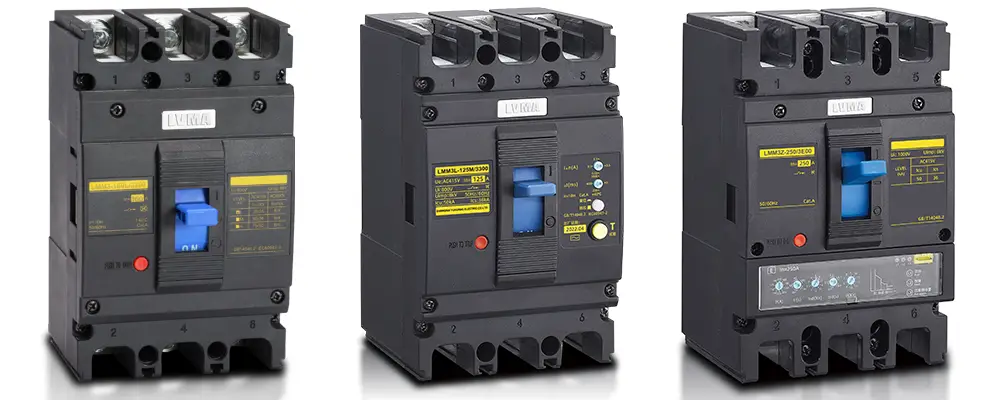
An MCCB is a low-voltage protective switching device encapsulated in a thermosetting molded plastic housing, compliant with UL489 and IEC 60947-2 international standards. It integrates circuit isolation, overload protection, short-circuit protection, and emergency switching functions in one compact structure, suitable for low-voltage circuits with AC voltage up to 1000V and DC voltage up to 1500V.
Compared with MCBs (miniature circuit breakers) for household mini-load protection, MCCBs cover a wider current range (16A–1600A) with adjustable trip settings and stronger short-circuit breaking capacity, making them the preferred protection device for medium and large power distribution loads.
2. Core Working Principle of MCCB
Modern MCCBs mainly adopt thermal-magnetic trip or electronic trip mechanisms, realizing graded protection against different electrical faults through two core working modes:
2.1 Thermal Overload Protection (Long-Time Delay)
This mechanism relies on a bimetallic strip that generates thermal deformation under sustained overcurrent. When the circuit current exceeds the rated value for a long time, the bimetallic strip bends and triggers the trip mechanism to cut off the circuit. It features an inverse time characteristic: the higher the overload current, the shorter the tripping time, effectively preventing cable and equipment aging damage caused by long-term overheating.
2.2 Magnetic Short-Circuit Protection (Instant Trip)
When an extreme short-circuit fault occurs in the circuit, the instantaneous huge current generates a strong magnetic field through the electromagnetic coil inside the MCCB. The magnetic force instantly drives the trip mechanism to disconnect the circuit within milliseconds, avoiding equipment burnout and fire hazards caused by short-circuit surges.
2.3 Electronic Trip Upgrade (Advanced MCCBs)
High-end MCCBs are equipped with electronic trip units, realizing precision adjustable protection including long-time delay, short-time delay, instantaneous trip, and ground fault protection, which solves the problem of fixed parameters of traditional thermal-magnetic breakers and meets selective protection requirements for complex power distribution systems.
3. Full Explanation of MCCB Core Parameters (Ir, Tr, Isd, Tsd, Ii, Ig)
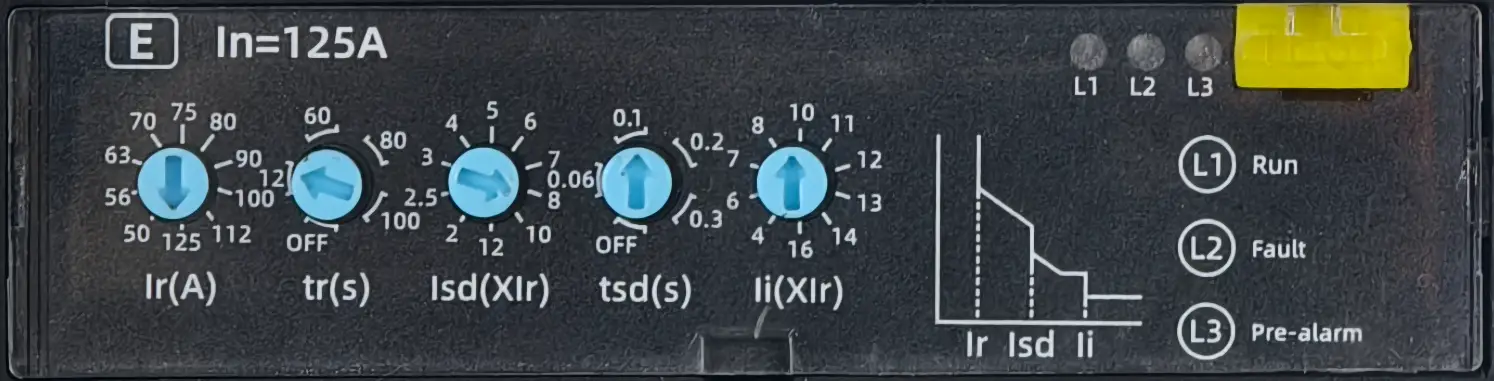
Most industrial MCCBs with electronic trip units are marked with professional parameter symbols, which are the key basis for model selection and debugging. The complete set of protection parameters is explained as follows:
3.1 Long-Time Overload Protection (Ir & Tr)
Ir (Long-Time Pickup Current): The adjustable overload protection current, usually set within 0.4–1.0×In (In refers to the MCCB frame rated current). It is the core parameter for daily overload protection of the circuit.
Tr (Long-Time Delay Time): The delay time for overload tripping, with common gears of 12s, 60s, 80s, 100s (corresponding to 2×Ir current). It avoids mis-tripping caused by short-term current fluctuation and ensures stable operation of normal loads.
3.2 Short-Time Delay Protection (Isd & Tsd)
Isd (Short-Time Pickup Current): Medium short-circuit protection current, adjustable within 2–12×Ir. It targets small and medium short-circuit faults in the circuit.
Tsd (Short-Time Delay Time): Short-circuit short delay time, commonly 0.06s, 0.1s, 0.2s, 0.3s. The delay design realizesupper and lower level selective protection, ensuring the lower-level breaker trips first while the upper-level breaker remains closed, avoiding overall power failure of the system.
3.3 Instantaneous Short-Circuit Protection (Ii)
Ii (Instantaneous Pickup Current): Severe short-circuit instantaneous trip current, set at 4–16×In. When a catastrophic short-circuit fault occurs, the MCCB trips instantly without delay to quickly cut off the fault current.
3.4 Ground Fault Protection (Ig)
Ig (Ground-Fault Pickup Current): Ground leakage and grounding fault protection current, adjustable within 0.2–1×In. It effectively protects against personal electric shock, equipment leakage damage, and grounding short-circuit faults, which is essential for safety protection of industrial and civil distribution systems.
4. Common MCCB Protection Types (LI / LSI / LSIG)
According to different protection function combinations, MCCBs are divided into three mainstream types, adapting to different application scenarios:
- LI Type (Long-time + Instantaneous): Basic protection type, only supports overload long-delay and short-circuit instantaneous trip. Suitable for simple low-demand distribution circuits such as ordinary factory lighting and small power loads.
- LSI Type (Long-time + Short-time + Instantaneous): Standard selective protection type, adding short-time delay protection. It realizes hierarchical matching of power distribution systems and is widely used in industrial power distribution cabinets and motor main circuits.
- LSIG Type (Long-time + Short-time + Instantaneous + Ground Fault): Full-function protection type, with complete grounding fault protection. It is the best choice for commercial buildings, medical facilities, precision equipment workshops, and high-safety requirement scenarios.
5. Key MCCB Selection Guidelines
Reasonable MCCB selection directly determines the safety and stability of the power distribution system. The following 5 core principles must be followed:
5.1 Confirm Rated Current (In) & Voltage
Select the frame current according to the actual load current, and the working voltage of the MCCB must match the system voltage (AC 400V/690V conventional grades). Avoid long-term overload operation caused by excessive or small rated current.
5.2 Match Short-Circuit Breaking Capacity
Select breaking capacity (25kA, 35kA, 50kA, 85kA) according to the system short-circuit current. High-current industrial distribution systems must choose high breaking capacity MCCBs to avoid breaker burnout during short-circuit faults.
5.3 Select Protection Function Combination
Simple household and ordinary industrial loads choose LI/LSI type; scenarios with strict safety requirements and grounding risks must choose full-function LSIG type.
5.4 Confirm Pole Number
3P poles are suitable for three-phase three-wire industrial power systems; 4P poles are applicable to three-phase four-wire systems with neutral wire, widely used in commercial building distribution systems.
5.5 Adapt Installation & Working Environment
Conventional fixed installation is suitable for most scenarios; plug-in and draw-out types are convenient for later maintenance and replacement, suitable for important power distribution equipment that requires uninterrupted power supply.
6. Main Applications of MCCBs
Thanks to its adjustable parameters, high safety, and strong durability, MCCBs cover almost all low-voltage power distribution scenarios:
- Industrial Power Distribution: Factory main distribution cabinets, motor control circuits, transformer outlet protection, and mechanical equipment power circuits.
- Commercial Buildings: Shopping malls, office buildings, hotels, and hospital power distribution systems, providing overload and leakage safety protection for public power consumption.
- New Energy Industry: Photovoltaic power generation, energy storage equipment, and wind power supporting low-voltage circuits, adapting to complex power fluctuation scenarios.
- Large Civil Facilities: Community centralized power distribution, large equipment supporting circuits, replacing MCBs to meet high-current load protection needs.
7. Common MCCB Usage Mistakes to Avoid
- Blindly increasing the rated current, resulting in failure of overload protection and cable overheating aging.
- Ignoring short-circuit breaking capacity matching, causing breaker failure and equipment damage during short-circuit faults.
- Improper setting of Isd and Tsd parameters, leading to protection disorder and upper-level over-tripping.
- Using LI-type MCCBs in high-safety scenarios without ground fault protection, bringing electric leakage safety hazards.
- Long-term non-maintenance, resulting in aging internal mechanisms and reduced protection sensitivity.
Final Conclusion
As key protective equipment for low-voltage power distribution systems, MCCBs undertake the important task of overload, short-circuit, and ground fault protection. Understanding the core working principles, professional parameters (Ir, Tr, Isd, Tsd, Ii, Ig), and protection type differences is the premise of correct model selection and safe use.
In industrial power distribution field, high-precision adjustable electronic trip MCCBs and full-function LSIG products have become the mainstream trend. Reasonable selection and parameter debugging can effectively improve the safety, stability, and service life of the power distribution system, reducing equipment failure rates and operation and maintenance costs for enterprises.
Share This Article
Follow Us
In low-voltage power distribution systems, electrical faults such as overload, short circuit, and ground fault are the main causes of equipment damage, circuit burnout, and even safety accidents. To stabilize power supply reliability and protect electrical facilities, Molded Case Circuit Breakers (MCCBs) have become core protective components for industrial, commercial, and large residential power distribution projects.
Different from miniature circuit breakers (MCBs) for household use, MCCBs feature adjustable protection parameters, high breaking capacity, and a sturdy molded insulated housing. They are widely used in distribution panels, transformer outlets, motor control circuits, and industrial power distribution systems. This comprehensive guide elaborates on MCCB working principles, core technical parameters, standard selection methods, protection functions, and application scenarios to help engineers and buyers make accurate device choices.
1. What Is an MCCB (Molded Case Circuit Breaker)?
An MCCB is a low-voltage protective switching device encapsulated in a thermosetting molded plastic housing, compliant with UL489 and IEC 60947-2 international standards. It integrates circuit isolation, overload protection, short-circuit protection, and emergency switching functions in one compact structure, suitable for low-voltage circuits with AC voltage up to 1000V and DC voltage up to 1500V.
Compared with MCBs (miniature circuit breakers) for household mini-load protection, MCCBs cover a wider current range (16A–1600A) with adjustable trip settings and stronger short-circuit breaking capacity, making them the preferred protection device for medium and large power distribution loads.
2. Core Working Principle of MCCB
Modern MCCBs mainly adopt thermal-magnetic trip or electronic trip mechanisms, realizing graded protection against different electrical faults through two core working modes:
2.1 Thermal Overload Protection (Long-Time Delay)
This mechanism relies on a bimetallic strip that generates thermal deformation under sustained overcurrent. When the circuit current exceeds the rated value for a long time, the bimetallic strip bends and triggers the trip mechanism to cut off the circuit. It features an inverse time characteristic: the higher the overload current, the shorter the tripping time, effectively preventing cable and equipment aging damage caused by long-term overheating.
2.2 Magnetic Short-Circuit Protection (Instant Trip)
When an extreme short-circuit fault occurs in the circuit, the instantaneous huge current generates a strong magnetic field through the electromagnetic coil inside the MCCB. The magnetic force instantly drives the trip mechanism to disconnect the circuit within milliseconds, avoiding equipment burnout and fire hazards caused by short-circuit surges.
2.3 Electronic Trip Upgrade (Advanced MCCBs)
High-end MCCBs are equipped with electronic trip units, realizing precision adjustable protection including long-time delay, short-time delay, instantaneous trip, and ground fault protection, which solves the problem of fixed parameters of traditional thermal-magnetic breakers and meets selective protection requirements for complex power distribution systems.
3. Full Explanation of MCCB Core Parameters (Ir, Tr, Isd, Tsd, Ii, Ig)
Most industrial MCCBs with electronic trip units are marked with professional parameter symbols, which are the key basis for model selection and debugging. The complete set of protection parameters is explained as follows:
3.1 Long-Time Overload Protection (Ir & Tr)
Ir (Long-Time Pickup Current): The adjustable overload protection current, usually set within 0.4–1.0×In (In refers to the MCCB frame rated current). It is the core parameter for daily overload protection of the circuit.
Tr (Long-Time Delay Time): The delay time for overload tripping, with common gears of 12s, 60s, 80s, 100s (corresponding to 2×Ir current). It avoids mis-tripping caused by short-term current fluctuation and ensures stable operation of normal loads.
3.2 Short-Time Delay Protection (Isd & Tsd)
Isd (Short-Time Pickup Current): Medium short-circuit protection current, adjustable within 2–12×Ir. It targets small and medium short-circuit faults in the circuit.
Tsd (Short-Time Delay Time): Short-circuit short delay time, commonly 0.06s, 0.1s, 0.2s, 0.3s. The delay design realizesupper and lower level selective protection, ensuring the lower-level breaker trips first while the upper-level breaker remains closed, avoiding overall power failure of the system.
3.3 Instantaneous Short-Circuit Protection (Ii)
Ii (Instantaneous Pickup Current): Severe short-circuit instantaneous trip current, set at 4–16×In. When a catastrophic short-circuit fault occurs, the MCCB trips instantly without delay to quickly cut off the fault current.
3.4 Ground Fault Protection (Ig)
Ig (Ground-Fault Pickup Current): Ground leakage and grounding fault protection current, adjustable within 0.2–1×In. It effectively protects against personal electric shock, equipment leakage damage, and grounding short-circuit faults, which is essential for safety protection of industrial and civil distribution systems.
4. Common MCCB Protection Types (LI / LSI / LSIG)
According to different protection function combinations, MCCBs are divided into three mainstream types, adapting to different application scenarios:
- LI Type (Long-time + Instantaneous): Basic protection type, only supports overload long-delay and short-circuit instantaneous trip. Suitable for simple low-demand distribution circuits such as ordinary factory lighting and small power loads.
- LSI Type (Long-time + Short-time + Instantaneous): Standard selective protection type, adding short-time delay protection. It realizes hierarchical matching of power distribution systems and is widely used in industrial power distribution cabinets and motor main circuits.
- LSIG Type (Long-time + Short-time + Instantaneous + Ground Fault): Full-function protection type, with complete grounding fault protection. It is the best choice for commercial buildings, medical facilities, precision equipment workshops, and high-safety requirement scenarios.
5. Key MCCB Selection Guidelines
Reasonable MCCB selection directly determines the safety and stability of the power distribution system. The following 5 core principles must be followed:
5.1 Confirm Rated Current (In) & Voltage
Select the frame current according to the actual load current, and the working voltage of the MCCB must match the system voltage (AC 400V/690V conventional grades). Avoid long-term overload operation caused by excessive or small rated current.
5.2 Match Short-Circuit Breaking Capacity
Select breaking capacity (25kA, 35kA, 50kA, 85kA) according to the system short-circuit current. High-current industrial distribution systems must choose high breaking capacity MCCBs to avoid breaker burnout during short-circuit faults.
5.3 Select Protection Function Combination
Simple household and ordinary industrial loads choose LI/LSI type; scenarios with strict safety requirements and grounding risks must choose full-function LSIG type.
5.4 Confirm Pole Number
3P poles are suitable for three-phase three-wire industrial power systems; 4P poles are applicable to three-phase four-wire systems with neutral wire, widely used in commercial building distribution systems.
5.5 Adapt Installation & Working Environment
Conventional fixed installation is suitable for most scenarios; plug-in and draw-out types are convenient for later maintenance and replacement, suitable for important power distribution equipment that requires uninterrupted power supply.
6. Main Applications of MCCBs
Thanks to its adjustable parameters, high safety, and strong durability, MCCBs cover almost all low-voltage power distribution scenarios:
- Industrial Power Distribution: Factory main distribution cabinets, motor control circuits, transformer outlet protection, and mechanical equipment power circuits.
- Commercial Buildings: Shopping malls, office buildings, hotels, and hospital power distribution systems, providing overload and leakage safety protection for public power consumption.
- New Energy Industry: Photovoltaic power generation, energy storage equipment, and wind power supporting low-voltage circuits, adapting to complex power fluctuation scenarios.
- Large Civil Facilities: Community centralized power distribution, large equipment supporting circuits, replacing MCBs to meet high-current load protection needs.
7. Common MCCB Usage Mistakes to Avoid
- Blindly increasing the rated current, resulting in failure of overload protection and cable overheating aging.
- Ignoring short-circuit breaking capacity matching, causing breaker failure and equipment damage during short-circuit faults.
- Improper setting of Isd and Tsd parameters, leading to protection disorder and upper-level over-tripping.
- Using LI-type MCCBs in high-safety scenarios without ground fault protection, bringing electric leakage safety hazards.
- Long-term non-maintenance, resulting in aging internal mechanisms and reduced protection sensitivity.
Final Conclusion
As key protective equipment for low-voltage power distribution systems, MCCBs undertake the important task of overload, short-circuit, and ground fault protection. Understanding the core working principles, professional parameters (Ir, Tr, Isd, Tsd, Ii, Ig), and protection type differences is the premise of correct model selection and safe use.
In industrial power distribution field, high-precision adjustable electronic trip MCCBs and full-function LSIG products have become the mainstream trend. Reasonable selection and parameter debugging can effectively improve the safety, stability, and service life of the power distribution system, reducing equipment failure rates and operation and maintenance costs for enterprises.
Contact Us
Related Blog




Contact Us
Have questions about our products or services? Our team is here to help you with any inquiries.