

Circuit Breaker Type ATS: MCB vs MCCB Automatic Transfer Switch Guide 2026
Circuit Breaker Type ATS: MCB vs MCCB Automatic Transfer Switch Guide 2026
Power downtime is one of the costliest risks for commercial, industrial, and mission-critical facilities. Unexpected grid failures, voltage fluctuations, and frequency anomalies can halt production, damage expensive electrical equipment, disrupt data center operations, and even trigger safety hazards. A circuit breaker type automatic transfer switch (CB-type ATS) solves these critical issues by enabling seamless, safe, and automatic switching between main power and backup power sources. This comprehensive guide covers everything you need to know about CB-type ATS, including working principles, core advantages, key applications, selection tips, and common FAQs for 2026 electrical system design.
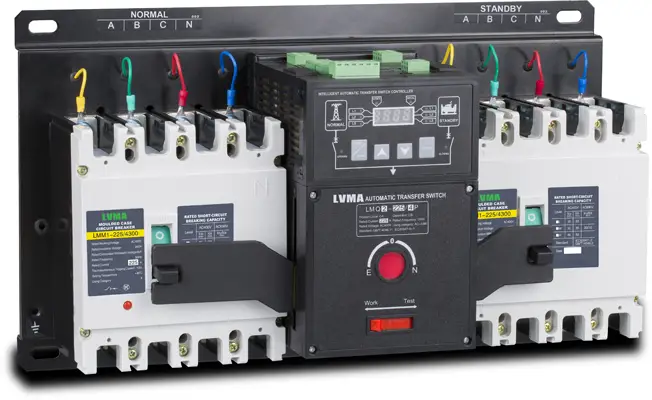
What Is a Circuit Breaker Type Automatic Transfer Switch (CB-Type ATS)?
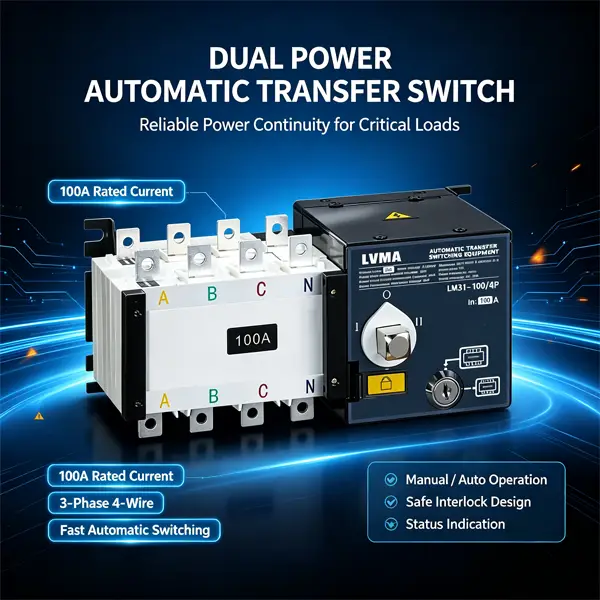
A circuit breaker type automatic transfer switch is a high-reliability power switching device built based on dual interlocked circuit breaker mechanisms. Unlike conventional solenoid-based ATS (PC-class ATS), CB-type ATS integrates professional short-circuit protection, overload protection, and automatic power switching functions into one compact unit. It continuously monitors the real-time status of the primary grid power and standby power (generator, UPS, or secondary grid power), automatically transferring critical loads to the backup power source once the main power fails or operates abnormally.
Classified as CB-level automatic transfer equipment, this switch features inherent circuit protection performance. Each switching unit is essentially a precision circuit breaker with mechanical and electrical interlock devices, completely eliminating the risk of parallel power source collision and ensuring full electrical system safety.
How Does a CB-Type Automatic Transfer Switch Work?
The working logic of a circuit breaker type ATS is fully automated and intelligent, requiring no manual intervention during normal operation. Its complete working cycle includes three core stages:
1. Real-Time Power Monitoring
Built-in high-precision voltage and frequency sensors continuously detect the operating status of the main power supply. The system monitors for common power anomalies including undervoltage, overvoltage, phase loss, frequency deviation, and sudden power outages 24/7.
2. Intelligent Fault Judgment & Switching Execution
When the main power fails to meet standard operating parameters, the controller instantly confirms the fault status. After a short delay to avoid misoperation caused by instantaneous power fluctuations, the device mechanically trips the main power circuit breaker and closes the backup power circuit breaker to complete load transfer. For delayed-transition models, a brief open phase between power sources protects motor loads and sensitive electrical devices from inrush current damage.
3. Automatic Power Recovery Switchback
Once the main grid power is fully restored and operates stably for a preset time, the CB-type ATS automatically switches the load back to the main power supply and enters standby monitoring mode, ensuring long-term stable power system operation.
Core Advantages of Circuit Breaker Type ATS
Compared with traditional PC-class solenoid ATS and manual transfer switches, CB-type automatic transfer switches stand out in safety, durability, and protection performance, making them the preferred choice for high-standard power systems:
1. Integrated Electrical Protection
The biggest advantage of CB-type ATS is its built-in overload and short-circuit protection. Conventional ATS requires additional external circuit breakers for system protection, while CB-type ATS integrates protection and switching functions. It can quickly cut off faulty circuits to avoid equipment burnout and fire risks, greatly improving power system safety.
2. Ultimate Operational Safety
Dual mechanical and electrical interlock structures strictly prevent simultaneous closing of main and backup power circuits, completely avoiding power source parallel collision accidents. The circuit breaker-based switching structure features strong arc extinction capability, stable breaking performance, and excellent resistance to current impact.
3. High Durability & Stability
Circuit breaker type ATS adopts industrial-grade breaker components with a long mechanical service life and strong anti-fatigue performance. It can adapt to frequent switching operations and harsh working environments including high temperature, humidity, and dust, with far lower failure rates than solenoid-type ATS.
4. Simplified System Wiring & Maintenance
The all-in-one integrated design eliminates the need for matching external protection components, simplifying on-site wiring and installation. The modular structure facilitates daily inspection, testing, and maintenance, reducing later operation costs and system failure risks.
5. Wide Load Adaptability
Available in multiple pole numbers (2P/3P/4P) and current specifications (10A–1250A), CB-type ATS adapts to low and high-current loads, covering residential, commercial, and industrial power supply scenarios.
CB-Type ATS vs PC-Type ATS: Key Differences
Most buyers confuse CB-class and PC-class automatic transfer switches. The following core differences help you select the right model for your project:
- Protection Function: CB-type ATS has built-in short-circuit and overload protection; PC-type ATS has no protection and requires external breakers.
- Core Structure: CB-type adopts dual circuit breaker interlock structure; PC-type uses solenoid coil structure.
- Safety Level: CB-type features higher breaking capacity and arc extinction performance, suitable for high-safety requirement scenarios./li>
- Cost & Application: PC-type is cost-effective for ordinary civilian loads; CB-type is ideal for mission-critical and industrial loads with higher investment value.
MCB Type vs MCCB Type ATS: Full Explanation
As two mainstream subcategories of circuit breaker type ATS, MCB-type ATS and MCCB-type ATS are widely adopted in low-voltage power distribution systems. Many purchasers and electrical engineers struggle to distinguish their structural differences, parameter limits, and application scenarios. Below is a detailed, industry-standard explanation of MCB and MCCB automatic transfer switches to help you make targeted selections.
What Is MCB Type ATS?
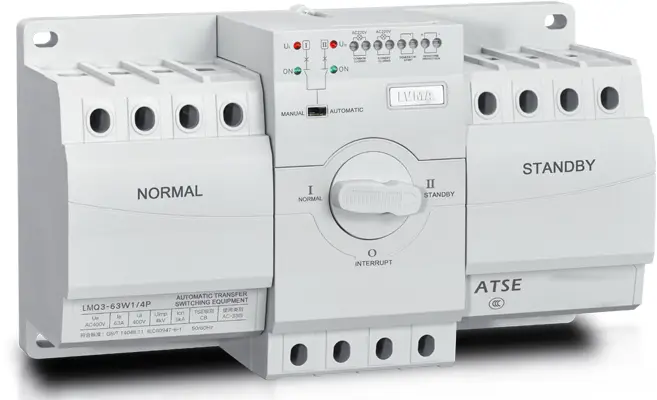
MCB stands for Miniature Circuit Breaker. MCB-type ATS is a compact automatic transfer switch equipped with miniature circuit breaker cores as the switching and protection unit. It is designed for low-current, light-load power supply systems with standardized small-size specifications, fixed breaking capacity, and integrated basic overload and short-circuit protection functions.
MCB-type ATS features a mini modular design, lightweight body, and easy installation in standard distribution boxes and small control cabinets. Its rated current range is generally from 10A to 63A, with a low to medium short-circuit breaking capacity, fully meeting the safety protection requirements of conventional low-power electrical loads. This type of ATS is mainly manufactured with 2P and 3P pole configurations, focusing on single-phase and small-power three-phase power supply scenarios.
What Is MCCB Type ATS?
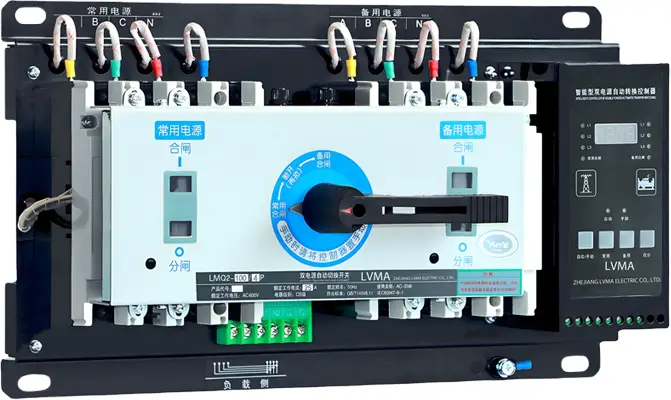
MCCB refers to Molded Case Circuit Breaker. MCCB-type ATS is a heavy-duty circuit breaker type ATS that adopts molded case circuit breaker components as the core switching unit. Compared with MCB-type ATS, it has a larger structural size, higher rated current, and far stronger short-circuit resistance and breaking performance.
The rated current of MCCB-type ATS ranges from 63A to 630A or higher, supporting high-current industrial and commercial loads. It features adjustable protection parameters, reliable arc extinction systems, and excellent overload and short-circuit tolerance. Most MCCB-type ATS adopts 3P and 4P pole designs, suitable for complex three-phase four-wire power distribution systems. With stronger environmental adaptability and operational stability, it can operate stably for a long time in high-load, high-current industrial scenarios.
Main Applications of Circuit Breaker Type Automatic Transfer Switch
Thanks to its superior safety and protection performance, CB-type ATS is widely used in scenarios requiring uninterrupted power supply and high electrical safety standards:
- Data Centers & Communication Rooms: Prevents server downtime and data loss caused by power interruptions.
- Medical Facilities: Ensures stable power for operating rooms, ICU equipment, and emergency medical devices.
- Industrial Plants: Protects production lines, precision machinery, and automated equipment from power fluctuation damage.
- Commercial Buildings: Guarantees normal operation of fire pumps, elevators, emergency lighting, and security systems.
- Public Infrastructure: Applies to subway systems, traffic monitoring equipment, and municipal emergency power supply systems.
- Residential & Villa Projects: Provides reliable backup power for household high-precision electrical equipment.
How to Choose the Right CB-Type ATS: 2026 Selection Guide
To maximize power system stability and safety, follow these key selection principles for circuit breaker type ATS:
- Match Current & Pole Number: Select rated current based on actual load power; choose 2P for single-phase power and 3P/4P for three-phase industrial power systems.
- Focus on Protection Grade: Prioritize industrial-grade models with reliable short-circuit breaking capacity for high-power and high-safety scenarios.
- Check Environmental Adaptability: Choose dustproof, moisture-proof, and high-temperature resistant models for outdoor and harsh industrial environments.
- Comply with Industry Standards: Ensure the product meets international electrical safety standards for project compliance and long-term stable operation.
Frequently Asked Questions (FAQs)
1. Is CB-type ATS better than solenoid-type ATS?
For scenarios requiring high safety and continuous power supply, CB-type ATS is definitely better. It integrates circuit protection, features higher safety and stability, and avoids additional configuration of external protective devices, making the power system simpler and more reliable.
2. Does a circuit breaker type ATS need regular maintenance?
Yes. Regular quarterly and annual inspections are recommended, including checking switching flexibility, sensor sensitivity, and line connection tightness. Routine testing effectively avoids failure during power faults and extends equipment service life.
3. Can CB-type ATS be used for generator backup power?
Absolutely. CB-type ATS is the most matching switching device for generator backup systems. It can automatically identify generator voltage stability and complete safe switching between grid power and generator power.
4. What is the service life of a CB-type automatic transfer switch?
Industrial-grade CB-type ATS has a mechanical service life of more than 10,000 switching cycles. With standardized installation and regular maintenance, it can operate stably for 8–15 years in conventional working environments.
Final Thoughts
In modern electrical system design, power continuity and safety are core operational guarantees. The circuit breaker type automatic transfer switch (CB-type ATS) integrates automatic switching and professional circuit protection, solving the safety loopholes and functional defects of traditional transfer switches. It is an essential core device for industrial production, commercial operation, and public safety systems.
Whether you are designing a new power system or upgrading old electrical equipment, choosing a high-quality CB-type ATS can effectively reduce downtime losses, avoid electrical safety accidents, and build a more stable and reliable uninterruptible power supply system.
Keywords: circuit breaker type automatic transfer switch, CB-type ATS, automatic power transfer switch, industrial ATS switch, uninterruptible power transfer device
Share This Article
Follow Us
Power downtime is one of the costliest risks for commercial, industrial, and mission-critical facilities. Unexpected grid failures, voltage fluctuations, and frequency anomalies can halt production, damage expensive electrical equipment, disrupt data center operations, and even trigger safety hazards. A circuit breaker type automatic transfer switch (CB-type ATS) solves these critical issues by enabling seamless, safe, and automatic switching between main power and backup power sources. This comprehensive guide covers everything you need to know about CB-type ATS, including working principles, core advantages, key applications, selection tips, and common FAQs for 2026 electrical system design.
What Is a Circuit Breaker Type Automatic Transfer Switch (CB-Type ATS)?
A circuit breaker type automatic transfer switch is a high-reliability power switching device built based on dual interlocked circuit breaker mechanisms. Unlike conventional solenoid-based ATS (PC-class ATS), CB-type ATS integrates professional short-circuit protection, overload protection, and automatic power switching functions into one compact unit. It continuously monitors the real-time status of the primary grid power and standby power (generator, UPS, or secondary grid power), automatically transferring critical loads to the backup power source once the main power fails or operates abnormally.
Classified as CB-level automatic transfer equipment, this switch features inherent circuit protection performance. Each switching unit is essentially a precision circuit breaker with mechanical and electrical interlock devices, completely eliminating the risk of parallel power source collision and ensuring full electrical system safety.
How Does a CB-Type Automatic Transfer Switch Work?
The working logic of a circuit breaker type ATS is fully automated and intelligent, requiring no manual intervention during normal operation. Its complete working cycle includes three core stages:
1. Real-Time Power Monitoring
Built-in high-precision voltage and frequency sensors continuously detect the operating status of the main power supply. The system monitors for common power anomalies including undervoltage, overvoltage, phase loss, frequency deviation, and sudden power outages 24/7.
2. Intelligent Fault Judgment & Switching Execution
When the main power fails to meet standard operating parameters, the controller instantly confirms the fault status. After a short delay to avoid misoperation caused by instantaneous power fluctuations, the device mechanically trips the main power circuit breaker and closes the backup power circuit breaker to complete load transfer. For delayed-transition models, a brief open phase between power sources protects motor loads and sensitive electrical devices from inrush current damage.
3. Automatic Power Recovery Switchback
Once the main grid power is fully restored and operates stably for a preset time, the CB-type ATS automatically switches the load back to the main power supply and enters standby monitoring mode, ensuring long-term stable power system operation.
Core Advantages of Circuit Breaker Type ATS
Compared with traditional PC-class solenoid ATS and manual transfer switches, CB-type automatic transfer switches stand out in safety, durability, and protection performance, making them the preferred choice for high-standard power systems:
1. Integrated Electrical Protection
The biggest advantage of CB-type ATS is its built-in overload and short-circuit protection. Conventional ATS requires additional external circuit breakers for system protection, while CB-type ATS integrates protection and switching functions. It can quickly cut off faulty circuits to avoid equipment burnout and fire risks, greatly improving power system safety.
2. Ultimate Operational Safety
Dual mechanical and electrical interlock structures strictly prevent simultaneous closing of main and backup power circuits, completely avoiding power source parallel collision accidents. The circuit breaker-based switching structure features strong arc extinction capability, stable breaking performance, and excellent resistance to current impact.
3. High Durability & Stability
Circuit breaker type ATS adopts industrial-grade breaker components with a long mechanical service life and strong anti-fatigue performance. It can adapt to frequent switching operations and harsh working environments including high temperature, humidity, and dust, with far lower failure rates than solenoid-type ATS.
4. Simplified System Wiring & Maintenance
The all-in-one integrated design eliminates the need for matching external protection components, simplifying on-site wiring and installation. The modular structure facilitates daily inspection, testing, and maintenance, reducing later operation costs and system failure risks.
5. Wide Load Adaptability
Available in multiple pole numbers (2P/3P/4P) and current specifications (10A–1250A), CB-type ATS adapts to low and high-current loads, covering residential, commercial, and industrial power supply scenarios.
CB-Type ATS vs PC-Type ATS: Key Differences
Most buyers confuse CB-class and PC-class automatic transfer switches. The following core differences help you select the right model for your project:
- Protection Function: CB-type ATS has built-in short-circuit and overload protection; PC-type ATS has no protection and requires external breakers.
- Core Structure: CB-type adopts dual circuit breaker interlock structure; PC-type uses solenoid coil structure.
- Safety Level: CB-type features higher breaking capacity and arc extinction performance, suitable for high-safety requirement scenarios./li>
- Cost & Application: PC-type is cost-effective for ordinary civilian loads; CB-type is ideal for mission-critical and industrial loads with higher investment value.
MCB Type vs MCCB Type ATS: Full Explanation
As two mainstream subcategories of circuit breaker type ATS, MCB-type ATS and MCCB-type ATS are widely adopted in low-voltage power distribution systems. Many purchasers and electrical engineers struggle to distinguish their structural differences, parameter limits, and application scenarios. Below is a detailed, industry-standard explanation of MCB and MCCB automatic transfer switches to help you make targeted selections.
What Is MCB Type ATS?
MCB stands for Miniature Circuit Breaker. MCB-type ATS is a compact automatic transfer switch equipped with miniature circuit breaker cores as the switching and protection unit. It is designed for low-current, light-load power supply systems with standardized small-size specifications, fixed breaking capacity, and integrated basic overload and short-circuit protection functions.
MCB-type ATS features a mini modular design, lightweight body, and easy installation in standard distribution boxes and small control cabinets. Its rated current range is generally from 10A to 63A, with a low to medium short-circuit breaking capacity, fully meeting the safety protection requirements of conventional low-power electrical loads. This type of ATS is mainly manufactured with 2P and 3P pole configurations, focusing on single-phase and small-power three-phase power supply scenarios.
What Is MCCB Type ATS?
MCCB refers to Molded Case Circuit Breaker. MCCB-type ATS is a heavy-duty circuit breaker type ATS that adopts molded case circuit breaker components as the core switching unit. Compared with MCB-type ATS, it has a larger structural size, higher rated current, and far stronger short-circuit resistance and breaking performance.
The rated current of MCCB-type ATS ranges from 63A to 630A or higher, supporting high-current industrial and commercial loads. It features adjustable protection parameters, reliable arc extinction systems, and excellent overload and short-circuit tolerance. Most MCCB-type ATS adopts 3P and 4P pole designs, suitable for complex three-phase four-wire power distribution systems. With stronger environmental adaptability and operational stability, it can operate stably for a long time in high-load, high-current industrial scenarios.
Main Applications of Circuit Breaker Type Automatic Transfer Switch
Thanks to its superior safety and protection performance, CB-type ATS is widely used in scenarios requiring uninterrupted power supply and high electrical safety standards:
- Data Centers & Communication Rooms: Prevents server downtime and data loss caused by power interruptions.
- Medical Facilities: Ensures stable power for operating rooms, ICU equipment, and emergency medical devices.
- Industrial Plants: Protects production lines, precision machinery, and automated equipment from power fluctuation damage.
- Commercial Buildings: Guarantees normal operation of fire pumps, elevators, emergency lighting, and security systems.
- Public Infrastructure: Applies to subway systems, traffic monitoring equipment, and municipal emergency power supply systems.
- Residential & Villa Projects: Provides reliable backup power for household high-precision electrical equipment.
How to Choose the Right CB-Type ATS: 2026 Selection Guide
To maximize power system stability and safety, follow these key selection principles for circuit breaker type ATS:
- Match Current & Pole Number: Select rated current based on actual load power; choose 2P for single-phase power and 3P/4P for three-phase industrial power systems.
- Focus on Protection Grade: Prioritize industrial-grade models with reliable short-circuit breaking capacity for high-power and high-safety scenarios.
- Check Environmental Adaptability: Choose dustproof, moisture-proof, and high-temperature resistant models for outdoor and harsh industrial environments.
- Comply with Industry Standards: Ensure the product meets international electrical safety standards for project compliance and long-term stable operation.
Frequently Asked Questions (FAQs)
1. Is CB-type ATS better than solenoid-type ATS?
For scenarios requiring high safety and continuous power supply, CB-type ATS is definitely better. It integrates circuit protection, features higher safety and stability, and avoids additional configuration of external protective devices, making the power system simpler and more reliable.
2. Does a circuit breaker type ATS need regular maintenance?
Yes. Regular quarterly and annual inspections are recommended, including checking switching flexibility, sensor sensitivity, and line connection tightness. Routine testing effectively avoids failure during power faults and extends equipment service life.
3. Can CB-type ATS be used for generator backup power?
Absolutely. CB-type ATS is the most matching switching device for generator backup systems. It can automatically identify generator voltage stability and complete safe switching between grid power and generator power.
4. What is the service life of a CB-type automatic transfer switch?
Industrial-grade CB-type ATS has a mechanical service life of more than 10,000 switching cycles. With standardized installation and regular maintenance, it can operate stably for 8–15 years in conventional working environments.
Final Thoughts
In modern electrical system design, power continuity and safety are core operational guarantees. The circuit breaker type automatic transfer switch (CB-type ATS) integrates automatic switching and professional circuit protection, solving the safety loopholes and functional defects of traditional transfer switches. It is an essential core device for industrial production, commercial operation, and public safety systems.
Whether you are designing a new power system or upgrading old electrical equipment, choosing a high-quality CB-type ATS can effectively reduce downtime losses, avoid electrical safety accidents, and build a more stable and reliable uninterruptible power supply system.
Keywords: circuit breaker type automatic transfer switch, CB-type ATS, automatic power transfer switch, industrial ATS switch, uninterruptible power transfer device
Contact Us
Related Blog





Contact Us
Have questions about our products or services? Our team is here to help you with any inquiries.