

What Is an Automatic Transfer Switch (ATS)? Working Principle, Types and Uses
What Is an Automatic Transfer Switch (ATS)? Working Principle, Types and Uses
Introduction
Power outages and grid fluctuations are unpredictable. For businesses, data centers, medical facilities, and critical infrastructure, even a one-second power drop can cause costly downtime, data loss, or safety hazards. While backup generators and UPS systems provide standby power, they cannot function effectively without a core control device — an Automatic Transfer Switch (ATS).
An automatic transfer switch is the “brain” of any redundant power system. It monitors power quality 24/7 and switches power sources instantly without manual operation. In this comprehensive guide, we will explain everything about ATS, including its definition, working principle, common types, benefits, and practical applications.
What Is an Automatic Transfer Switch (ATS)?
An Automatic Transfer Switch (ATS) is an electrical device that automatically transfers electrical loads between two independent power sources — typically a utility grid (main power) and a backup power source such as a generator or UPS.
The core purpose of an ATS is to ensure uninterrupted power supply. It continuously monitors the voltage, frequency, and stability of the primary power source. Once it detects a power failure, undervoltage, overvoltage, or phase loss, it automatically shifts the load to the standby power source. When the main grid power is restored, the ATS switches back automatically and returns to standby monitoring mode.
It is important to note that ATS is a mandatory safety component for dual power supply systems. Without an ATS, users must manually connect generators, which causes delayed power recovery and brings serious electrical safety risks.
How Does an Automatic Transfer Switch Work?
The working process of an automatic transfer switch is fully intelligent, stable, and repeatable. It can be divided into four clear stages:
1. Normal Grid Power Mode
Under regular conditions, the utility grid supplies power to all electrical loads. The ATS keeps the main power circuit closed and the standby power circuit open. The backup generator or UPS remains in hot standby mode, ready for emergency activation at any time.
2. Real-Time Fault Detection
The built-in intelligent controller of the ATS monitors power parameters in real time. When the grid experiences a blackout, voltage instability, or frequency deviation, the system immediately confirms a main power fault.
3. Automatic Load Transfer
After fault confirmation, the ATS cuts off the main power circuit first to avoid backfeeding (a critical electrical safety protection). It then closes the standby power circuit to supply power to the load. The entire switching process usually takes 2–10 seconds, fast enough to sustain critical equipment operation.
4. Automatic Recovery & Reset
When the utility grid recovers and runs stably for a preset delay period (usually 3–5 minutes), the ATS automatically transfers the load back to the main power source and shuts down the standby generator, avoiding frequent switching and equipment wear.
Main Types of Automatic Transfer Switches
ATS devices are categorized by electrical grade, structural performance, and application standards in industrial and commercial electrical systems. The most authoritative and industry-standard classification isPC-calss ATS and CB-class ATS, which differ greatly in safety performance, load capacity, and service scenarios. Below is a detailed comparison of the two core types, while other auxiliary classifications are listed at the end.
1. PC-Level Automatic Transfer Switch
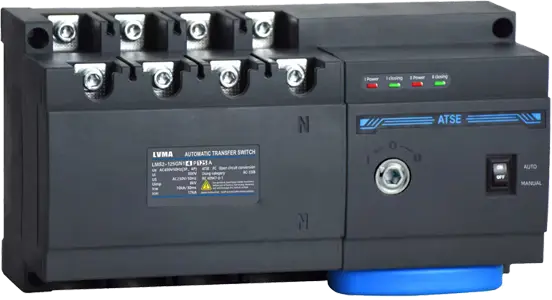
PC-level ATS is defined as a specialized power switching device without overload and short-circuit protection functions, focusing purely on reliable, frequent power source switching. It features a simple and sturdy mechanical structure, strong resistance to inrush current, and extremely high switching stability and durability.
As a professional power-grade switch, PC-level ATS is designed for long-term uninterrupted power supply systems. It can withstand frequent switching operations and instantaneous current impacts during generator and grid switching, with a service life far exceeding CB-level ATS. Since it does not have automatic tripping protection, it will not mis-switch or trip due to instantaneous current fluctuations, ensuring continuous power supply for critical loads.
2. CB-Level Automatic Transfer Switch
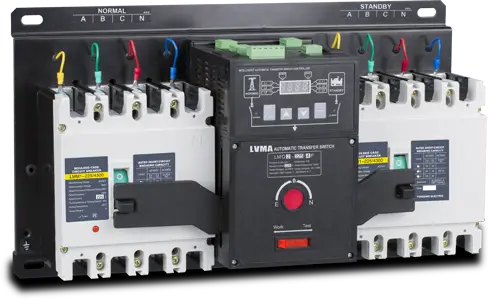
CB-level ATS is an integrated switching device based on circuit breaker components, equipped with complete overload, short-circuit, and overcurrent protection functions. Its core feature is dual functions of power switching and circuit protection in one unit.
Different from PC-level ATS, CB-level ATS adopts circuit breaker mechanical structure, which will automatically trip and cut off the circuit when the load has overload or short-circuit faults to protect electrical equipment. However, its mechanical structure is more delicate, with poor resistance to instantaneous inrush current, and it is not suitable for frequent switching operations, which may cause mechanical wear and failure after long-term use.
Other Classifications
According to installation and current, ATS can also be divided into miniature household ATS, modular industrial ATS, and high-current cabinet-type ATS, covering scenarios from small buildings to large industrial parks.
Key Benefits of Using an Automatic Transfer Switch
1. Zero Manual Operation, Full Automation
ATS works 24/7 unattended. It can respond to power faults instantly even when no staff is on duty, greatly improving the efficiency of emergency power supply and avoiding losses caused by human response delays.
2. Improves Electrical Safety
Manual power switching easily causes backfeeding, short circuits, and electric shock accidents. Standard ATS is equipped with interlock protection to prevent two power sources from connecting at the same time, completely eliminating hidden electrical safety hazards.
3. Reduces Downtime & Economic Losses
For enterprises and public facilities, every minute of power outage means lost revenue and suspended services. Fast ATS switching minimizes power interruption time and protects production, business, and data security.
4. Prolongs Service Life of Backup Equipment
The intelligent delay and reset mechanism of ATS avoids frequent start and stop of generators and UPS, reducing equipment loss and lowering long-term maintenance costs.
Common Applications of Automatic Transfer Switches
ATS is a core supporting device for all uninterrupted power scenarios, widely used in the following fields:
- Data Centers & Server Rooms: Protect network servers, storage devices, and cloud computing systems from power failures to ensure 100% network uptime.
- Medical Institutions: Guarantee continuous power supply for operating rooms, ICU equipment, and emergency medical devices to ensure patient safety.
- Commercial Buildings: Control backup power for fire fighting systems, elevators, emergency lighting, and security monitoring in malls, hotels, and office buildings.
- Industrial Plants: Protect automated production lines, PLC control systems, and precision testing instruments from power fluctuation damage.
- Public Infrastructure: Applied in communication base stations, traffic signal systems, and emergency command centers to maintain normal public service operation.
- Residential High-Rise Buildings: Ensure the normal operation of elevators and fire emergency systems to meet building electrical safety standards.
ATS vs MTS: What Is the Difference?
Many users confuse Automatic Transfer Switch (ATS) with Manual Transfer Switch (MTS). Here is a simple comparison:
ATS (Automatic Transfer Switch): Realizes fully automatic power switching without human operation. Suitable for critical scenarios requiring fast response and uninterrupted power.
MTS (Manual Transfer Switch): Requires manual operation to complete power source switching. It is low-cost but slow in response, only suitable for non-critical backup power scenarios.
FAQs About Automatic Transfer Switch
Q1: Do I need an ATS for my generator?
A: Yes, especially for unattended power supply systems. An ATS allows the generator to start and switch automatically during power outages, which is essential for safe and efficient backup power operation.
Q2: How fast does an ATS switch power?
A: Standard open-transition ATS completes switching in 2–10 seconds. Solenoid-type ATS can realize seamless switching without power-off gaps(20-100ms).
Q3: Can ATS be used for home power backup?
A: Yes. Miniature ATS is widely used for household generator and solar backup power systems, providing automatic power switching for household loads during grid outages.
Conclusion
An Automatic Transfer Switch (ATS) is the core control device of all backup and dual power supply systems. It acts as an intelligent power guard, realizing automatic detection, fast switching, and safe reset of power sources. Whether for industrial production, commercial facilities, or household backup power, ATS effectively improves power supply reliability, reduces safety risks, and avoids economic losses caused by power failures.
If you are building a generator backup system or a dual power supply solution, configuring a high-quality ATS is the most cost-effective investment to ensure long-term stable and safe power operation.
Share This Article
Follow Us
Introduction
Power outages and grid fluctuations are unpredictable. For businesses, data centers, medical facilities, and critical infrastructure, even a one-second power drop can cause costly downtime, data loss, or safety hazards. While backup generators and UPS systems provide standby power, they cannot function effectively without a core control device — an Automatic Transfer Switch (ATS).
An automatic transfer switch is the “brain” of any redundant power system. It monitors power quality 24/7 and switches power sources instantly without manual operation. In this comprehensive guide, we will explain everything about ATS, including its definition, working principle, common types, benefits, and practical applications.
What Is an Automatic Transfer Switch (ATS)?
An Automatic Transfer Switch (ATS) is an electrical device that automatically transfers electrical loads between two independent power sources — typically a utility grid (main power) and a backup power source such as a generator or UPS.
The core purpose of an ATS is to ensure uninterrupted power supply. It continuously monitors the voltage, frequency, and stability of the primary power source. Once it detects a power failure, undervoltage, overvoltage, or phase loss, it automatically shifts the load to the standby power source. When the main grid power is restored, the ATS switches back automatically and returns to standby monitoring mode.
It is important to note that ATS is a mandatory safety component for dual power supply systems. Without an ATS, users must manually connect generators, which causes delayed power recovery and brings serious electrical safety risks.
How Does an Automatic Transfer Switch Work?
The working process of an automatic transfer switch is fully intelligent, stable, and repeatable. It can be divided into four clear stages:
1. Normal Grid Power Mode
Under regular conditions, the utility grid supplies power to all electrical loads. The ATS keeps the main power circuit closed and the standby power circuit open. The backup generator or UPS remains in hot standby mode, ready for emergency activation at any time.
2. Real-Time Fault Detection
The built-in intelligent controller of the ATS monitors power parameters in real time. When the grid experiences a blackout, voltage instability, or frequency deviation, the system immediately confirms a main power fault.
3. Automatic Load Transfer
After fault confirmation, the ATS cuts off the main power circuit first to avoid backfeeding (a critical electrical safety protection). It then closes the standby power circuit to supply power to the load. The entire switching process usually takes 2–10 seconds, fast enough to sustain critical equipment operation.
4. Automatic Recovery & Reset
When the utility grid recovers and runs stably for a preset delay period (usually 3–5 minutes), the ATS automatically transfers the load back to the main power source and shuts down the standby generator, avoiding frequent switching and equipment wear.
Main Types of Automatic Transfer Switches
ATS devices are categorized by electrical grade, structural performance, and application standards in industrial and commercial electrical systems. The most authoritative and industry-standard classification isPC-calss ATS and CB-class ATS, which differ greatly in safety performance, load capacity, and service scenarios. Below is a detailed comparison of the two core types, while other auxiliary classifications are listed at the end.
1. PC-Level Automatic Transfer Switch
PC-level ATS is defined as a specialized power switching device without overload and short-circuit protection functions, focusing purely on reliable, frequent power source switching. It features a simple and sturdy mechanical structure, strong resistance to inrush current, and extremely high switching stability and durability.
As a professional power-grade switch, PC-level ATS is designed for long-term uninterrupted power supply systems. It can withstand frequent switching operations and instantaneous current impacts during generator and grid switching, with a service life far exceeding CB-level ATS. Since it does not have automatic tripping protection, it will not mis-switch or trip due to instantaneous current fluctuations, ensuring continuous power supply for critical loads.
2. CB-Level Automatic Transfer Switch
CB-level ATS is an integrated switching device based on circuit breaker components, equipped with complete overload, short-circuit, and overcurrent protection functions. Its core feature is dual functions of power switching and circuit protection in one unit.
Different from PC-level ATS, CB-level ATS adopts circuit breaker mechanical structure, which will automatically trip and cut off the circuit when the load has overload or short-circuit faults to protect electrical equipment. However, its mechanical structure is more delicate, with poor resistance to instantaneous inrush current, and it is not suitable for frequent switching operations, which may cause mechanical wear and failure after long-term use.
Other Classifications
According to installation and current, ATS can also be divided into miniature household ATS, modular industrial ATS, and high-current cabinet-type ATS, covering scenarios from small buildings to large industrial parks.
Key Benefits of Using an Automatic Transfer Switch
1. Zero Manual Operation, Full Automation
ATS works 24/7 unattended. It can respond to power faults instantly even when no staff is on duty, greatly improving the efficiency of emergency power supply and avoiding losses caused by human response delays.
2. Improves Electrical Safety
Manual power switching easily causes backfeeding, short circuits, and electric shock accidents. Standard ATS is equipped with interlock protection to prevent two power sources from connecting at the same time, completely eliminating hidden electrical safety hazards.
3. Reduces Downtime & Economic Losses
For enterprises and public facilities, every minute of power outage means lost revenue and suspended services. Fast ATS switching minimizes power interruption time and protects production, business, and data security.
4. Prolongs Service Life of Backup Equipment
The intelligent delay and reset mechanism of ATS avoids frequent start and stop of generators and UPS, reducing equipment loss and lowering long-term maintenance costs.
Common Applications of Automatic Transfer Switches
ATS is a core supporting device for all uninterrupted power scenarios, widely used in the following fields:
- Data Centers & Server Rooms: Protect network servers, storage devices, and cloud computing systems from power failures to ensure 100% network uptime.
- Medical Institutions: Guarantee continuous power supply for operating rooms, ICU equipment, and emergency medical devices to ensure patient safety.
- Commercial Buildings: Control backup power for fire fighting systems, elevators, emergency lighting, and security monitoring in malls, hotels, and office buildings.
- Industrial Plants: Protect automated production lines, PLC control systems, and precision testing instruments from power fluctuation damage.
- Public Infrastructure: Applied in communication base stations, traffic signal systems, and emergency command centers to maintain normal public service operation.
- Residential High-Rise Buildings: Ensure the normal operation of elevators and fire emergency systems to meet building electrical safety standards.
ATS vs MTS: What Is the Difference?
Many users confuse Automatic Transfer Switch (ATS) with Manual Transfer Switch (MTS). Here is a simple comparison:
ATS (Automatic Transfer Switch): Realizes fully automatic power switching without human operation. Suitable for critical scenarios requiring fast response and uninterrupted power.
MTS (Manual Transfer Switch): Requires manual operation to complete power source switching. It is low-cost but slow in response, only suitable for non-critical backup power scenarios.
FAQs About Automatic Transfer Switch
Q1: Do I need an ATS for my generator?
A: Yes, especially for unattended power supply systems. An ATS allows the generator to start and switch automatically during power outages, which is essential for safe and efficient backup power operation.
Q2: How fast does an ATS switch power?
A: Standard open-transition ATS completes switching in 2–10 seconds. Solenoid-type ATS can realize seamless switching without power-off gaps(20-100ms).
Q3: Can ATS be used for home power backup?
A: Yes. Miniature ATS is widely used for household generator and solar backup power systems, providing automatic power switching for household loads during grid outages.
Conclusion
An Automatic Transfer Switch (ATS) is the core control device of all backup and dual power supply systems. It acts as an intelligent power guard, realizing automatic detection, fast switching, and safe reset of power sources. Whether for industrial production, commercial facilities, or household backup power, ATS effectively improves power supply reliability, reduces safety risks, and avoids economic losses caused by power failures.
If you are building a generator backup system or a dual power supply solution, configuring a high-quality ATS is the most cost-effective investment to ensure long-term stable and safe power operation.
Contact Us
Related Blog



Contact Us
Have questions about our products or services? Our team is here to help you with any inquiries.