

What is MCB?
What is MCB?
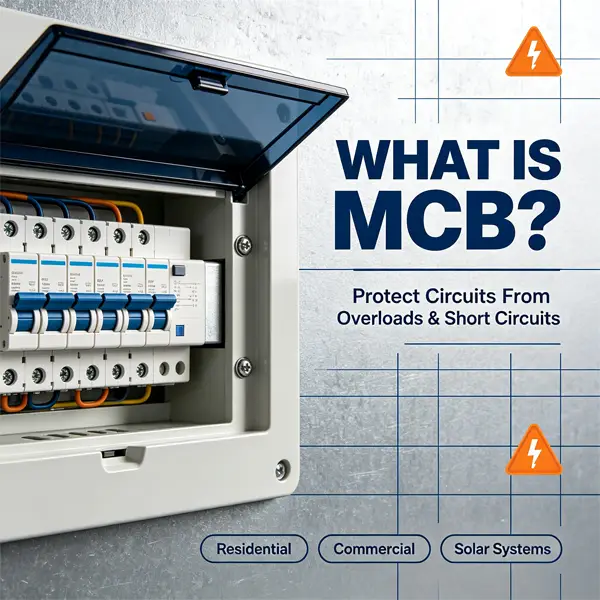
What is MCB? MCB is the short form for Miniature Circuit Breaker, one of the most widely‑used low‑voltage protective devices in modern electrical installations. It automatically cuts off electric current when overload or short‑circuit faults happen, preventing cable burnout, equipment damage and potential fire hazards.
Different from disposable fuses that must be replaced after a fault, MCB can be manually reset once the electrical problem is fixed. This reusable feature makes MCB the standard safety component for homes, offices, retail buildings and small‑scale solar energy projects across global markets.
How Does an MCB Work?
An MCB handles two main electrical risks: overload and short‑circuit.
For overload protection: When too many devices run on one circuit, current exceeds the rated capacity. A bimetallic strip inside the MCB heats up, bends and triggers the trip mechanism to disconnect power slowly. This avoids damage caused by long‑term excess current.
For short‑circuit protection: During a short circuit, huge current surges instantly. The built‑in electromagnetic coil creates a magnetic force to trip the switch within milliseconds. Fast reaction stops severe damage before it spreads to wiring and connected loads.
After tripping, you do not need to change any parts. Simply switch the MCB back to ON position after locating and solving the fault source.
Common MCB Types by Trip Curve
When sourcing circuit breakers, trip curve classification is critical for matching your load conditions. The most popular types include B curve, C curve and D curve MCB.
- B‑curve MCB: Trips at 3‑5 times rated current. Best for resistive loads such as lighting circuits, household sockets. Widely used in residential wiring.
- C‑curve MCB: Trips at 5‑10 times rated current. Suitable for general commercial circuits, small motors, and solar auxiliary circuits. This is the most common MCB type for general‑purpose use.
- D‑curve MCB: Trips at 10‑20 times rated current. Designed for high inrush‑current equipment like large motors, transformers. Mainly applied in light‑industrial locations.
Main Applications of MCB
Miniature circuit breakers can be found in nearly every low‑voltage power distribution scenario:
- Residential distribution boards: Protect lighting, wall sockets and home appliance circuits.
- Commercial buildings: Offices, shops, hotels for power distribution safety.
- Solar PV systems: DC or AC side circuit protection for small‑medium solar and energy‑storage installations.
- Light‑industrial sites: Protect small‑power machinery and control cabinets.
Many customers confuse MCB with MCCB. MCB covers lower current ratings normally up to 63A, while MCCB (Molded Case Circuit Breaker) handles higher current for heavy‑duty power distribution.
MCB vs Fuse: Why Choose MCB?
Lots of old installations use fuses for circuit protection. Here is the core comparison:
- Fuse: One‑time consumable. Melts during fault, needs full replacement. Slow response in some cases.
- MCB: Reusable. Reset after fault diagnosis. Clear visual trip status, faster short‑circuit response. Lower long‑term maintenance cost.
For modern electrical projects, MCB has largely replaced traditional fuses for safety and convenience.
Key Factors to Consider When Buying MCB
Selecting the correct MCB avoids nuisance tripping or insufficient protection. Keep these points in mind:
- Rated current: Match ampere rating to your cable and actual load, do not oversize blindly.
- Trip curve: Pick B / C / D curve according to load types.
- Voltage level: Confirm AC or DC MCB, especially important for solar DC circuits. DC MCB requires special arc‑quenching design.
- Certifications: Choose MCB with international safety certifications to guarantee stable performance.
- Pole number: 1‑pole, 2‑pole, 3‑pole, 4‑pole for single‑phase or three‑phase power networks.
Frequently Asked Questions
Q1: Will MCB stop electric shock?
No. MCB protects against overload and short‑circuit. For human leakage‑shock protection, you need an RCCB or RCBO device combined with MCB.
Q2: Why does my MCB keep tripping?
Frequent tripping usually means circuit overload, hidden short‑circuit fault, or wrong MCB rating. Check connected loads and wiring before resetting repeatedly.
Q3: Can I use AC MCB for DC solar circuits?
Not recommended. AC breakers lack proper DC arc suppression. Using AC‑rated MCB on DC may cause arc‑extinguishing failure and safety risks. Always use dedicated DC MCB for PV loops.
Final Thoughts
MCB is the first‑line safety guard for low‑voltage power systems. Knowing what MCB is, its trip characteristics and application limits helps contractors, installers and bulk buyers make right component choices. Whether you are doing residential wiring, commercial renovation or solar‑storage project procurement, proper MCB selection directly lifts overall electrical safety.
If you are looking for reliable MCB solutions for your projects, feel free to contact our technical team for professional support.
Share This Article
Follow Us
What is MCB? MCB is the short form for Miniature Circuit Breaker, one of the most widely‑used low‑voltage protective devices in modern electrical installations. It automatically cuts off electric current when overload or short‑circuit faults happen, preventing cable burnout, equipment damage and potential fire hazards.
Different from disposable fuses that must be replaced after a fault, MCB can be manually reset once the electrical problem is fixed. This reusable feature makes MCB the standard safety component for homes, offices, retail buildings and small‑scale solar energy projects across global markets.
How Does an MCB Work?
An MCB handles two main electrical risks: overload and short‑circuit.
For overload protection: When too many devices run on one circuit, current exceeds the rated capacity. A bimetallic strip inside the MCB heats up, bends and triggers the trip mechanism to disconnect power slowly. This avoids damage caused by long‑term excess current.
For short‑circuit protection: During a short circuit, huge current surges instantly. The built‑in electromagnetic coil creates a magnetic force to trip the switch within milliseconds. Fast reaction stops severe damage before it spreads to wiring and connected loads.
After tripping, you do not need to change any parts. Simply switch the MCB back to ON position after locating and solving the fault source.
Common MCB Types by Trip Curve
When sourcing circuit breakers, trip curve classification is critical for matching your load conditions. The most popular types include B curve, C curve and D curve MCB.
- B‑curve MCB: Trips at 3‑5 times rated current. Best for resistive loads such as lighting circuits, household sockets. Widely used in residential wiring.
- C‑curve MCB: Trips at 5‑10 times rated current. Suitable for general commercial circuits, small motors, and solar auxiliary circuits. This is the most common MCB type for general‑purpose use.
- D‑curve MCB: Trips at 10‑20 times rated current. Designed for high inrush‑current equipment like large motors, transformers. Mainly applied in light‑industrial locations.
Main Applications of MCB
Miniature circuit breakers can be found in nearly every low‑voltage power distribution scenario:
- Residential distribution boards: Protect lighting, wall sockets and home appliance circuits.
- Commercial buildings: Offices, shops, hotels for power distribution safety.
- Solar PV systems: DC or AC side circuit protection for small‑medium solar and energy‑storage installations.
- Light‑industrial sites: Protect small‑power machinery and control cabinets.
Many customers confuse MCB with MCCB. MCB covers lower current ratings normally up to 63A, while MCCB (Molded Case Circuit Breaker) handles higher current for heavy‑duty power distribution.
MCB vs Fuse: Why Choose MCB?
Lots of old installations use fuses for circuit protection. Here is the core comparison:
- Fuse: One‑time consumable. Melts during fault, needs full replacement. Slow response in some cases.
- MCB: Reusable. Reset after fault diagnosis. Clear visual trip status, faster short‑circuit response. Lower long‑term maintenance cost.
For modern electrical projects, MCB has largely replaced traditional fuses for safety and convenience.
Key Factors to Consider When Buying MCB
Selecting the correct MCB avoids nuisance tripping or insufficient protection. Keep these points in mind:
- Rated current: Match ampere rating to your cable and actual load, do not oversize blindly.
- Trip curve: Pick B / C / D curve according to load types.
- Voltage level: Confirm AC or DC MCB, especially important for solar DC circuits. DC MCB requires special arc‑quenching design.
- Certifications: Choose MCB with international safety certifications to guarantee stable performance.
- Pole number: 1‑pole, 2‑pole, 3‑pole, 4‑pole for single‑phase or three‑phase power networks.
Frequently Asked Questions
Q1: Will MCB stop electric shock?
No. MCB protects against overload and short‑circuit. For human leakage‑shock protection, you need an RCCB or RCBO device combined with MCB.
Q2: Why does my MCB keep tripping?
Frequent tripping usually means circuit overload, hidden short‑circuit fault, or wrong MCB rating. Check connected loads and wiring before resetting repeatedly.
Q3: Can I use AC MCB for DC solar circuits?
Not recommended. AC breakers lack proper DC arc suppression. Using AC‑rated MCB on DC may cause arc‑extinguishing failure and safety risks. Always use dedicated DC MCB for PV loops.
Final Thoughts
MCB is the first‑line safety guard for low‑voltage power systems. Knowing what MCB is, its trip characteristics and application limits helps contractors, installers and bulk buyers make right component choices. Whether you are doing residential wiring, commercial renovation or solar‑storage project procurement, proper MCB selection directly lifts overall electrical safety.
If you are looking for reliable MCB solutions for your projects, feel free to contact our technical team for professional support.
Contact Us
Related Blog





Contact Us
Have questions about our products or services? Our team is here to help you with any inquiries.