

What Is an RCBO?
What Is an RCBO?
Introduction
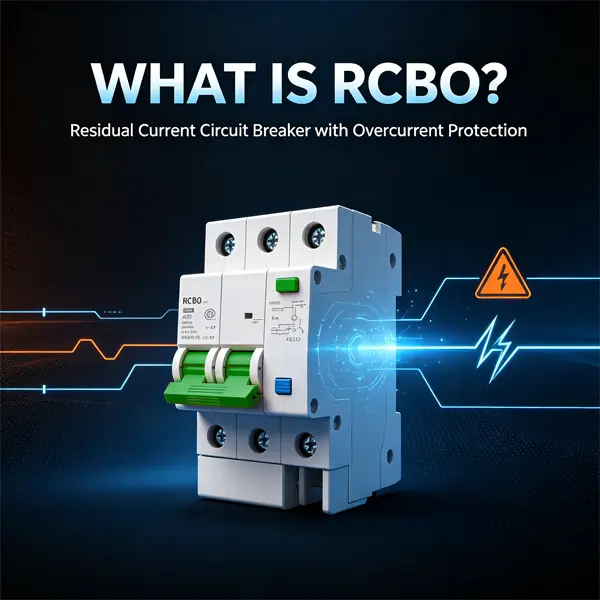
Electrical safety is non‑negotiable for residential buildings, commercial facilities and renewable‑energy installations. Many property owners, electricians and panel builders confuse common protective devices such as MCB and RCD. An RCBO (Residual Current Circuit‑Breaker with Overcurrent Protection) delivers combined circuit and human safety inside one compact DIN‑rail module.
Unlike separate MCB plus RCD setups, an RCBO safeguards against three major electrical hazards: earth leakage (electric shock risk), circuit overload and short‑circuit faults. This article explains RCBO basics, operating logic, core benefits, comparisons, typical use‑cases and practical selection tips for your next electrical project.
What Exactly Is an RCBO?
RCBO stands for Residual Current Operated Circuit‑Breaker with integral Overcurrent Protection, defined under IEC 61009‑1 international standard. It merges two independent protection functions previously handled by separate components:
- Residual current / earth‑leakage protection (RCD function): detects current leakage caused by damaged cables, wet environments or accidental live‑part contact, preventing electric shock and fire risks.
- Overcurrent protection (MCB function): trips during sustained overload or sudden short‑circuit faults to protect wiring and connected equipment from burning out.
In short: one single RCBO provides full‑scope protection for an individual final circuit. When a fault arises, only the affected circuit trips, instead of cutting power to an entire building or multiple circuits at once.
How Does an RCBO Work?
Inside each RCBO unit sit two separate detection mechanisms running simultaneously:
1. Residual Current Detection
A toroidal current transformer continuously measures current flowing through live and neutral wires. Under normal working conditions, incoming and returning current values balance each other. When electricity leaks to earth (residual current appears), an imbalance is detected. If leakage exceeds the rated sensitivity (commonly 30 mA for human‑shock protection), the mechanism instantly triggers tripping to cut power within milliseconds.
2. Overcurrent Detection
- Overload protection: A thermal bimetallic strip slowly deforms under continuous excess current and trips the breaker with time delay. It prevents cable overheating when too many loads run on one circuit.
- Short‑circuit protection: A magnetic solenoid reacts immediately to huge fault current spikes and opens contacts in fractions of a second, avoiding arc damage and fire hazards.
Important note: RCBO still requires proper earthing connection to deliver reliable earth‑fault protection performance.
RCBO vs MCB vs RCD: Key Differences
Many installers struggle to pick the correct device. Below is a simple practical comparison:
| Device | Earth‑leakage / shock protection | Overload & short‑circuit protection | Typical working scenario |
|---|---|---|---|
| MCB | ❌ No | ✅ Yes | Defends wiring against overcurrent only; cannot detect electric‑shock leakage |
| RCD / RCCB | ✅ Yes | ❌ No | Guards against shock and leakage; offers zero protection for overload or short‑circuit damage |
| RCBO | ✅ Yes | ✅ Yes | Full dual protection for each single circuit; fault isolation per‑circuit |
Traditional installation often fits one main RCD feeding multiple MCBs. The weakness: one leakage fault trips all connected circuits, causing widespread blackouts (nuisance tripping). Using RCBO for each branch circuit eliminates this problem effectively.
Main Benefits of Installing RCBO
- All‑in‑one comprehensive safety: Human shock prevention plus circuit fire protection within one unit.
- Circuit‑level fault isolation: Only the faulty circuit disconnects; other lights and sockets keep running, improving site safety and operational continuity.
- Space‑saving for distribution boards: Replaces two separate devices, saving precious DIN‑rail space in compact consumer units.
- Simpler installation & troubleshooting: Less wiring work; technicians can quickly locate which branch triggered the trip.
- Compliance with modern wiring codes: Widely specified for new‑build housing, renovation projects and solar‑energy related circuits across most global markets.
Common RCBO Applications
RCBO devices are widely deployed wherever high‑level circuit safety is required:
- Residential: Bathroom sockets, kitchen circuits, outdoor garden outlets, garage power points, and PV‑related AC side circuits for rooftop solar systems.
- Commercial: Offices, retail stores, hotel guest rooms, public‑area socket circuits.
- Light‑industrial: Workshop power sockets, small machinery supply circuits.
- Renewable energy projects: Off‑grid and grid‑tie solar installations, battery energy‑storage auxiliary circuits.
Circuits exposed to moisture or accessible to human contact are the top priority locations for RCBO upgrade.
Quick RCBO Selection Tips
When you source RCBO products, check these core parameters before ordering:
- Rated current (In): Match circuit design load: 10A,16A,20A,25A,32A,40A,63A are popular ratings.
- Residual operating current: 30 mA for personal‑shock protection; higher values (100mA / 300mA) for fire‑protection‑only purposes.
- Type classification: Type AC, Type A or Type B, according whether circuits contain DC residual current (critical for solar and inverter‑fed circuits).
- Breaking capacity: Select 6kA or higher breaking capacity for reliable short‑circuit fault clearance.
- Standard certification: Confirm compliance with IEC 61009‑1 for international projects.
Frequently Asked Questions
Q1: Can I replace MCB directly with RCBO?
A: Yes, on most single‑branch circuits. Confirm distribution board DIN‑rail space, current rating and residual‑current type before replacement.
Q2: Is RCBO better than RCD plus MCB combination?
A: For per‑circuit protection, RCBO performs better for fault selectivity and reduces nuisance tripping. RCD+MCB combination remains acceptable for cost‑sensitive multi‑circuit group protection.
Q3: Does RCBO work without earth wire?
A: No. Reliable earth connection is essential for correct residual‑fault detection of RCBO devices.
Conclusion
An RCBO represents a modern upgrade in low‑voltage distribution safety. By combining residual‑current and overcurrent protection, it defends people from electric shock while protecting cables and equipment against overload and short‑circuit damage. For new installations, renovation work and solar‑energy projects, specifying RCBO for high‑risk final circuits reduces safety risks and improves whole‑system reliability.
If you are sourcing electrical protective components for residential or commercial projects, always verify ratings, type classification and international certification to match local wiring requirements.
Share This Article
Follow Us
Introduction
Electrical safety is non‑negotiable for residential buildings, commercial facilities and renewable‑energy installations. Many property owners, electricians and panel builders confuse common protective devices such as MCB and RCD. An RCBO (Residual Current Circuit‑Breaker with Overcurrent Protection) delivers combined circuit and human safety inside one compact DIN‑rail module.
Unlike separate MCB plus RCD setups, an RCBO safeguards against three major electrical hazards: earth leakage (electric shock risk), circuit overload and short‑circuit faults. This article explains RCBO basics, operating logic, core benefits, comparisons, typical use‑cases and practical selection tips for your next electrical project.
What Exactly Is an RCBO?
RCBO stands for Residual Current Operated Circuit‑Breaker with integral Overcurrent Protection, defined under IEC 61009‑1 international standard. It merges two independent protection functions previously handled by separate components:
- Residual current / earth‑leakage protection (RCD function): detects current leakage caused by damaged cables, wet environments or accidental live‑part contact, preventing electric shock and fire risks.
- Overcurrent protection (MCB function): trips during sustained overload or sudden short‑circuit faults to protect wiring and connected equipment from burning out.
In short: one single RCBO provides full‑scope protection for an individual final circuit. When a fault arises, only the affected circuit trips, instead of cutting power to an entire building or multiple circuits at once.
How Does an RCBO Work?
Inside each RCBO unit sit two separate detection mechanisms running simultaneously:
1. Residual Current Detection
A toroidal current transformer continuously measures current flowing through live and neutral wires. Under normal working conditions, incoming and returning current values balance each other. When electricity leaks to earth (residual current appears), an imbalance is detected. If leakage exceeds the rated sensitivity (commonly 30 mA for human‑shock protection), the mechanism instantly triggers tripping to cut power within milliseconds.
2. Overcurrent Detection
- Overload protection: A thermal bimetallic strip slowly deforms under continuous excess current and trips the breaker with time delay. It prevents cable overheating when too many loads run on one circuit.
- Short‑circuit protection: A magnetic solenoid reacts immediately to huge fault current spikes and opens contacts in fractions of a second, avoiding arc damage and fire hazards.
Important note: RCBO still requires proper earthing connection to deliver reliable earth‑fault protection performance.
RCBO vs MCB vs RCD: Key Differences
Many installers struggle to pick the correct device. Below is a simple practical comparison:
| Device | Earth‑leakage / shock protection | Overload & short‑circuit protection | Typical working scenario |
|---|---|---|---|
| MCB | ❌ No | ✅ Yes | Defends wiring against overcurrent only; cannot detect electric‑shock leakage |
| RCD / RCCB | ✅ Yes | ❌ No | Guards against shock and leakage; offers zero protection for overload or short‑circuit damage |
| RCBO | ✅ Yes | ✅ Yes | Full dual protection for each single circuit; fault isolation per‑circuit |
Traditional installation often fits one main RCD feeding multiple MCBs. The weakness: one leakage fault trips all connected circuits, causing widespread blackouts (nuisance tripping). Using RCBO for each branch circuit eliminates this problem effectively.
Main Benefits of Installing RCBO
- All‑in‑one comprehensive safety: Human shock prevention plus circuit fire protection within one unit.
- Circuit‑level fault isolation: Only the faulty circuit disconnects; other lights and sockets keep running, improving site safety and operational continuity.
- Space‑saving for distribution boards: Replaces two separate devices, saving precious DIN‑rail space in compact consumer units.
- Simpler installation & troubleshooting: Less wiring work; technicians can quickly locate which branch triggered the trip.
- Compliance with modern wiring codes: Widely specified for new‑build housing, renovation projects and solar‑energy related circuits across most global markets.
Common RCBO Applications
RCBO devices are widely deployed wherever high‑level circuit safety is required:
- Residential: Bathroom sockets, kitchen circuits, outdoor garden outlets, garage power points, and PV‑related AC side circuits for rooftop solar systems.
- Commercial: Offices, retail stores, hotel guest rooms, public‑area socket circuits.
- Light‑industrial: Workshop power sockets, small machinery supply circuits.
- Renewable energy projects: Off‑grid and grid‑tie solar installations, battery energy‑storage auxiliary circuits.
Circuits exposed to moisture or accessible to human contact are the top priority locations for RCBO upgrade.
Quick RCBO Selection Tips
When you source RCBO products, check these core parameters before ordering:
- Rated current (In): Match circuit design load: 10A,16A,20A,25A,32A,40A,63A are popular ratings.
- Residual operating current: 30 mA for personal‑shock protection; higher values (100mA / 300mA) for fire‑protection‑only purposes.
- Type classification: Type AC, Type A or Type B, according whether circuits contain DC residual current (critical for solar and inverter‑fed circuits).
- Breaking capacity: Select 6kA or higher breaking capacity for reliable short‑circuit fault clearance.
- Standard certification: Confirm compliance with IEC 61009‑1 for international projects.
Frequently Asked Questions
Q1: Can I replace MCB directly with RCBO?
A: Yes, on most single‑branch circuits. Confirm distribution board DIN‑rail space, current rating and residual‑current type before replacement.
Q2: Is RCBO better than RCD plus MCB combination?
A: For per‑circuit protection, RCBO performs better for fault selectivity and reduces nuisance tripping. RCD+MCB combination remains acceptable for cost‑sensitive multi‑circuit group protection.
Q3: Does RCBO work without earth wire?
A: No. Reliable earth connection is essential for correct residual‑fault detection of RCBO devices.
Conclusion
An RCBO represents a modern upgrade in low‑voltage distribution safety. By combining residual‑current and overcurrent protection, it defends people from electric shock while protecting cables and equipment against overload and short‑circuit damage. For new installations, renovation work and solar‑energy projects, specifying RCBO for high‑risk final circuits reduces safety risks and improves whole‑system reliability.
If you are sourcing electrical protective components for residential or commercial projects, always verify ratings, type classification and international certification to match local wiring requirements.
Contact Us
Related Blog




Contact Us
Have questions about our products or services? Our team is here to help you with any inquiries.