

What Is a PV Grid-Tied Distribution Box?
What Is a PV Grid-Tied Distribution Box?
Introduction
When a rooftop or commercial solar system generates clean electricity, that power must safely and legally connect to the public utility grid. The component that makes this connection possible — and compliant — is the PV grid-tied distribution box (also called a grid-connection box or PV AC combiner box).
Installed on the AC side of the solar inverter, between the inverter output and the utility mains, the grid-tied box serves as the critical interface for protection, metering, isolation, and grid-code compliance.
In this guide, we break down what it does, what is inside, how it differs from a DC combiner box, and how to select the right one for your project.
1. Core Functions of a PV Grid-Tied Distribution Box
A properly designed grid-tied box performs five essential jobs:
1.1 Grid Connection & Protection
It carries the AC output from the inverter to the grid while providing overload, short-circuit, and over/under-voltage protection. In the event of a grid fault, the box disconnects the solar system to protect both utility workers and on-site equipment.
1.2 Electrical Isolation
A built-in visible-break isolator switch allows installers and maintenance teams to physically disconnect the PV system from the grid before servicing — a mandatory safety requirement in most national grid codes.
1.3 Energy Metering
The box provides a dedicated, sealed compartment for a bidirectional smart meter that records:
- Self-consumed solar energy
- Exported (feed-in) energy
- Imported grid energy
Many utilities require a lead-seal, tamper-proof metering chamber to prevent unauthorized access.
1.4 Surge & Lightning Protection
An integrated AC surge protective device (SPD) absorbs transient voltage spikes caused by lightning or grid switching, safeguarding the inverter and downstream loads.
1.5 Grid-Code Compliance
The box is engineered to meet local utility interconnection standards, including anti-islanding protection interfaces, RS485/Modbus communication, and automatic reclosure options where required.
2. Typical Internal Components
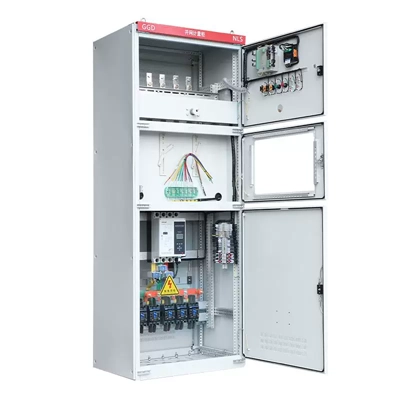
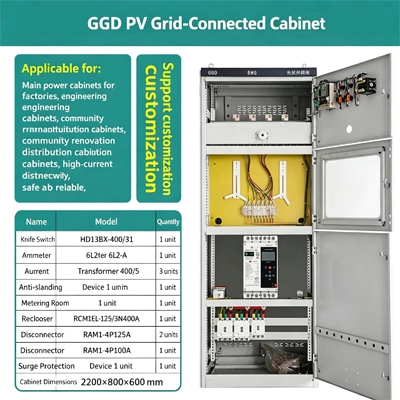
| Component | Function |
|---|---|
| AC circuit breaker (grid-tie type) | Overload & short-circuit protection, manual disconnection |
| Visible-break isolator | Safe physical isolation during maintenance |
| AC surge protector (Type 2 SPD) | Lightning & transient overvoltage protection |
| Bidirectional energy meter | Measures import/export energy |
| Terminal blocks & busbars | Reliable cable termination |
| PE/N grounding bars | Protective earthing and neutral distribution |
| Optional: over/under-voltage reclosure | Automatic recovery after grid voltage normalization |
| Optional: RS485 / smart meter module | Remote monitoring and data acquisition |
3. Grid-Tied Box vs. DC Combiner Box — What’s the Difference?
This is one of the most common questions we receive from overseas buyers. The two boxes sit at opposite ends of the solar system and handle completely different electrical conditions.
| Parameter | PV Grid-Tied Distribution Box | DC Combiner Box |
|---|---|---|
| Location | After the inverter — AC side | After the PV modules — DC side |
| Voltage type | AC 230V / 400V | DC 1000V / 1500V |
| Primary task | Grid interface, metering, AC protection | Combine multiple PV strings into one DC output |
| Key devices | AC breaker, bidirectional meter, AC-SPD | DC fuses, DC breaker, DC-SPD |
| Typical current | 16A – 630A (AC) | 10A – 630A (DC) |
System flow: PV Modules → DC Combiner Box → Inverter (DC→AC) → Grid-Tied Distribution Box → Utility Grid
4. How to Select the Right Grid-Tied Box
When specifying a grid-tied distribution box for your project, consider the following:
4.1 System Voltage & Phase
- Single-phase systems: 230V AC (residential rooftop)
- Three-phase systems: 400V AC (commercial & industrial)
4.2 Inverter Output Current
Size the AC breaker and busbars to handle at least 125% of the inverter’s rated output current to account for harmonic distortion and ambient temperature derating.
4.3 Environmental Rating
Outdoor installations require IP54 – IP65 enclosures. Stainless steel (304/316) or powder-coated cold-rolled steel is recommended for coastal or corrosive environments.
4.4 Local Grid Code Requirements
Different markets have different interconnection standards. Always confirm:
- Metering compartment sealing requirements
- Anti-islanding and reclosure specifications
- Communication protocol (Modbus RTU / TCP)
- Certification (CE, IEC 61439, TÜV, etc.)
5. Why LVMA Grid-Tied Distribution Boxes Stand Out
5.1 Engineered for Global Markets
LVMA grid-tied boxes are designed to meet IEC 61439 and regional utility standards across Africa, the Middle East, Southeast Asia, and Europe. Every unit is factory-tested before shipment.
5.2 Customizable Configurations
Whether you need a compact single-phase residential unit or a three-phase 630A commercial enclosure, LVMA offers:
- Custom current ratings (16A – 630A)
- Optional reclosure, SPD type, and smart metering
- Brand-neutral meter compartments compatible with local utility meters
- Custom labeling and silk-screening for OEM/ODM partners
5.3 Built for Harsh Environments
IP65-rated stainless steel enclosures with UV-resistant gaskets ensure reliable operation in desert heat, coastal humidity, and tropical rainfall — ideal for the markets we serve.
5.4 Competitive Lead Times & Export Support
With dedicated export packaging, multilingual technical documentation, and flexible MOQ, LVMA supports distributors, EPC contractors, and solar installers worldwide.
6. Custom Solutions for Your Project
Every solar project is unique. LVMA’s engineering team works directly with you to design grid-tied distribution boxes that match your:
- Inverter specifications
- Local utility interconnection rules
- Installation environment (indoor / outdoor / coastal)
- Branding and packaging requirements
Contact our technical sales team with your project datasheet, and we will return a customized proposal within 24 hours.
FAQ
Q1: Can a grid-tied distribution box be used for off-grid systems?
No. A grid-tied box is specifically designed for connection to the public utility grid and includes metering and grid-protection features. Off-grid systems use a different type of AC distribution panel connected to battery inverters.
Q2: What is the difference between a grid-tied box and a normal distribution box?
A standard distribution box only distributes power to loads. A PV grid-tied box includes specialized features such as a sealed bidirectional metering compartment, grid-side protection, anti-islanding interfaces, and compliance with utility interconnection standards.
Q3: Do I need an SPD in the grid-tied box if the inverter already has one?
Yes. The inverter’s internal SPD protects the inverter itself, but an external AC-SPD in the grid-tied box provides a second line of defense for the entire AC side, especially in lightning-prone regions. Best practice is to install SPDs at both the DC and AC sides.
Q4: What IP rating do I need for outdoor installation?
For outdoor wall-mounted installations, IP54 is the minimum, and IP65 is recommended for exposed locations or areas with heavy rain, dust, or coastal salt spray.
Q5: Can LVMA provide boxes that accept our local utility’s meter?
Yes. LVMA grid-tied boxes feature a brand-neutral, dimension-adjustable metering compartment. Provide your utility meter’s dimensions and wiring diagram, and we will customize the box accordingly.
Conclusion
The PV grid-tied distribution box is far more than a simple enclosure — it is the safety, metering, and compliance gateway between your solar installation and the public grid. Selecting a well-engineered, code-compliant box protects your investment, ensures utility approval, and reduces long-term maintenance risk.
LVMA manufactures and exports reliable, customizable grid-tied distribution boxes for residential, commercial, and utility-scale solar projects worldwide. Request a quote today and let our engineering team support your next project.
LVMA Electric — Your Trusted Partner in Low-Voltage Power Distribution & Solar Electrical Solutions.
Share This Article
Follow Us
Introduction
When a rooftop or commercial solar system generates clean electricity, that power must safely and legally connect to the public utility grid. The component that makes this connection possible — and compliant — is the PV grid-tied distribution box (also called a grid-connection box or PV AC combiner box).
Installed on the AC side of the solar inverter, between the inverter output and the utility mains, the grid-tied box serves as the critical interface for protection, metering, isolation, and grid-code compliance.
In this guide, we break down what it does, what is inside, how it differs from a DC combiner box, and how to select the right one for your project.
1. Core Functions of a PV Grid-Tied Distribution Box
A properly designed grid-tied box performs five essential jobs:
1.1 Grid Connection & Protection
It carries the AC output from the inverter to the grid while providing overload, short-circuit, and over/under-voltage protection. In the event of a grid fault, the box disconnects the solar system to protect both utility workers and on-site equipment.
1.2 Electrical Isolation
A built-in visible-break isolator switch allows installers and maintenance teams to physically disconnect the PV system from the grid before servicing — a mandatory safety requirement in most national grid codes.
1.3 Energy Metering
The box provides a dedicated, sealed compartment for a bidirectional smart meter that records:
- Self-consumed solar energy
- Exported (feed-in) energy
- Imported grid energy
Many utilities require a lead-seal, tamper-proof metering chamber to prevent unauthorized access.
1.4 Surge & Lightning Protection
An integrated AC surge protective device (SPD) absorbs transient voltage spikes caused by lightning or grid switching, safeguarding the inverter and downstream loads.
1.5 Grid-Code Compliance
The box is engineered to meet local utility interconnection standards, including anti-islanding protection interfaces, RS485/Modbus communication, and automatic reclosure options where required.
2. Typical Internal Components
| Component | Function |
|---|---|
| AC circuit breaker (grid-tie type) | Overload & short-circuit protection, manual disconnection |
| Visible-break isolator | Safe physical isolation during maintenance |
| AC surge protector (Type 2 SPD) | Lightning & transient overvoltage protection |
| Bidirectional energy meter | Measures import/export energy |
| Terminal blocks & busbars | Reliable cable termination |
| PE/N grounding bars | Protective earthing and neutral distribution |
| Optional: over/under-voltage reclosure | Automatic recovery after grid voltage normalization |
| Optional: RS485 / smart meter module | Remote monitoring and data acquisition |
3. Grid-Tied Box vs. DC Combiner Box — What’s the Difference?
This is one of the most common questions we receive from overseas buyers. The two boxes sit at opposite ends of the solar system and handle completely different electrical conditions.
| Parameter | PV Grid-Tied Distribution Box | DC Combiner Box |
|---|---|---|
| Location | After the inverter — AC side | After the PV modules — DC side |
| Voltage type | AC 230V / 400V | DC 1000V / 1500V |
| Primary task | Grid interface, metering, AC protection | Combine multiple PV strings into one DC output |
| Key devices | AC breaker, bidirectional meter, AC-SPD | DC fuses, DC breaker, DC-SPD |
| Typical current | 16A – 630A (AC) | 10A – 630A (DC) |
System flow: PV Modules → DC Combiner Box → Inverter (DC→AC) → Grid-Tied Distribution Box → Utility Grid
4. How to Select the Right Grid-Tied Box
When specifying a grid-tied distribution box for your project, consider the following:
4.1 System Voltage & Phase
- Single-phase systems: 230V AC (residential rooftop)
- Three-phase systems: 400V AC (commercial & industrial)
4.2 Inverter Output Current
Size the AC breaker and busbars to handle at least 125% of the inverter’s rated output current to account for harmonic distortion and ambient temperature derating.
4.3 Environmental Rating
Outdoor installations require IP54 – IP65 enclosures. Stainless steel (304/316) or powder-coated cold-rolled steel is recommended for coastal or corrosive environments.
4.4 Local Grid Code Requirements
Different markets have different interconnection standards. Always confirm:
- Metering compartment sealing requirements
- Anti-islanding and reclosure specifications
- Communication protocol (Modbus RTU / TCP)
- Certification (CE, IEC 61439, TÜV, etc.)
5. Why LVMA Grid-Tied Distribution Boxes Stand Out
5.1 Engineered for Global Markets
LVMA grid-tied boxes are designed to meet IEC 61439 and regional utility standards across Africa, the Middle East, Southeast Asia, and Europe. Every unit is factory-tested before shipment.
5.2 Customizable Configurations
Whether you need a compact single-phase residential unit or a three-phase 630A commercial enclosure, LVMA offers:
- Custom current ratings (16A – 630A)
- Optional reclosure, SPD type, and smart metering
- Brand-neutral meter compartments compatible with local utility meters
- Custom labeling and silk-screening for OEM/ODM partners
5.3 Built for Harsh Environments
IP65-rated stainless steel enclosures with UV-resistant gaskets ensure reliable operation in desert heat, coastal humidity, and tropical rainfall — ideal for the markets we serve.
5.4 Competitive Lead Times & Export Support
With dedicated export packaging, multilingual technical documentation, and flexible MOQ, LVMA supports distributors, EPC contractors, and solar installers worldwide.
6. Custom Solutions for Your Project
Every solar project is unique. LVMA’s engineering team works directly with you to design grid-tied distribution boxes that match your:
- Inverter specifications
- Local utility interconnection rules
- Installation environment (indoor / outdoor / coastal)
- Branding and packaging requirements
Contact our technical sales team with your project datasheet, and we will return a customized proposal within 24 hours.
FAQ
Q1: Can a grid-tied distribution box be used for off-grid systems?
No. A grid-tied box is specifically designed for connection to the public utility grid and includes metering and grid-protection features. Off-grid systems use a different type of AC distribution panel connected to battery inverters.
Q2: What is the difference between a grid-tied box and a normal distribution box?
A standard distribution box only distributes power to loads. A PV grid-tied box includes specialized features such as a sealed bidirectional metering compartment, grid-side protection, anti-islanding interfaces, and compliance with utility interconnection standards.
Q3: Do I need an SPD in the grid-tied box if the inverter already has one?
Yes. The inverter’s internal SPD protects the inverter itself, but an external AC-SPD in the grid-tied box provides a second line of defense for the entire AC side, especially in lightning-prone regions. Best practice is to install SPDs at both the DC and AC sides.
Q4: What IP rating do I need for outdoor installation?
For outdoor wall-mounted installations, IP54 is the minimum, and IP65 is recommended for exposed locations or areas with heavy rain, dust, or coastal salt spray.
Q5: Can LVMA provide boxes that accept our local utility’s meter?
Yes. LVMA grid-tied boxes feature a brand-neutral, dimension-adjustable metering compartment. Provide your utility meter’s dimensions and wiring diagram, and we will customize the box accordingly.
Conclusion
The PV grid-tied distribution box is far more than a simple enclosure — it is the safety, metering, and compliance gateway between your solar installation and the public grid. Selecting a well-engineered, code-compliant box protects your investment, ensures utility approval, and reduces long-term maintenance risk.
LVMA manufactures and exports reliable, customizable grid-tied distribution boxes for residential, commercial, and utility-scale solar projects worldwide. Request a quote today and let our engineering team support your next project.
LVMA Electric — Your Trusted Partner in Low-Voltage Power Distribution & Solar Electrical Solutions.
Contact Us
Related Blog

Contact Us
Have questions about our products or services? Our team is here to help you with any inquiries.