

Solenoid ATS VS Motorized ATS: Advantages & Application Scenarios
Solenoid ATS VS Motorized ATS: Advantages & Application Scenarios
In low-voltage power distribution systems, Automatic Transfer Switches (ATS) play a core role in ensuring uninterrupted power supply by switching between utility power and standby generator power. When selecting a dual power ATS for industrial, commercial, and residential projects, users often struggle with two mainstream types: solenoid ATS and motorized ATS.
Although both devices realize automatic dual power conversion, they differ drastically in driving structure, switching speed, service life, operating cost, and applicable scenarios.
1. What Is a Solenoid ATS?
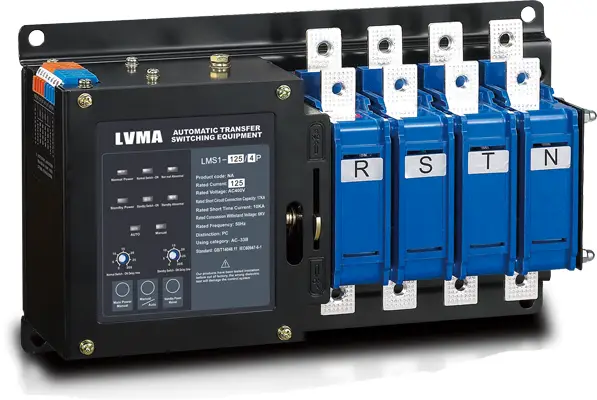
A solenoid automatic transfer switch adopts an electromagnetic drive structure. It relies on the instantaneous electromagnetic suction generated by the solenoid coil to drive the mechanical transmission mechanism, completing the power switching action between the main power and standby power in a very short time. It is a typical instantaneous action dual power switch without continuous power consumption during standby.
The working logic is simple and efficient: when the main power fails (power loss, overvoltage, undervoltage, phase loss), the controller instantly triggers the solenoid coil to energize, generates strong electromagnetic force to push the switch contact to switch to the standby power circuit; after the main power is restored, the solenoid acts again to switch back to the main power supply.
2. What Is a Motorized ATS?
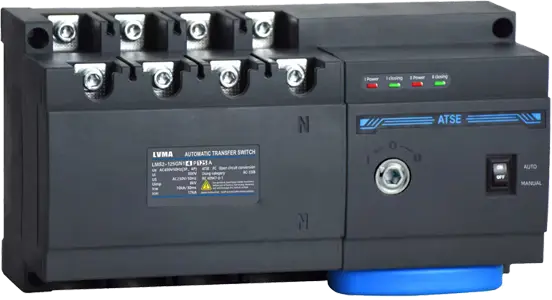
A motorized ATS is driven by a small servo motor and gear reduction mechanism. It uses motor rotation to drive the mechanical linkage system to realize the opening and closing of power contacts. The whole switching process is a stable, continuous mechanical action with controllable speed and uniform force.
During operation, the motor receives the control signal from the ATS controller, rotates forward or reversely to drive the switch body to complete power switching, and the motor stops automatically after the action is in place. It maintains a stable locking state after switching, with excellent mechanical stability.
2. Core Differences Between Solenoid ATS and Motorized ATS
To help you intuitively distinguish the two ATS types, we summarize their key differences in driving mode, switching performance, durability, and cost as follows:
2.1 Driving Structure & Working Mechanism
Solenoid ATS: Driven by electromagnetic coil instantaneous suction, the action is instantaneous and explosive. The structure is simple with fewer mechanical parts, no complex gear transmission, and low failure rate of mechanical jamming.
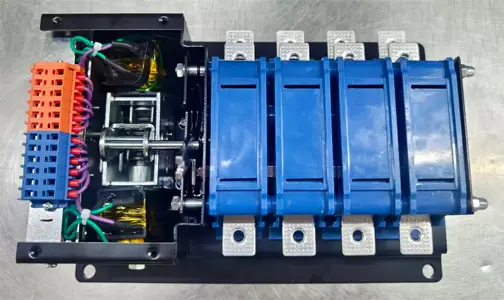
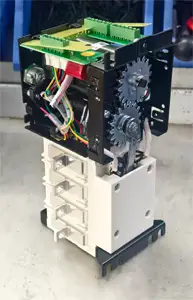
Motorized ATS: Driven by motor + gear set transmission, the action process is slow and stable. The mechanical structure is precise with more matching parts, realizing buffered and stable switching action.
2.2 Switching Speed
Solenoid ATS: Extremely fast switching speed, usually 0.1~0.3 seconds. It can complete power conversion in an instant, which is suitable for loads with extremely high requirements for power supply continuity and no tolerance for power-off delay.
Motorized ATS: Relatively slow switching speed, generally 1~3 seconds. The switching process is stable and without impact, which will not cause current impact on precision electrical equipment.
2.3 Service Life & Mechanical Stability
Solenoid ATS: Due to instantaneous strong impact during each switching, the mechanical contacts and transmission parts wear relatively fast. The mechanical service life is about 5,000 to 10,000 times, suitable for scenarios with low frequent switching.
Motorized ATS: The motor drives smooth transmission with no impact force, uniform contact closing pressure, and minimal wear of internal parts. The mechanical service life can reach 30,000 to 50,000 times, with ultra-high stability and durability, suitable for long-term frequent operation.
2.4 Power Consumption & Safety
Solenoid ATS: The coil only consumes power instantaneously during switching, with almost no standby power consumption. However, the instantaneous current is large during action, and strong electromagnetic impact will be generated.
Motorized ATS: The motor only works during switching and has no power consumption in standby state. The whole operation process is safe and stable, no electromagnetic interference, and will not affect surrounding precision electronic equipment.
2.5 Cost & Maintenance
Solenoid ATS: Simple structure, low manufacturing cost, affordable price, and convenient later maintenance with almost no daily maintenance required.
Motorized ATS: Complex precision mechanical structure, high production process requirements, higher overall cost, and regular inspection of motor and gear wear is needed in later maintenance.
3. Unique Advantages of Each ATS Type
3.1 Advantages of Solenoid ATS
- Ultra-fast switching: Effectively avoid equipment shutdown and data loss caused by short power interruption
- Simple and reliable structure: Few vulnerable parts, low failure rate, strong environmental adaptability
- Energy-saving and efficient: No standby power consumption, low operating cost
- Cost-effective: Lower purchase cost, suitable for budget-limited projects
<h3″>3.2 Advantages of Motorized ATS
- Smooth and impact-free switching: Protect precision instruments and industrial equipment from current impact damage
- Super long service life: Suitable for frequent power switching scenarios and long-term continuous operation
- High operational stability: Precise mechanical locking, no contact loosening or virtual connection
- Low electromagnetic interference: Friendly to medical, communication, and laboratory precision power supply environments
4. Applicable Scenarios: How to Choose?
4.1 Choose Solenoid ATS for These Scenarios
Solenoid ATS is the preferred choice for scenarios requiring rapid power recovery and low switching frequency:
- Emergency lighting, fire protection power supply of commercial buildings
- Ordinary residential community dual power distribution system
- Small and medium-sized generator supporting power switching
- Scenarios with low switching frequency and strict budget control
4.2 Choose Motorized ATS for These Scenarios
Motorized ATS is more suitable for high-standard, high-frequency, and high-precision power supply scenarios:
- Hospital operating rooms, ICU, and medical precision equipment power supply
- Data center, communication base station uninterrupted power system
- Industrial production lines, automated equipment that runs continuously all year round
- Solar energy storage and micro-grid systems with frequent power switching
- Laboratory, instrument and meter precision power distribution scenarios
5. Frequently Asked Questions (FAQ)
Q1: Which is better, solenoid ATS or motorized ATS?
There is no absolute good or bad, only suitability. Solenoid ATS is suitable for conventional emergency power supply scenarios that need fast switching and cost control; motorized ATS is better for high-precision, high-frequency, and long-term continuous operation scenarios with higher stability requirements.
Q2: Does fast switching of solenoid ATS damage electrical equipment?
The instantaneous electromagnetic impact of solenoid ATS is negligible for conventional power equipment such as fire protection, lighting, and ordinary power distribution. But for precision instruments and sensitive electronic equipment, the slight current impact may cause interference, so motorized ATS is recommended.
Q3: Is motorized ATS more durable than solenoid ATS?
Yes. The motorized ATS adopts buffered mechanical switching without impact wear, and its service life is 3-5 times that of solenoid ATS. It is more suitable for projects that require frequent power switching and long-term stable operation.
Q4: Can solenoid ATS be used for solar storage systems?
It can be used for small solar storage systems with low switching frequency. For large industrial energy storage and micro-grid systems with frequent power switching, motorized ATS is more recommended to extend equipment service life.
6. Conclusion
Solenoid ATS and motorized ATS are two essential types of dual power automatic transfer switches in low-voltage distribution systems. The core difference lies in the driving mode, which determines their differences in switching speed, service life, stability, and application scenarios.
For conventional civil building fire protection, ordinary industrial and commercial emergency power supply with budget constraints, motorized ATS is the most cost-effective choice. For high-end scenarios such as medical treatment, data centers, precision manufacturing, and new energy storage that pursue long-term stability and zero equipment impact, solenoid ATS is the optimal solution.
If you need customized ATS model selection, wholesale quotation, or professional power distribution scheme design, feel free to contact our professional electrical engineering team for one-stop technical support.
Share This Article
Follow Us
In low-voltage power distribution systems, Automatic Transfer Switches (ATS) play a core role in ensuring uninterrupted power supply by switching between utility power and standby generator power. When selecting a dual power ATS for industrial, commercial, and residential projects, users often struggle with two mainstream types: solenoid ATS and motorized ATS.
Although both devices realize automatic dual power conversion, they differ drastically in driving structure, switching speed, service life, operating cost, and applicable scenarios.
1. What Is a Solenoid ATS?
A solenoid automatic transfer switch adopts an electromagnetic drive structure. It relies on the instantaneous electromagnetic suction generated by the solenoid coil to drive the mechanical transmission mechanism, completing the power switching action between the main power and standby power in a very short time. It is a typical instantaneous action dual power switch without continuous power consumption during standby.
The working logic is simple and efficient: when the main power fails (power loss, overvoltage, undervoltage, phase loss), the controller instantly triggers the solenoid coil to energize, generates strong electromagnetic force to push the switch contact to switch to the standby power circuit; after the main power is restored, the solenoid acts again to switch back to the main power supply.
2. What Is a Motorized ATS?
A motorized ATS is driven by a small servo motor and gear reduction mechanism. It uses motor rotation to drive the mechanical linkage system to realize the opening and closing of power contacts. The whole switching process is a stable, continuous mechanical action with controllable speed and uniform force.
During operation, the motor receives the control signal from the ATS controller, rotates forward or reversely to drive the switch body to complete power switching, and the motor stops automatically after the action is in place. It maintains a stable locking state after switching, with excellent mechanical stability.
2. Core Differences Between Solenoid ATS and Motorized ATS
To help you intuitively distinguish the two ATS types, we summarize their key differences in driving mode, switching performance, durability, and cost as follows:
2.1 Driving Structure & Working Mechanism
Solenoid ATS: Driven by electromagnetic coil instantaneous suction, the action is instantaneous and explosive. The structure is simple with fewer mechanical parts, no complex gear transmission, and low failure rate of mechanical jamming.
Motorized ATS: Driven by motor + gear set transmission, the action process is slow and stable. The mechanical structure is precise with more matching parts, realizing buffered and stable switching action.
2.2 Switching Speed
Solenoid ATS: Extremely fast switching speed, usually 0.1~0.3 seconds. It can complete power conversion in an instant, which is suitable for loads with extremely high requirements for power supply continuity and no tolerance for power-off delay.
Motorized ATS: Relatively slow switching speed, generally 1~3 seconds. The switching process is stable and without impact, which will not cause current impact on precision electrical equipment.
2.3 Service Life & Mechanical Stability
Solenoid ATS: Due to instantaneous strong impact during each switching, the mechanical contacts and transmission parts wear relatively fast. The mechanical service life is about 5,000 to 10,000 times, suitable for scenarios with low frequent switching.
Motorized ATS: The motor drives smooth transmission with no impact force, uniform contact closing pressure, and minimal wear of internal parts. The mechanical service life can reach 30,000 to 50,000 times, with ultra-high stability and durability, suitable for long-term frequent operation.
2.4 Power Consumption & Safety
Solenoid ATS: The coil only consumes power instantaneously during switching, with almost no standby power consumption. However, the instantaneous current is large during action, and strong electromagnetic impact will be generated.
Motorized ATS: The motor only works during switching and has no power consumption in standby state. The whole operation process is safe and stable, no electromagnetic interference, and will not affect surrounding precision electronic equipment.
2.5 Cost & Maintenance
Solenoid ATS: Simple structure, low manufacturing cost, affordable price, and convenient later maintenance with almost no daily maintenance required.
Motorized ATS: Complex precision mechanical structure, high production process requirements, higher overall cost, and regular inspection of motor and gear wear is needed in later maintenance.
3. Unique Advantages of Each ATS Type
3.1 Advantages of Solenoid ATS
- Ultra-fast switching: Effectively avoid equipment shutdown and data loss caused by short power interruption
- Simple and reliable structure: Few vulnerable parts, low failure rate, strong environmental adaptability
- Energy-saving and efficient: No standby power consumption, low operating cost
- Cost-effective: Lower purchase cost, suitable for budget-limited projects
<h3″>3.2 Advantages of Motorized ATS
- Smooth and impact-free switching: Protect precision instruments and industrial equipment from current impact damage
- Super long service life: Suitable for frequent power switching scenarios and long-term continuous operation
- High operational stability: Precise mechanical locking, no contact loosening or virtual connection
- Low electromagnetic interference: Friendly to medical, communication, and laboratory precision power supply environments
4. Applicable Scenarios: How to Choose?
4.1 Choose Solenoid ATS for These Scenarios
Solenoid ATS is the preferred choice for scenarios requiring rapid power recovery and low switching frequency:
- Emergency lighting, fire protection power supply of commercial buildings
- Ordinary residential community dual power distribution system
- Small and medium-sized generator supporting power switching
- Scenarios with low switching frequency and strict budget control
4.2 Choose Motorized ATS for These Scenarios
Motorized ATS is more suitable for high-standard, high-frequency, and high-precision power supply scenarios:
- Hospital operating rooms, ICU, and medical precision equipment power supply
- Data center, communication base station uninterrupted power system
- Industrial production lines, automated equipment that runs continuously all year round
- Solar energy storage and micro-grid systems with frequent power switching
- Laboratory, instrument and meter precision power distribution scenarios
5. Frequently Asked Questions (FAQ)
Q1: Which is better, solenoid ATS or motorized ATS?
There is no absolute good or bad, only suitability. Solenoid ATS is suitable for conventional emergency power supply scenarios that need fast switching and cost control; motorized ATS is better for high-precision, high-frequency, and long-term continuous operation scenarios with higher stability requirements.
Q2: Does fast switching of solenoid ATS damage electrical equipment?
The instantaneous electromagnetic impact of solenoid ATS is negligible for conventional power equipment such as fire protection, lighting, and ordinary power distribution. But for precision instruments and sensitive electronic equipment, the slight current impact may cause interference, so motorized ATS is recommended.
Q3: Is motorized ATS more durable than solenoid ATS?
Yes. The motorized ATS adopts buffered mechanical switching without impact wear, and its service life is 3-5 times that of solenoid ATS. It is more suitable for projects that require frequent power switching and long-term stable operation.
Q4: Can solenoid ATS be used for solar storage systems?
It can be used for small solar storage systems with low switching frequency. For large industrial energy storage and micro-grid systems with frequent power switching, motorized ATS is more recommended to extend equipment service life.
6. Conclusion
Solenoid ATS and motorized ATS are two essential types of dual power automatic transfer switches in low-voltage distribution systems. The core difference lies in the driving mode, which determines their differences in switching speed, service life, stability, and application scenarios.
For conventional civil building fire protection, ordinary industrial and commercial emergency power supply with budget constraints, motorized ATS is the most cost-effective choice. For high-end scenarios such as medical treatment, data centers, precision manufacturing, and new energy storage that pursue long-term stability and zero equipment impact, solenoid ATS is the optimal solution.
If you need customized ATS model selection, wholesale quotation, or professional power distribution scheme design, feel free to contact our professional electrical engineering team for one-stop technical support.
Contact Us
Related Blog


Contact Us
Have questions about our products or services? Our team is here to help you with any inquiries.