

ATS Solenoid Type: Principle, Features & Applications
ATS Solenoid Type: Principle, Features & Applications
Introduction
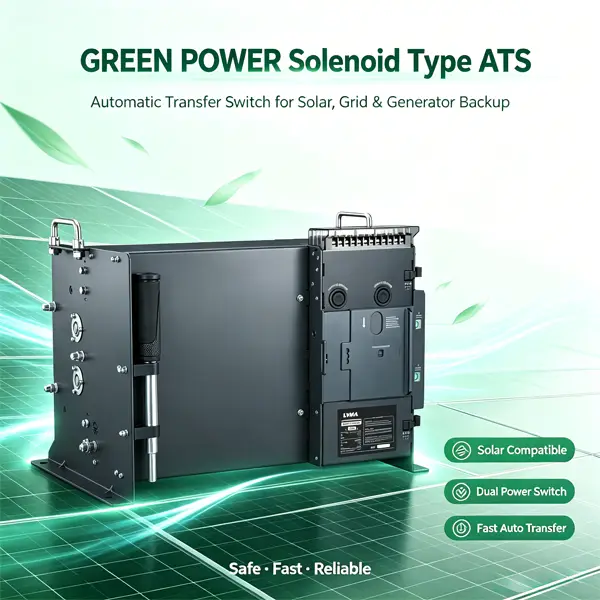
Automatic Transfer Switches (ATS) are critical for maintaining uninterrupted power supply in industrial, commercial, and public power systems. Among mainstream ATS models,ATS Solenoid Type is widely favored for its compact structure, ultra-fast response, and stable operation. Unlike motor-driven ATS that relies on mechanical transmission, this electromagnetic-driven power switch completes power transfer through solenoid electromagnetic force, realizing automatic switching between mains and standby power. This article systematically introduces its working principle, core features, practical advantages, typical applications, as well as selection and maintenance guidelines to help users master this practical power distribution device.
1. How Does ATS Solenoid Type Work? Basic Working Principle
1.1 Core Composition
The device adopts a modular and simplified structure, mainly composed of an electromagnetic coil, iron core transmission part, spring reset assembly, conductive contact mechanism and intelligent control module. The electromagnetic coil provides instantaneous driving power, while the iron core converts electromagnetic force into mechanical motion. The spring assembly supports automatic reset, and the control module undertakes real-time power monitoring and command output, forming a complete closed-loop switching system.
1.2 Power Switching Working Mechanism
The whole working process is fully automatic and unattended. Under normal conditions, the system is connected to mains power to support normal load operation. Once the control module detects mains power failure, severe voltage fluctuation or circuit abnormality, it immediately energizes the solenoid. The generated electromagnetic force pulls the iron core and drives the contact mechanism to quickly disconnect the faulty mains circuit and connect the standby power circuit. When mains power recovers and stabilizes, the solenoid de-energizes, and the spring resets the mechanism to complete automatic reverse switching.
1.3 Core Working Characteristics
Its most notable feature is instantaneous electromagnetic drive, which avoids the delay of traditional mechanical switching. Equipped with a built-in mechanical locking structure, it fixes the contact state after switching, preventing frequent switch jumping caused by transient voltage fluctuations and ensuring accurate and stable each switching action.
2. Key Functional Features of ATS Solenoid Type Devices
2.1 Fast Response Switching
Thanks to high-sensitivity electromagnetic drive, the device completes power transfer in an extremely short time, minimizing load power interruption. This effectively prevents equipment shutdown, data loss and production stagnation caused by short-term power failures, meeting the uninterrupted power supply needs of precision equipment and continuous production scenarios.
2.2 Stable Mechanical Structure
With fewer transmission parts and no complex rotating structures, the solenoid ATS features a compact, wear-resistant and durable design. It adapts to long-term frequent switching operations, not prone to mechanical jamming or component damage, and maintains low failure rate in long-term continuous operation.
2.3 Automatic Intelligent Control
Built-in intelligent monitoring system can real-timely track the voltage and operating status of mains and standby power sources. It independently judges power faults and completes switching without manual intervention, and automatically identifies stable power recovery to realize reverse switching, greatly reducing daily operation and maintenance costs.
2.4 Reliable Safety Performance
The anti-misoperation locking structure effectively avoids wrong switching caused by signal errors or power fluctuations, preventing circuit short circuits and power supply confusion. It also supports overload and short-circuit linkage protection, cutting off faulty circuits in time to protect power distribution equipment and terminal electrical appliances.
3. Core Advantages of Solenoid‑Driven ATS in Power Switching
3.1 High Operational Reliability
Compared with motor-driven ATS, solenoid-driven structure has simpler mechanical logic and fewer vulnerable parts, eliminating failures caused by motor aging and gear wear. It adapts to humid, dusty and complex industrial environments, delivering stable long-term operation.
3.2 Low Energy Consumption & High Efficiency
The solenoid adopts intermittent energization mode, consuming electric energy only during instantaneous switching. It keeps static power-off in standby and normal working state, realizing low energy consumption while ensuring efficient one-step power transfer without switching delay loss.
3.3 Excellent Cost Performance
The simplified structure reduces manufacturing costs, and its low failure rate greatly lowers later maintenance expenses. Balancing stable performance and economic cost, it is highly suitable for large-scale promotion in most civil, commercial and industrial power distribution scenarios.
3.4 Strong Scene Adaptability
It supports multiple voltage levels and adapts to resistive, inductive and capacitive loads. It can operate stably in high and low temperature environments, covering small civil power distribution and large industrial power supply systems.
4. Typical Application Scenarios for ATS Solenoid Type
ATS Solenoid Type covers diversified high-demand power supply scenarios. In industrial systems, it guarantees continuous operation of production lines and processing equipment, avoiding economic losses from power outages. In commercial buildings such as shopping malls and office buildings, it ensures normal operation of elevators, lighting and office equipment to maintain stable commercial operation.
In communication base stations and small and medium-sized data centers, its fast switching effectively prevents server crashes and data loss, protecting information system security. In public infrastructure including hospitals, residential communities and fire-fighting systems, it provides reliable emergency power switching, safeguarding public safety and daily life stability.
5. Practical Tips for Selection and Maintenance of ATS Solenoid Type
5.1 Scientific Selection Criteria
Model selection shall be based on actual demands. Match appropriate voltage level and rated current to avoid equipment overload. For precision loads, prioritize high-speed switching models. Meanwhile, select products with matching protection levels according to on-site temperature, humidity and dust conditions.
5.2 Installation & Commissioning Guidelines
Follow standard wiring specifications during installation to ensure correct connection of mains power, standby power and loads. After installation, complete simulation tests including power failure switching and power recovery reverse switching to verify sensitive and accurate equipment operation without jamming or misoperation.
5.3 Routine Maintenance & Fault Prevention
Regularly clean dust on coils and contacts to ensure flexible mechanical movement. Inspect coil insulation, spring flexibility and circuit tightness periodically. For idle equipment, conduct regular switching tests to prevent mechanical rust and jamming, ensuring long-term stable operation.
Conclusion
As a cost-effective and high-reliability power switching device, ATS Solenoid Type features fast response, stable structure and wide adaptability, solving the core demand of uninterrupted power supply for various scenarios. With simple principle, outstanding performance and low maintenance cost, it has become a mainstream choice in modern power distribution systems. As intelligent power distribution technology continues to develop, solenoid-type ATS will be further optimized to provide safer and more efficient power supply guarantee for industrial and civilian fields.
Share This Article
Follow Us
Introduction
Automatic Transfer Switches (ATS) are critical for maintaining uninterrupted power supply in industrial, commercial, and public power systems. Among mainstream ATS models,ATS Solenoid Type is widely favored for its compact structure, ultra-fast response, and stable operation. Unlike motor-driven ATS that relies on mechanical transmission, this electromagnetic-driven power switch completes power transfer through solenoid electromagnetic force, realizing automatic switching between mains and standby power. This article systematically introduces its working principle, core features, practical advantages, typical applications, as well as selection and maintenance guidelines to help users master this practical power distribution device.
1. How Does ATS Solenoid Type Work? Basic Working Principle
1.1 Core Composition
The device adopts a modular and simplified structure, mainly composed of an electromagnetic coil, iron core transmission part, spring reset assembly, conductive contact mechanism and intelligent control module. The electromagnetic coil provides instantaneous driving power, while the iron core converts electromagnetic force into mechanical motion. The spring assembly supports automatic reset, and the control module undertakes real-time power monitoring and command output, forming a complete closed-loop switching system.
1.2 Power Switching Working Mechanism
The whole working process is fully automatic and unattended. Under normal conditions, the system is connected to mains power to support normal load operation. Once the control module detects mains power failure, severe voltage fluctuation or circuit abnormality, it immediately energizes the solenoid. The generated electromagnetic force pulls the iron core and drives the contact mechanism to quickly disconnect the faulty mains circuit and connect the standby power circuit. When mains power recovers and stabilizes, the solenoid de-energizes, and the spring resets the mechanism to complete automatic reverse switching.
1.3 Core Working Characteristics
Its most notable feature is instantaneous electromagnetic drive, which avoids the delay of traditional mechanical switching. Equipped with a built-in mechanical locking structure, it fixes the contact state after switching, preventing frequent switch jumping caused by transient voltage fluctuations and ensuring accurate and stable each switching action.
2. Key Functional Features of ATS Solenoid Type Devices
2.1 Fast Response Switching
Thanks to high-sensitivity electromagnetic drive, the device completes power transfer in an extremely short time, minimizing load power interruption. This effectively prevents equipment shutdown, data loss and production stagnation caused by short-term power failures, meeting the uninterrupted power supply needs of precision equipment and continuous production scenarios.
2.2 Stable Mechanical Structure
With fewer transmission parts and no complex rotating structures, the solenoid ATS features a compact, wear-resistant and durable design. It adapts to long-term frequent switching operations, not prone to mechanical jamming or component damage, and maintains low failure rate in long-term continuous operation.
2.3 Automatic Intelligent Control
Built-in intelligent monitoring system can real-timely track the voltage and operating status of mains and standby power sources. It independently judges power faults and completes switching without manual intervention, and automatically identifies stable power recovery to realize reverse switching, greatly reducing daily operation and maintenance costs.
2.4 Reliable Safety Performance
The anti-misoperation locking structure effectively avoids wrong switching caused by signal errors or power fluctuations, preventing circuit short circuits and power supply confusion. It also supports overload and short-circuit linkage protection, cutting off faulty circuits in time to protect power distribution equipment and terminal electrical appliances.
3. Core Advantages of Solenoid‑Driven ATS in Power Switching
3.1 High Operational Reliability
Compared with motor-driven ATS, solenoid-driven structure has simpler mechanical logic and fewer vulnerable parts, eliminating failures caused by motor aging and gear wear. It adapts to humid, dusty and complex industrial environments, delivering stable long-term operation.
3.2 Low Energy Consumption & High Efficiency
The solenoid adopts intermittent energization mode, consuming electric energy only during instantaneous switching. It keeps static power-off in standby and normal working state, realizing low energy consumption while ensuring efficient one-step power transfer without switching delay loss.
3.3 Excellent Cost Performance
The simplified structure reduces manufacturing costs, and its low failure rate greatly lowers later maintenance expenses. Balancing stable performance and economic cost, it is highly suitable for large-scale promotion in most civil, commercial and industrial power distribution scenarios.
3.4 Strong Scene Adaptability
It supports multiple voltage levels and adapts to resistive, inductive and capacitive loads. It can operate stably in high and low temperature environments, covering small civil power distribution and large industrial power supply systems.
4. Typical Application Scenarios for ATS Solenoid Type
ATS Solenoid Type covers diversified high-demand power supply scenarios. In industrial systems, it guarantees continuous operation of production lines and processing equipment, avoiding economic losses from power outages. In commercial buildings such as shopping malls and office buildings, it ensures normal operation of elevators, lighting and office equipment to maintain stable commercial operation.
In communication base stations and small and medium-sized data centers, its fast switching effectively prevents server crashes and data loss, protecting information system security. In public infrastructure including hospitals, residential communities and fire-fighting systems, it provides reliable emergency power switching, safeguarding public safety and daily life stability.
5. Practical Tips for Selection and Maintenance of ATS Solenoid Type
5.1 Scientific Selection Criteria
Model selection shall be based on actual demands. Match appropriate voltage level and rated current to avoid equipment overload. For precision loads, prioritize high-speed switching models. Meanwhile, select products with matching protection levels according to on-site temperature, humidity and dust conditions.
5.2 Installation & Commissioning Guidelines
Follow standard wiring specifications during installation to ensure correct connection of mains power, standby power and loads. After installation, complete simulation tests including power failure switching and power recovery reverse switching to verify sensitive and accurate equipment operation without jamming or misoperation.
5.3 Routine Maintenance & Fault Prevention
Regularly clean dust on coils and contacts to ensure flexible mechanical movement. Inspect coil insulation, spring flexibility and circuit tightness periodically. For idle equipment, conduct regular switching tests to prevent mechanical rust and jamming, ensuring long-term stable operation.
Conclusion
As a cost-effective and high-reliability power switching device, ATS Solenoid Type features fast response, stable structure and wide adaptability, solving the core demand of uninterrupted power supply for various scenarios. With simple principle, outstanding performance and low maintenance cost, it has become a mainstream choice in modern power distribution systems. As intelligent power distribution technology continues to develop, solenoid-type ATS will be further optimized to provide safer and more efficient power supply guarantee for industrial and civilian fields.
Contact Us
Related Blog





Contact Us
Have questions about our products or services? Our team is here to help you with any inquiries.