

B Type MCB Now Available for EV Charging & PV System
B Type MCB Now Available for EV Charging & PV System
If you are an electrical designer, solar EPC contractor, EVSE integrator or low-voltage distributor serving the Middle East, Africa and Southeast Asia, you have likely encountered compliance questions around residual current protection. A standard Type A or Type AC RCCB works well for ordinary lighting, sockets and simple electronics, but it can be blinded by smooth DC residual current generated by modern power conversion equipment. This is why Type B RCCB has become a mandatory specification in a growing number of regional wiring codes and inspection standards.
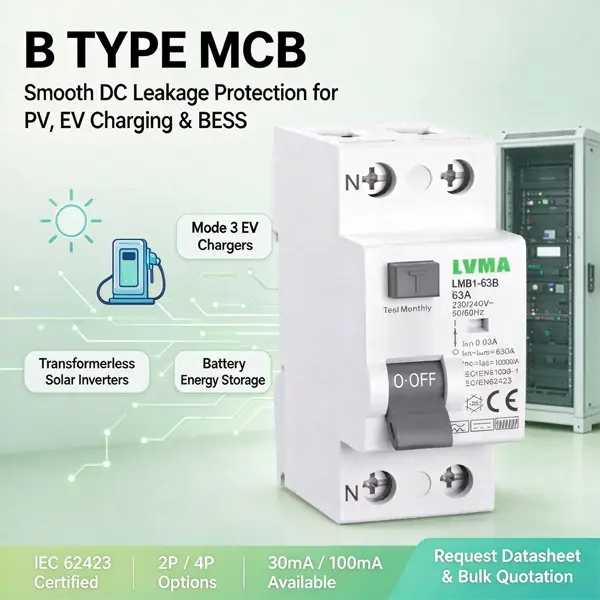
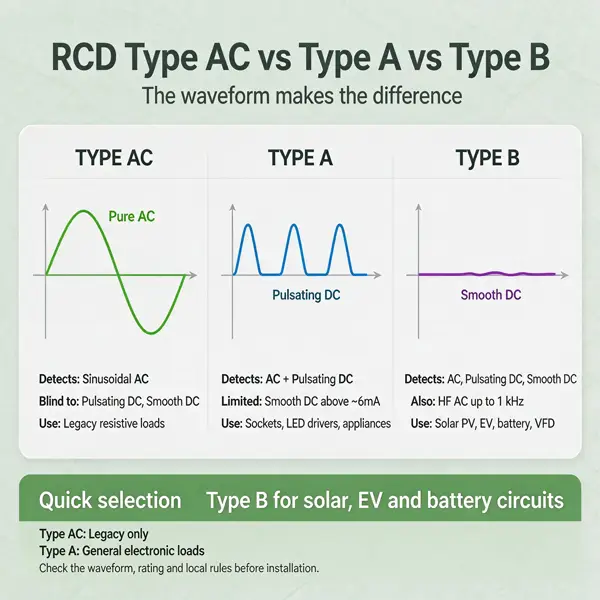
Unlike Type A RCCBs, which only detect AC and pulsating DC leakage, Type B RCCB complies with IEC 62423 and IEC 61008-1, capable of detecting sinusoidal AC residual current, pulsating DC residual current, smooth DC residual current and high-frequency residual current up to 1kHz. This unique full-spectrum detection capability defines its suitable application boundaries. It is not a universal replacement for Type A, but the safest, code-compliant choice for circuits where DC leakage can leak back into the AC side. Below we break down the most common and commercially valuable application scenarios for Type B RCCB.
1. Transformerless Solar PV Systems
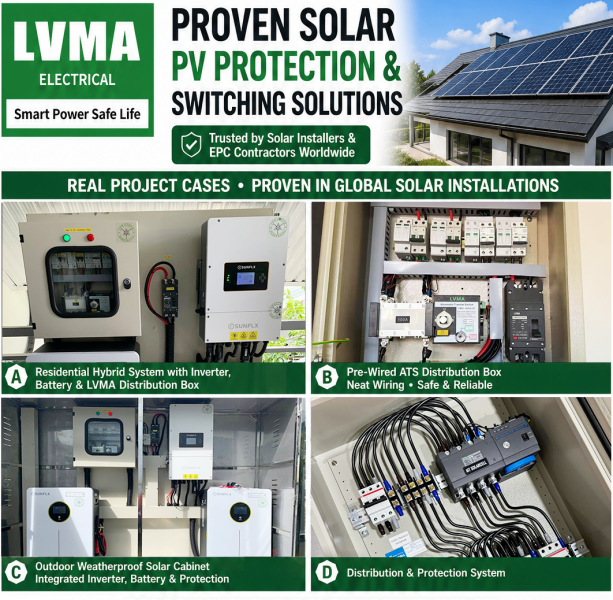
This is one of the largest use cases for Type B RCCB. Transformerless string inverters and hybrid solar inverters are widely adopted in rooftop solar, ground-mounted solar farms and off-grid solar projects for higher efficiency and lower cost. Without an isolation transformer, a ground fault inside the inverter power circuit can inject smooth DC residual current onto the AC distribution line.
When a Type A RCCB is installed on this AC side, steady DC leakage may saturate the magnetic sensing core, causing the RCCB to fail to trip even under dangerous earth fault conditions. This creates electric shock risk for installers and fire risk inside distribution boards and combiner cabinets.
LVMA Type B RCCB is designed for the AC output side of transformerless inverters and hybrid inverters. It meets IEC 60364-7-712 photovoltaic installation requirements. For many markets including Egypt, Kenya, Saudi Arabia, Thailand and Vietnam, local inspectors will explicitly require Type B protection if the inverter does not include built-in smooth DC fault detection. You can select 2P for single-phase rooftop solar and 4P for three-phase large solar plants. 30mA sensitivity is used for direct touch protection, while 100mA is widely used for upstream fire protection for PV combiner boxes and main distribution incomers.
2. Mode 3 EV Charging Stations & Commercial Charging Hubs
EV charging infrastructure is another high-growth scenario where Type B RCCB is heavily specified. Mode 3 AC chargers, including 7kW wallboxes, 11kW and 22kW three-phase charging points, contain internal rectifier circuits. Under vehicle fault conditions, smooth DC leakage can flow backwards from the EV battery circuit into the AC supply.
IEC 61851-1 sets safety requirements for EV charging installations. Many consultants and approval bodies accept two solutions: either each charger integrates certified RDC-DD DC leakage detection, or a Type B RCCB is installed upstream. For distributors and panel builders supplying multiple charger brands, Type B RCCB is often the preferred option, simplifying bill of materials and reducing dependency on charger internal electronics.
It applies to residential garage chargers, workplace charging, public parking charging hubs and fleet charging depots. For multi-charger charging cabinets, designers often use a 4P Type B RCCB as the main incoming protection, paired with individual circuit breakers for each charging outlet. Bulk orders of Type B RCCB are common for EV charging turnkey projects across Africa and the GCC region.
3. Battery Energy Storage Systems (BESS) & DC Microgrids
Hybrid storage systems, battery inverters and off-grid DC microgrids combine solar generation, battery banks and bidirectional converters. Bidirectional power conversion creates complex residual current waveforms mixing AC, pulsating DC and smooth DC. Fault conditions can send DC leakage into the AC bus, which Type A protection cannot reliably capture.
Type B RCCB is suitable for the AC side of grid-tied battery inverters and hybrid storage cabinets. It is also used for critical AC loads in DC microgrid projects for remote mining sites, rural electrification and telecom power backup. In these remote locations, site technicians often work live near distribution panels, so reliable earth fault protection is critical.
When you combine Type B RCCB with our DC MCCB, PV SPD and combiner boxes, you can build a fully coordinated protection package for solar-plus-storage EPC projects. Our engineering team can provide selectivity guidance for panel layout and wiring coordination.
4. Variable Frequency Drives (VFD) & Industrial Automation Equipment
Modern industrial machinery with variable frequency drives, servo drives and high-frequency switching power supplies generates high-frequency residual current. Traditional RCCBs may suffer nuisance tripping or fail to respond to combined AC+DC fault waveforms.
Typical applications include water pump stations, HVAC heat pumps, conveyor systems, CNC workshops and packaging machinery. Three-phase VFD loads are common in factories, agricultural irrigation projects and mining facilities. For these industrial panels, 4P Type B RCCB is widely specified as main incomer residual current protection. It reduces unplanned downtime caused by undetected earth faults and helps factories meet local electrical inspection requirements.
5. Medical Facilities & Healthcare Power Distribution
Medical power circuits are classified as high-risk installations. Operating rooms, patient monitoring equipment, diagnostic imaging devices and laboratory power supplies use high-frequency converters and isolated power modules. Earth faults here can put patients and medical staff at risk.
International healthcare wiring standards require residual current protection capable of handling smooth DC and high-frequency leakage. Type B RCCB is selected for medical critical power distribution boards, separate from general-purpose power circuits. It balances reliable fault tripping while avoiding unwanted tripping that could interrupt life-support equipment.
6. UPS, Data Center and IT Critical Power Systems
Online double-conversion UPS systems produce DC offset and high-frequency residual currents during rectifier and inverter operation. For data center edge rooms, telecom base stations and server power cabinets, electrical engineers often specify Type B RCCB on the AC input side of UPS units.
This scenario is especially relevant for off-grid telecom sites powered by solar + battery + UPS, a very common project type in remote areas of Africa and Central Asia. Wrong RCCB selection can lead to hidden faults that damage expensive IT and telecom hardware.
When You Do NOT Need Type B RCCB
It is equally important for buyers and designers to know when Type A is sufficient, to avoid unnecessary project cost increases. Type A RCCB is suitable for ordinary sockets, lighting circuits, simple household appliances, and loads that only produce AC or pulsating DC leakage without smooth DC components. Type B is more costly, so it should be targeted only at circuits with power electronics that can inject smooth DC leakage into the AC side.
LVMA Type B RCCB Support for Your Projects
Our Type B RCCB range covers 2P and 4P versions, with multiple rated currents and sensitivity ratings (30mA, 100mA) in stock. Every unit passes smooth DC injection testing, thermal cycling, dielectric strength and endurance tests before shipment, suitable for sea transport to tropical and high-humidity markets.
We support samples for witness testing, OEM private label, custom laser marking and neutral packing for resale. If you are building a tender package or panel design for PV, EV charging or industrial projects, our technical team can provide datasheets, test reports, wiring diagrams and certificate files for SABER, COC and local electrical approval.
If you are sourcing residual current protection devices for renewable energy or power electronics projects, contact our electrical engineers today to check specifications, confirm compliance and get a competitive bulk quotation.
Share This Article
Follow Us
If you are an electrical designer, solar EPC contractor, EVSE integrator or low-voltage distributor serving the Middle East, Africa and Southeast Asia, you have likely encountered compliance questions around residual current protection. A standard Type A or Type AC RCCB works well for ordinary lighting, sockets and simple electronics, but it can be blinded by smooth DC residual current generated by modern power conversion equipment. This is why Type B RCCB has become a mandatory specification in a growing number of regional wiring codes and inspection standards.
Unlike Type A RCCBs, which only detect AC and pulsating DC leakage, Type B RCCB complies with IEC 62423 and IEC 61008-1, capable of detecting sinusoidal AC residual current, pulsating DC residual current, smooth DC residual current and high-frequency residual current up to 1kHz. This unique full-spectrum detection capability defines its suitable application boundaries. It is not a universal replacement for Type A, but the safest, code-compliant choice for circuits where DC leakage can leak back into the AC side. Below we break down the most common and commercially valuable application scenarios for Type B RCCB.
1. Transformerless Solar PV Systems
This is one of the largest use cases for Type B RCCB. Transformerless string inverters and hybrid solar inverters are widely adopted in rooftop solar, ground-mounted solar farms and off-grid solar projects for higher efficiency and lower cost. Without an isolation transformer, a ground fault inside the inverter power circuit can inject smooth DC residual current onto the AC distribution line.
When a Type A RCCB is installed on this AC side, steady DC leakage may saturate the magnetic sensing core, causing the RCCB to fail to trip even under dangerous earth fault conditions. This creates electric shock risk for installers and fire risk inside distribution boards and combiner cabinets.
LVMA Type B RCCB is designed for the AC output side of transformerless inverters and hybrid inverters. It meets IEC 60364-7-712 photovoltaic installation requirements. For many markets including Egypt, Kenya, Saudi Arabia, Thailand and Vietnam, local inspectors will explicitly require Type B protection if the inverter does not include built-in smooth DC fault detection. You can select 2P for single-phase rooftop solar and 4P for three-phase large solar plants. 30mA sensitivity is used for direct touch protection, while 100mA is widely used for upstream fire protection for PV combiner boxes and main distribution incomers.
2. Mode 3 EV Charging Stations & Commercial Charging Hubs
EV charging infrastructure is another high-growth scenario where Type B RCCB is heavily specified. Mode 3 AC chargers, including 7kW wallboxes, 11kW and 22kW three-phase charging points, contain internal rectifier circuits. Under vehicle fault conditions, smooth DC leakage can flow backwards from the EV battery circuit into the AC supply.
IEC 61851-1 sets safety requirements for EV charging installations. Many consultants and approval bodies accept two solutions: either each charger integrates certified RDC-DD DC leakage detection, or a Type B RCCB is installed upstream. For distributors and panel builders supplying multiple charger brands, Type B RCCB is often the preferred option, simplifying bill of materials and reducing dependency on charger internal electronics.
It applies to residential garage chargers, workplace charging, public parking charging hubs and fleet charging depots. For multi-charger charging cabinets, designers often use a 4P Type B RCCB as the main incoming protection, paired with individual circuit breakers for each charging outlet. Bulk orders of Type B RCCB are common for EV charging turnkey projects across Africa and the GCC region.
3. Battery Energy Storage Systems (BESS) & DC Microgrids
Hybrid storage systems, battery inverters and off-grid DC microgrids combine solar generation, battery banks and bidirectional converters. Bidirectional power conversion creates complex residual current waveforms mixing AC, pulsating DC and smooth DC. Fault conditions can send DC leakage into the AC bus, which Type A protection cannot reliably capture.
Type B RCCB is suitable for the AC side of grid-tied battery inverters and hybrid storage cabinets. It is also used for critical AC loads in DC microgrid projects for remote mining sites, rural electrification and telecom power backup. In these remote locations, site technicians often work live near distribution panels, so reliable earth fault protection is critical.
When you combine Type B RCCB with our DC MCCB, PV SPD and combiner boxes, you can build a fully coordinated protection package for solar-plus-storage EPC projects. Our engineering team can provide selectivity guidance for panel layout and wiring coordination.
4. Variable Frequency Drives (VFD) & Industrial Automation Equipment
Modern industrial machinery with variable frequency drives, servo drives and high-frequency switching power supplies generates high-frequency residual current. Traditional RCCBs may suffer nuisance tripping or fail to respond to combined AC+DC fault waveforms.
Typical applications include water pump stations, HVAC heat pumps, conveyor systems, CNC workshops and packaging machinery. Three-phase VFD loads are common in factories, agricultural irrigation projects and mining facilities. For these industrial panels, 4P Type B RCCB is widely specified as main incomer residual current protection. It reduces unplanned downtime caused by undetected earth faults and helps factories meet local electrical inspection requirements.
5. Medical Facilities & Healthcare Power Distribution
Medical power circuits are classified as high-risk installations. Operating rooms, patient monitoring equipment, diagnostic imaging devices and laboratory power supplies use high-frequency converters and isolated power modules. Earth faults here can put patients and medical staff at risk.
International healthcare wiring standards require residual current protection capable of handling smooth DC and high-frequency leakage. Type B RCCB is selected for medical critical power distribution boards, separate from general-purpose power circuits. It balances reliable fault tripping while avoiding unwanted tripping that could interrupt life-support equipment.
6. UPS, Data Center and IT Critical Power Systems
Online double-conversion UPS systems produce DC offset and high-frequency residual currents during rectifier and inverter operation. For data center edge rooms, telecom base stations and server power cabinets, electrical engineers often specify Type B RCCB on the AC input side of UPS units.
This scenario is especially relevant for off-grid telecom sites powered by solar + battery + UPS, a very common project type in remote areas of Africa and Central Asia. Wrong RCCB selection can lead to hidden faults that damage expensive IT and telecom hardware.
When You Do NOT Need Type B RCCB
It is equally important for buyers and designers to know when Type A is sufficient, to avoid unnecessary project cost increases. Type A RCCB is suitable for ordinary sockets, lighting circuits, simple household appliances, and loads that only produce AC or pulsating DC leakage without smooth DC components. Type B is more costly, so it should be targeted only at circuits with power electronics that can inject smooth DC leakage into the AC side.
LVMA Type B RCCB Support for Your Projects
Our Type B RCCB range covers 2P and 4P versions, with multiple rated currents and sensitivity ratings (30mA, 100mA) in stock. Every unit passes smooth DC injection testing, thermal cycling, dielectric strength and endurance tests before shipment, suitable for sea transport to tropical and high-humidity markets.
We support samples for witness testing, OEM private label, custom laser marking and neutral packing for resale. If you are building a tender package or panel design for PV, EV charging or industrial projects, our technical team can provide datasheets, test reports, wiring diagrams and certificate files for SABER, COC and local electrical approval.
If you are sourcing residual current protection devices for renewable energy or power electronics projects, contact our electrical engineers today to check specifications, confirm compliance and get a competitive bulk quotation.
Contact Us
Related Blog

Contact Us
Have questions about our products or services? Our team is here to help you with any inquiries.