

Electronic vs Electromagnetic RCCB: What Is the Real Difference?
Electronic vs Electromagnetic RCCB: What Is the Real Difference?
Both devices protect people against electric shock and equipment against earth leakage — but they trip in fundamentally different ways. Choosing the wrong release technology on site can leave a circuit unprotected at exactly the moment a fault occurs.
A Residual Current Circuit Breaker (RCCB) — also called an RCD in Europe and a GFCI in North America — monitors the vector sum of currents flowing through phase and neutral. When the imbalance exceeds the rated residual current (typically 30 mA for human protection, 300 mA for fire protection), the device must open the circuit within milliseconds.
Inside every RCCB sits a toroidal differential transformer that detects the imbalance. The difference between electronic and electromagnetic RCCBs is entirely in how that tiny signal is converted into a mechanical trip. That single design choice changes reliability, cost, surge behaviour and the kind of installation the device is allowed to protect.
How an Electronic RCCB Works
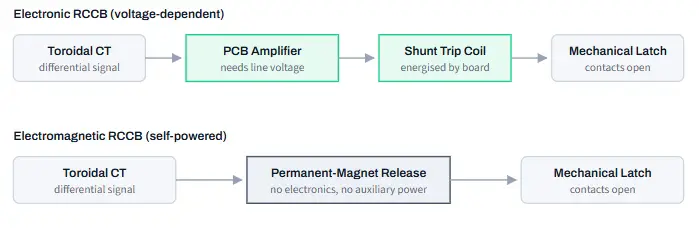
Inside an electronic RCCB, the weak signal from the toroidal transformer feeds a small printed circuit board containing an operational amplifier, a comparator and a triac or transistor stage. Only when the amplified signal crosses a threshold does the board energise a small shunt trip coil, which releases the mechanical latch and opens the contacts.
Two consequences follow from this architecture:
- The board needs auxiliary power taken from the line-side phase-neutral voltage to operate.
- The amplifier can easily be extended to recognise non-sinusoidal waveforms — which is why most Type A, Type F and Type B RCCBs on the market use electronic electronics.
How an Electromagnetic RCCB Works
An electromagnetic RCCB removes the electronics altogether. The toroidal transformer’s output drives a sensitive permanent-magnet reed relay (or polarized magnetic release) directly. The residual current itself supplies the energy needed to overcome the magnetic holding force and trip the mechanism.
This is a fully passive, self-powered trip chain. There is no amplifier, no semiconductor and no auxiliary voltage connection. The device trips the same way whether the supply is present, absent or partially collapsed.
Side-by-Side Comparison
| Parameter | Electronic RCCB | Electromagnetic RCCB |
|---|---|---|
| Trip principle | Amplifier PCB drives a shunt trip coil | Permanent-magnet release directly actuated by the toroidal CT |
| Auxiliary power | Required (line-side voltage) | Not required — self-powered |
| Trip on voltage loss | May fail if supply collapses during fault | Always trips regardless of supply state |
| Sensitivity range | Wide (high-mA to low-mA, easy to tune) | Standard ranges; fine tuning is harder |
| Waveform type | Easily built as Type A, F or B | Mostly Type AC / A; Type B is available but more costly |
| Surge / lightning immunity | Moderate — sensitive semiconductors | High — purely mechanical / magnetic |
| EMC performance | Can nuisance-trip on fast transients (burst, ESD) | High immunity to conducted RF and bursts |
| Temperature range | Limited by electronics (typically −5 °C to +40 °C) | Wider (typically −25 °C to +60 °C) |
| Expected lifetime | Affected by capacitor / PCB aging | Longer — no consumable electronic parts |
| Cost | Lower (≈ 30–50 % cheaper) | Higher |
| Size | More compact | Slightly larger due to magnetic release |
| Typical use | Residential, commercial, stable grids | TT systems, medical, construction, solar, critical loads |
| Standard | Both manufactured to IEC 61008-1 / IEC 61009-1 (and national equivalents such as GB/T 6829, UL 1053, AS/NZS 61008) | |
The One Difference That Matters Most: Voltage Dependence
Of all the rows in the table above, the one that should drive your specification is voltage dependence. In a TN system with a solid earth fault, the supply voltage often stays present while the fault current flows — so an electronic RCCB will normally trip as expected.
In a TT system, however, the exposed-conductive-parts rise to a dangerous touch voltage during the same fault that is supposed to open the RCCB. If the supply side collapses — for example because the upstream MCB has already begun to open, or because the neutral has broken — the electronic board loses its reference voltage and may stay silent. The electromagnetic release, drawing its energy purely from the residual current, has no such failure mode.
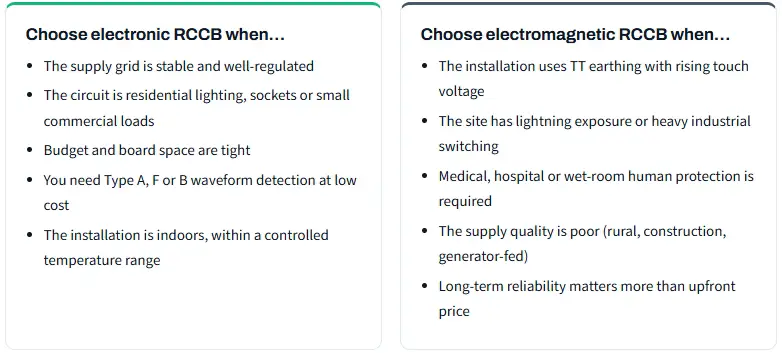
Specification tip: For TT earthing systems, rural supplies, construction sites, medical locations and any circuit touching people in wet environments, specify voltage-independent (electromagnetic) RCCBs explicitly in the bill of materials.
When to Choose Each Type
What About Solar PV and Battery Storage?
Photovoltaic inverters and battery energy storage systems inject not only sinusoidal leakage but also smoothed DC residual current into the AC side. A conventional Type AC RCCB will not detect this waveform at all, which is why modern PV installations call for Type A, Type F or Type B protection per IEC 62423.
In practice, that usually means an electronic RCCB — because the electronics needed to recognise DC residual current are unavoidable. The compromise used by reputable manufacturers is to keep the detection electronics but use an electromagnetic trip release for the final mechanical stage, so the device remains fail-safe even when DC leakage drops the supply voltage. Ask your supplier explicitly whether the Type B device you are quoted uses an electronic or an electromagnetic release; the two are not interchangeable in this context.
Cost vs Long-Term Value
An electromagnetic RCCB typically costs 30–50 % more at purchase. Over a 15–20 year installation life that difference is recovered many times over if it avoids one nuisance-trip downtime, one service call, or — far more importantly — one failure to trip during a real earth fault. For a residential consumer unit the premium is usually unnecessary; for an industrial or utility-scale installation it is the safer default.
Share This Article
Follow Us
Both devices protect people against electric shock and equipment against earth leakage — but they trip in fundamentally different ways. Choosing the wrong release technology on site can leave a circuit unprotected at exactly the moment a fault occurs.
A Residual Current Circuit Breaker (RCCB) — also called an RCD in Europe and a GFCI in North America — monitors the vector sum of currents flowing through phase and neutral. When the imbalance exceeds the rated residual current (typically 30 mA for human protection, 300 mA for fire protection), the device must open the circuit within milliseconds.
Inside every RCCB sits a toroidal differential transformer that detects the imbalance. The difference between electronic and electromagnetic RCCBs is entirely in how that tiny signal is converted into a mechanical trip. That single design choice changes reliability, cost, surge behaviour and the kind of installation the device is allowed to protect.
How an Electronic RCCB Works
Inside an electronic RCCB, the weak signal from the toroidal transformer feeds a small printed circuit board containing an operational amplifier, a comparator and a triac or transistor stage. Only when the amplified signal crosses a threshold does the board energise a small shunt trip coil, which releases the mechanical latch and opens the contacts.
Two consequences follow from this architecture:
- The board needs auxiliary power taken from the line-side phase-neutral voltage to operate.
- The amplifier can easily be extended to recognise non-sinusoidal waveforms — which is why most Type A, Type F and Type B RCCBs on the market use electronic electronics.
How an Electromagnetic RCCB Works
An electromagnetic RCCB removes the electronics altogether. The toroidal transformer’s output drives a sensitive permanent-magnet reed relay (or polarized magnetic release) directly. The residual current itself supplies the energy needed to overcome the magnetic holding force and trip the mechanism.
This is a fully passive, self-powered trip chain. There is no amplifier, no semiconductor and no auxiliary voltage connection. The device trips the same way whether the supply is present, absent or partially collapsed.
Side-by-Side Comparison
| Parameter | Electronic RCCB | Electromagnetic RCCB |
|---|---|---|
| Trip principle | Amplifier PCB drives a shunt trip coil | Permanent-magnet release directly actuated by the toroidal CT |
| Auxiliary power | Required (line-side voltage) | Not required — self-powered |
| Trip on voltage loss | May fail if supply collapses during fault | Always trips regardless of supply state |
| Sensitivity range | Wide (high-mA to low-mA, easy to tune) | Standard ranges; fine tuning is harder |
| Waveform type | Easily built as Type A, F or B | Mostly Type AC / A; Type B is available but more costly |
| Surge / lightning immunity | Moderate — sensitive semiconductors | High — purely mechanical / magnetic |
| EMC performance | Can nuisance-trip on fast transients (burst, ESD) | High immunity to conducted RF and bursts |
| Temperature range | Limited by electronics (typically −5 °C to +40 °C) | Wider (typically −25 °C to +60 °C) |
| Expected lifetime | Affected by capacitor / PCB aging | Longer — no consumable electronic parts |
| Cost | Lower (≈ 30–50 % cheaper) | Higher |
| Size | More compact | Slightly larger due to magnetic release |
| Typical use | Residential, commercial, stable grids | TT systems, medical, construction, solar, critical loads |
| Standard | Both manufactured to IEC 61008-1 / IEC 61009-1 (and national equivalents such as GB/T 6829, UL 1053, AS/NZS 61008) | |
The One Difference That Matters Most: Voltage Dependence
Of all the rows in the table above, the one that should drive your specification is voltage dependence. In a TN system with a solid earth fault, the supply voltage often stays present while the fault current flows — so an electronic RCCB will normally trip as expected.
In a TT system, however, the exposed-conductive-parts rise to a dangerous touch voltage during the same fault that is supposed to open the RCCB. If the supply side collapses — for example because the upstream MCB has already begun to open, or because the neutral has broken — the electronic board loses its reference voltage and may stay silent. The electromagnetic release, drawing its energy purely from the residual current, has no such failure mode.
Specification tip: For TT earthing systems, rural supplies, construction sites, medical locations and any circuit touching people in wet environments, specify voltage-independent (electromagnetic) RCCBs explicitly in the bill of materials.
When to Choose Each Type
What About Solar PV and Battery Storage?
Photovoltaic inverters and battery energy storage systems inject not only sinusoidal leakage but also smoothed DC residual current into the AC side. A conventional Type AC RCCB will not detect this waveform at all, which is why modern PV installations call for Type A, Type F or Type B protection per IEC 62423.
In practice, that usually means an electronic RCCB — because the electronics needed to recognise DC residual current are unavoidable. The compromise used by reputable manufacturers is to keep the detection electronics but use an electromagnetic trip release for the final mechanical stage, so the device remains fail-safe even when DC leakage drops the supply voltage. Ask your supplier explicitly whether the Type B device you are quoted uses an electronic or an electromagnetic release; the two are not interchangeable in this context.
Cost vs Long-Term Value
An electromagnetic RCCB typically costs 30–50 % more at purchase. Over a 15–20 year installation life that difference is recovered many times over if it avoids one nuisance-trip downtime, one service call, or — far more importantly — one failure to trip during a real earth fault. For a residential consumer unit the premium is usually unnecessary; for an industrial or utility-scale installation it is the safer default.
Contact Us
Related Blog





Contact Us
Have questions about our products or services? Our team is here to help you with any inquiries.