

DC MCB 1500V: Safety Solution for Solar Power Plants
DC MCB 1500V: Safety Solution for Solar Power Plants
Introduction
As utility-scale solar installations expand globally, high-voltage DC distribution has become standard to reduce transmission losses and simplify system design. Protecting these DC circuits demands specialized equipment rated for sustained high voltage and the unique arcing behavior of direct current. DC MCB 1500V is engineered specifically for this environment, delivering reliable overcurrent and short-circuit protection for photovoltaic strings and combiner boxes. This article examines its technical advantages, risk-mitigation capabilities, selection criteria, installation best practices, and real-world benefits for large solar projects.
1. Core Technical Advantages of DC MCB 1500V in High-voltage PV Systems
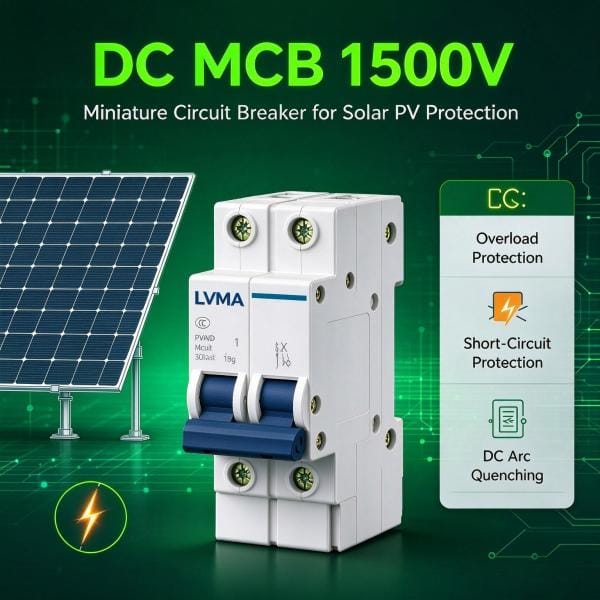
Unlike standard AC circuit breakers, a DC-rated breaker must extinguish an arc that does not naturally cross zero. The DC MCB 1500V incorporates an extended arc chute and magnetic blowout design to rapidly stretch and cool the arc, ensuring safe interruption at 1500V DC. Its compact housing fits standard DIN-rail mounting, making it compatible with existing PV combiner box layouts without requiring panel redesign.
Thermal-magnetic trip technology provides dual protection: a bimetallic element responds to sustained overloads, while a solenoid triggers instantaneously on short-circuit currents. Rated current options cover common PV string requirements, and the breaker supports both positive and negative pole configurations for flexible system architecture.
2. How DC MCB 1500V Mitigates Short-circuit and Overcurrent Risks for Solar Projects
Solar arrays present unique fault conditions. Partial shading, module defects, or cable damage can create reverse currents and ground faults that escalate into thermal runaway or fire. The DC MCB 1500V detects abnormal current levels and isolates the affected string before damage propagates. Its high breaking capacity handles the maximum prospective short-circuit current typical of large parallel PV arrays.
For overload conditions, the thermal trip curve is calibrated to avoid nuisance tripping from normal inrush currents while still protecting conductors and connectors from overheating. This balance is critical in solar systems, where current fluctuations from changing irradiance are frequent but must not trigger unnecessary shutdowns.
3. Key Selection Criteria When Sourcing DC MCB 1500V for Utility-scale Solar Plants
When procuring breakers for utility-scale projects, several parameters demand close attention. First, confirm the DC voltage rating matches the system maximum — 1500V systems require breakers explicitly certified for 1500V DC, not merely AC-rated units repurposed for DC use. Second, verify the breaking capacity exceeds the calculated short-circuit current at the point of installation.
Third, evaluate trip curve characteristics against the string current profile to ensure selectivity with upstream and downstream protection devices. Fourth, check environmental ratings: outdoor combiner boxes require breakers resistant to wide temperature swings, humidity, and UV exposure. Finally, confirm compliance with IEC 60947-2 and relevant PV-specific standards to satisfy local inspection and certification requirements.
4. Installation Considerations to Maximize the Performance of DC MCB 1500V
Proper installation directly affects breaker reliability and service life. Torque terminal connections to the manufacturer’s specification — loose connections generate heat and can cause premature tripping or contact damage. Use appropriately sized DC-rated cables with sufficient cross-sectional area to minimize voltage drop and heat buildup.
Polarity matters: install the breaker so that current flows from the line side (PV array) to the load side (inverter), as reverse installation can impair arc extinction. Allow adequate clearance around the breaker for heat dissipation, and avoid bundling multiple breakers tightly in enclosures without ventilation. Periodic inspection of terminal tightness and contact condition is recommended, especially in sites with high thermal cycling.
5. Real-world Benefits of Deploying DC MCB 1500V Across Large-scale Photovoltaic Sites
Field deployment across utility-scale solar plants demonstrates measurable operational advantages. Plants using properly rated DC breakers report fewer unplanned string outages and lower maintenance callouts compared to sites using underrated or AC-converted devices. The 1500V architecture itself reduces balance-of-system costs by allowing longer string lengths and fewer combiner boxes, and the breaker supports this architecture with dependable protection.
For plant operators, the result is improved uptime, reduced fire risk, and simplified compliance with insurance and grid-code requirements. When combined with regular maintenance, these breakers deliver consistent performance over the 25-year design life of a typical solar installation.
Conclusion
High-voltage DC protection is a critical but often overlooked component of solar plant reliability. The DC MCB 1500V addresses the specific challenges of 1500V PV systems with specialized arc-extinction technology, calibrated trip curves, and robust construction. By selecting the right rating, following installation best practices, and deploying it across all DC string circuits, solar plant owners can significantly enhance safety, reduce downtime, and protect their long-term investment.
FAQ
Q1: Can I use a standard AC MCB rated at 1500V for my PV system? A: No. AC breakers cannot safely interrupt DC arcs, which lack a natural zero-crossing. Always use a breaker explicitly certified for the DC voltage of your system.
Q2: What is the typical service life of a DC MCB 1500V in a solar installation? A: Under normal operating conditions and with periodic maintenance, a quality unit can match the 25-year design life of a PV system.
Q3: How do I determine the correct current rating for my PV strings? A: Calculate the maximum short-circuit current of the string and select a breaker rated above that value, with a safety margin per local electrical codes.
References
- IEC 60947-2, Low-voltage switchgear and controlgear — Circuit breakers
- IEC 62548, Photovoltaic (PV) array design requirements
Share This Article
Follow Us
Introduction
As utility-scale solar installations expand globally, high-voltage DC distribution has become standard to reduce transmission losses and simplify system design. Protecting these DC circuits demands specialized equipment rated for sustained high voltage and the unique arcing behavior of direct current. DC MCB 1500V is engineered specifically for this environment, delivering reliable overcurrent and short-circuit protection for photovoltaic strings and combiner boxes. This article examines its technical advantages, risk-mitigation capabilities, selection criteria, installation best practices, and real-world benefits for large solar projects.
1. Core Technical Advantages of DC MCB 1500V in High-voltage PV Systems
Unlike standard AC circuit breakers, a DC-rated breaker must extinguish an arc that does not naturally cross zero. The DC MCB 1500V incorporates an extended arc chute and magnetic blowout design to rapidly stretch and cool the arc, ensuring safe interruption at 1500V DC. Its compact housing fits standard DIN-rail mounting, making it compatible with existing PV combiner box layouts without requiring panel redesign.
Thermal-magnetic trip technology provides dual protection: a bimetallic element responds to sustained overloads, while a solenoid triggers instantaneously on short-circuit currents. Rated current options cover common PV string requirements, and the breaker supports both positive and negative pole configurations for flexible system architecture.
2. How DC MCB 1500V Mitigates Short-circuit and Overcurrent Risks for Solar Projects
Solar arrays present unique fault conditions. Partial shading, module defects, or cable damage can create reverse currents and ground faults that escalate into thermal runaway or fire. The DC MCB 1500V detects abnormal current levels and isolates the affected string before damage propagates. Its high breaking capacity handles the maximum prospective short-circuit current typical of large parallel PV arrays.
For overload conditions, the thermal trip curve is calibrated to avoid nuisance tripping from normal inrush currents while still protecting conductors and connectors from overheating. This balance is critical in solar systems, where current fluctuations from changing irradiance are frequent but must not trigger unnecessary shutdowns.
3. Key Selection Criteria When Sourcing DC MCB 1500V for Utility-scale Solar Plants
When procuring breakers for utility-scale projects, several parameters demand close attention. First, confirm the DC voltage rating matches the system maximum — 1500V systems require breakers explicitly certified for 1500V DC, not merely AC-rated units repurposed for DC use. Second, verify the breaking capacity exceeds the calculated short-circuit current at the point of installation.
Third, evaluate trip curve characteristics against the string current profile to ensure selectivity with upstream and downstream protection devices. Fourth, check environmental ratings: outdoor combiner boxes require breakers resistant to wide temperature swings, humidity, and UV exposure. Finally, confirm compliance with IEC 60947-2 and relevant PV-specific standards to satisfy local inspection and certification requirements.
4. Installation Considerations to Maximize the Performance of DC MCB 1500V
Proper installation directly affects breaker reliability and service life. Torque terminal connections to the manufacturer’s specification — loose connections generate heat and can cause premature tripping or contact damage. Use appropriately sized DC-rated cables with sufficient cross-sectional area to minimize voltage drop and heat buildup.
Polarity matters: install the breaker so that current flows from the line side (PV array) to the load side (inverter), as reverse installation can impair arc extinction. Allow adequate clearance around the breaker for heat dissipation, and avoid bundling multiple breakers tightly in enclosures without ventilation. Periodic inspection of terminal tightness and contact condition is recommended, especially in sites with high thermal cycling.
5. Real-world Benefits of Deploying DC MCB 1500V Across Large-scale Photovoltaic Sites
Field deployment across utility-scale solar plants demonstrates measurable operational advantages. Plants using properly rated DC breakers report fewer unplanned string outages and lower maintenance callouts compared to sites using underrated or AC-converted devices. The 1500V architecture itself reduces balance-of-system costs by allowing longer string lengths and fewer combiner boxes, and the breaker supports this architecture with dependable protection.
For plant operators, the result is improved uptime, reduced fire risk, and simplified compliance with insurance and grid-code requirements. When combined with regular maintenance, these breakers deliver consistent performance over the 25-year design life of a typical solar installation.
Conclusion
High-voltage DC protection is a critical but often overlooked component of solar plant reliability. The DC MCB 1500V addresses the specific challenges of 1500V PV systems with specialized arc-extinction technology, calibrated trip curves, and robust construction. By selecting the right rating, following installation best practices, and deploying it across all DC string circuits, solar plant owners can significantly enhance safety, reduce downtime, and protect their long-term investment.
FAQ
Q1: Can I use a standard AC MCB rated at 1500V for my PV system? A: No. AC breakers cannot safely interrupt DC arcs, which lack a natural zero-crossing. Always use a breaker explicitly certified for the DC voltage of your system.
Q2: What is the typical service life of a DC MCB 1500V in a solar installation? A: Under normal operating conditions and with periodic maintenance, a quality unit can match the 25-year design life of a PV system.
Q3: How do I determine the correct current rating for my PV strings? A: Calculate the maximum short-circuit current of the string and select a breaker rated above that value, with a safety margin per local electrical codes.
References
- IEC 60947-2, Low-voltage switchgear and controlgear — Circuit breakers
- IEC 62548, Photovoltaic (PV) array design requirements
Contact Us
Related Blog



Contact Us
Have questions about our products or services? Our team is here to help you with any inquiries.